The Cambrian of the Grand Canyon: Refinement of a Classic Stratigraphic Model
Carol Dehler et al.
In this article
Authors
Carol Dehler
Department of Geosciences, Utah State University, Logan, Utah 84322, USA
Frederick Sundberg
Department of Earth & Planetary Sciences, University of New Mexico, Albuquerque, New Mexico 87131, USA
Karl Karlstrom
Department of Earth & Planetary Sciences, University of New Mexico, Albuquerque, New Mexico 87131, USA
Laura Crossey
Department of Earth & Planetary Sciences, University of New Mexico, Albuquerque, New Mexico 87131, USA
Mark Schmitz
Department of Geosciences, Boise State University, Boise, Idaho 83706, USA
Stephen Rowland
Department of Geoscience, University of Las Vegas, Las Vegas, Nevada 89154, USA
James Hagadorn
Denver Museum of Nature & Science, Denver, Colorado 80205, USA
Abstract
The Cambrian Tonto Group of the Grand Canyon was used by Edwin McKee in 1945 to make an insightful visual representation of how sedimentary facies record transgression across a craton—a common conceptual framework still used in geologic education. Although the tenets of McKee’s facies diagram persist, the integration of new stratigraphy, depositional models, paleontology, biostratigraphy, and other data is refining the underlying dynamics of this cratonic transgression. Instead of McKee’s interpretation of one major transgression with only minor regressions, there are at least five stratigraphic sequences, of which the lower three are separated by disconformities. These hiatal surfaces likely represent erosion of previously deposited Cambrian sediments that were laid down on the tropical, pre-vegetated landscape. Rather than being fully marine in origin, these sequences were formed by a mosaic of depositional environments including braided coastal plain, eolian, marginal marine, and various shallow marine environments. McKee, not having the insights of sequence stratigraphy and plate tectonics, concluded that the preservation of these sediments were due to predepositional topography and subsidence of the “geosyncline.” Our modern interpretation is that accommodation space was a result of eustasy and differential subsidence on the continental margin. Our modified depositional model provides a more effective teaching tool for fundamentals and nuances of modern stratigraphic thinking, using the Tonto Group as a still-influential type location for understanding transgressive successions.
† Co-first authors
‡ Supplemental Material. Figures S1 and S2: Maps of measured sections and disconformity images. Tables S1–S3: Facies, fossil localities, and C-isotope data tables. Please visit https://doi.org/10.1130/GSAT.S.27239115.v1 to access the supplemental material; contact editing@geosociety.org with any questions.
CITATION: Dehler, C., et al., 2024, The Cambrian of the Grand Canyon: Refinement of a classic stratigraphic model: GSA Today, v. 34, no. 11, p. 4–11, https://doi.org/10.1130/GSATG604A.1.
Manuscript received 18 March 2024 Revised manuscript received 15 August 2024 Manuscript accepted 1 October 2024.
© 2024 The Authors. Gold Open Access: This paper is published under the terms of the CC-BY-NC license. Printed in USA.
Introduction
Edwin McKee’s 1945 model of marine transgression in the Grand Canyon (Fig. 1) has influenced generations of geoscientists (Sloss, 1963; Bond and Kominz, 1984; Runkel et al., 2012; Łabaj and Pratt, 2016; Handkamer et al., 2023) and is showcased in many textbooks (Boggs, 1995; Stanley and Luczai, 2014). Using the physical stratigraphy and trilobite biostratigraphy of the Cambrian Tonto Group in the Grand Canyon, together with Walther’s law (Walther, 1894), he hypothesized that the shallow water Tapeats Sandstone, deeper water Bright Angel Shale, and the deepest water Muav Limestone transgressed across a slowly subsiding geosyncline—experiencing only minor regressions.
Here we review the evolution of thought since McKee’s pre–sequence-stratigraphic and pre–plate tectonic work and show how new results refine his model. Our work builds on growing awareness that the Cambrian Tonto Group consists of five formations representing a diverse array of depositional environments and timing (Fig. 2; see Table S1 in the Supplemental Material‡). For example, Wanless (1975) interpreted one member of the Bright Angel Formation to be terrestrial and suggested that the Muav Limestone reflects peritidal rather than deep water deposition. Similarly, many workers have reinterpreted the “marine” Tapeats Sandstone to represent a range of depositional environments including braided fluvial, deltaic, and eolian settings (Table S1). Most recently, new geochronologic constraints from U-Pb zircon maximum depositional ages for the Tapeats Sandstone, combined with reevaluation of trilobite zones, indicate that the time represented by the Tonto Group is short (Fig. 2; Karlstrom et al., 2020; Sundberg et al., 2020; Cothren et al., 2022; Rowland et al., 2023). A synthesis of these data leads us to identify at least five time-calibrated stratigraphic sequences within the Tonto Group.
Figure 1
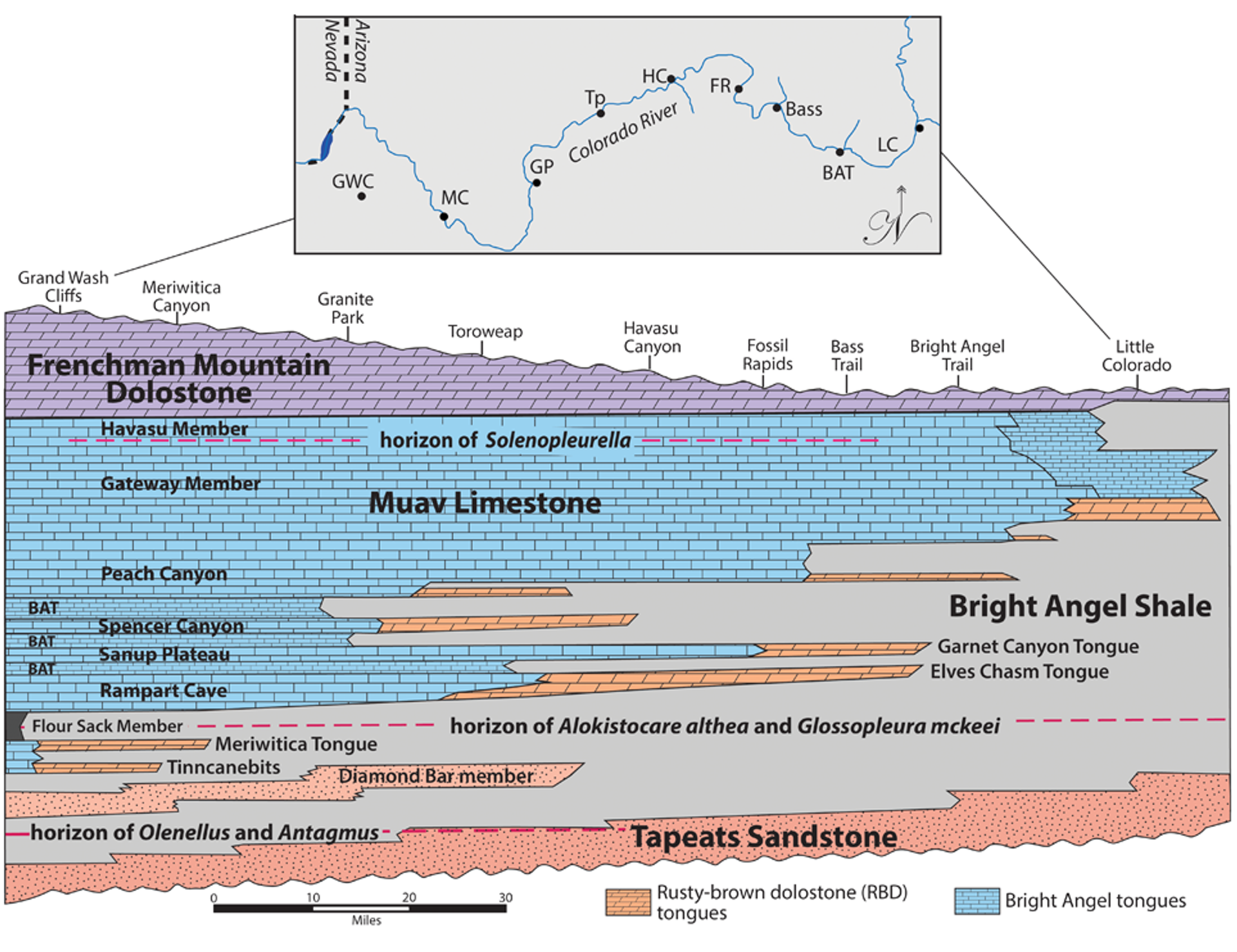
Adaptation of McKee’s (1945, fig. 1) panel diagram of the Tonto Group in the Grand Canyon. Colors match the rock types in Figures 2 and 3. BAT— Bright Angel tongues (modified from “silty platy limestones”).
Reevaluation of the McKee Model
Stratigraphic Methods
More than 50 stratigraphic sections were measured or updated, including historic sections that span most of the 500-km-wide Grand Canyon region (Fig. S1). Thickness and Wheeler diagrams (Figs. 2 and 3) were constructed based on 28 sections arranged by longitude from the restored position of the Frenchman Mountain section in the west to the Palisades section in the east. To synthesize data for this publication, detailed stratigraphic sections were generalized to reduce heterolithic complexity and produce a fence panel that illustrates overall stratigraphic and temporal relationships (Fig. 2).
Paleontological information was derived from reevaluation of trilobites and associated faunas in museum collections as well as our 169 new fossil localities, most of which represent in situ occurrences in our measured sections. Biostratigraphy is detailed by Sundberg and all other authors (2024, pers. observ.) and used to constrain correlation of sections (Table S2). Our Wheeler diagram (Fig. 3) uses the relative durations of zones based on graphic correlation of the Laurentian traditional middle and upper Cambrian (CONOP [CONstrained OPtimization algorithm] results from Farrell and all other authors [2024, pers. observ.]) and comparison of zones from the traditional lower to middle Cambrian in the Pioche area, Nevada (Webster, 2011b, 2011c; McCollum et al., 2011), providing a robust relative-time axis. Preliminary C-isotope data are presented from the Fossil Rapids area to aid in correlation with our relatively unfossiliferous Frenchman Mountain section (Table S3), and major faults are shown to assess local influences of tectonics on deposition.
Figure 2
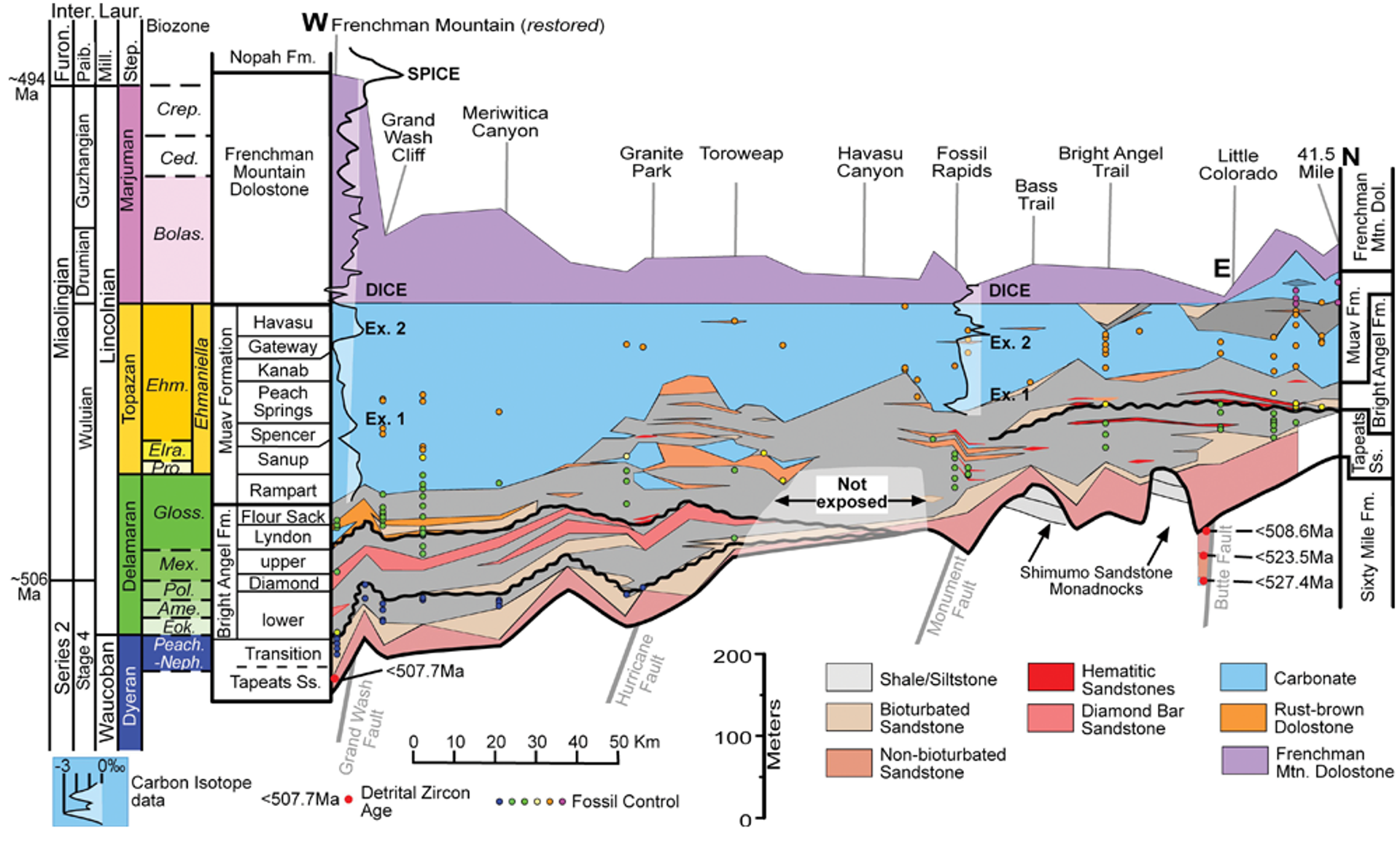
Stratigraphic thickness diagram that leverages updated historic and new measured sections as well as new and reinterpreted paleontology, fault relations, and δ13C chemostratigraphy. Frenchman Mountain is shown in its restored position. Zone/Subzone abbreviations: Peach.-Neph.—Peachella iddingsi to Nephrolenellus multinodus; Eok.—Eokochaspis nodosa; Ame.—Amecephalus arrojosensis; Pol.—Poliella denticulata; Mex.—Mexicella mexicana; Gloss.—Glossopleura walcotti; Pro.—Proehmaniella; Elra.—Elrathiella; Ehm.—Ehmaniella; Bolas.—Bolaspidella; Ced.—Cedaria; Crep.—Crepicephalus. Member abbreviations: Gateway—Gateway Canyon; Kanab—Kanab Canyon; Spencer—Spencer Canyon, Sanup—Sanup Plateau; Rampart—Rampart Cave; Lyndon—Lyndon Limestone; upper—upper slope unit (used by McKee, 1945); Diamond—Diamond Bar; lower—lower slope unit (of McKee, 1945); Series/Stage/Rock abbreviations: Inter.—International; Furon—Furongian, Paib.—Paibian; Laur—Laurentian; Mill.—Millardan; Step—Steptoean. Other abbreviations: Fm.—Formation; Ss.—Sandstone; Mtn.—Mountain; Dol.—Dolostone; Ex—excursion; SPICE—Steptoean positive isotope carbon excursion; DICE—Drumian isotope carbon excursion.
Biostratigraphic Scheme
Cambrian strata in the Grand Canyon span at least the global Stage 4 of Series 2 to the Drumian Stage of the Miaolingian Series (Fig. 2; Karlstrom et al., 2020; Sundberg et al., 2020). The rocks of the Tonto Group are poorly fossiliferous, and no individual section contains a continuous fossiliferous succession to determine the stratigraphic ranges of taxa. Hence, boundaries between zones cannot be accurately identified in most measured sections. Nonetheless, the strata contain representatives of seven Laurentian trilobite zones (Sundberg and all other authors, 2024, pers. observ.).
The lowest zones are the Peachella iddingsi, Bolbolenellus euryparia, and Nephrolenellus multinodus zones, which occur in the basal Bright Angel Formation in the westernmost Grand Canyon region (Webster 2011a, 2011b). These zones are equivalent to the Olenellus zone of McKee (1945). Disconformably overlying these olenellid zones at Frenchman Mountain is the ptychoparioid trilobite Mexicella cf. M. robusta that is probably from the middle Eokochaspis nodosa or lower Amecephalus arrojosensis zones (Lincolnian Series, Delamaran Stage; McCollum and Sundberg, 2000). There is no paleontological evidence that strata of the A. arrojosensis to Poliella denticulata zones occur elsewhere in the Grand Canyon. McKee (1945) did not recognize this biostratigraphic interval. In contrast, the Albertella zone was recognized based on a single pygidium. This zone is now referred to as the Mexicella mexicana Zone (McCollum and Sundberg, 2007); taxa of this zone occur in our Frenchman Mountain and Rampart Cave sections (Fig. 2; McKee, 1945). Taxa of the Glossopleura walcotti Zone occur throughout the Grand Canyon area from below the Tincanebits Tongue through the Rampart Cave Member (Fig. 2). In the western Grand Canyon, this zone lies disconformably above the M. mexicana Zone. The trilobite fauna is relatively diverse (McKee, 1945) and may represent only the upper portion of the zone, due to its faunal similarity and stratigraphic position below the Ehmaniella Zone in Utah (Sundberg, 2005). The Ehmaniella Zone is subdivided into the Proehmaniella, Elrathiella, Ehmaniella, and Altiocculus subzones (Sundberg, 1994). In the western Grand Canyon, the Proehmaniella subzone is represented by taxa in the Elves’ Chasm tongue and Sanup Plateau Member. The Elrathiella subzone is represented by three species and commonly occurs within the densely glauconitic facies of the Bright Angel Formation directly above the G. walcotti Zone in the eastern Grand Canyon.
Differentiating between the Ehmaniella and Altiocculus subzones in the Grand Canyon is difficult given the Muav Formation’s limited fauna. There are no robust criteria to separate the two subzones in the Grand Canyon given the stratigraphic ranges of trilobites in the Peach Springs to Gateway Canyon members of the Muav Formation. As a result, only the Ehmaniella subzone is used. This zone is represented by taxa distributed across the Grand Canyon. This fauna is partly equivalent to the Solenopleurella horizon of McKee (1945).
In the easternmost Grand Canyon, we discovered a new trilobite fauna (Glyphaspis tetonensis, Crepicephalus? upis, Solenopleurella? quadrata, and Modocia sp.) from the uppermost Muav Formation and lowermost Frenchman Mountain Dolostone (Sundberg and all other authors, 2024, pers. observ.). These taxa are known from the Bolaspidella Zone elsewhere in Laurentia (Rasetti, 1963; Schwimmer, 1973; Melzak and Westrop, 1994). Bolaspidella time is also present in the Frenchman Mountain Dolostone type section and at our Fossil Rapids, where the Drumian Isotope Carbon Excursion (DICE) is recorded (Rowland et al., 2023; Table S2).
Figure 3
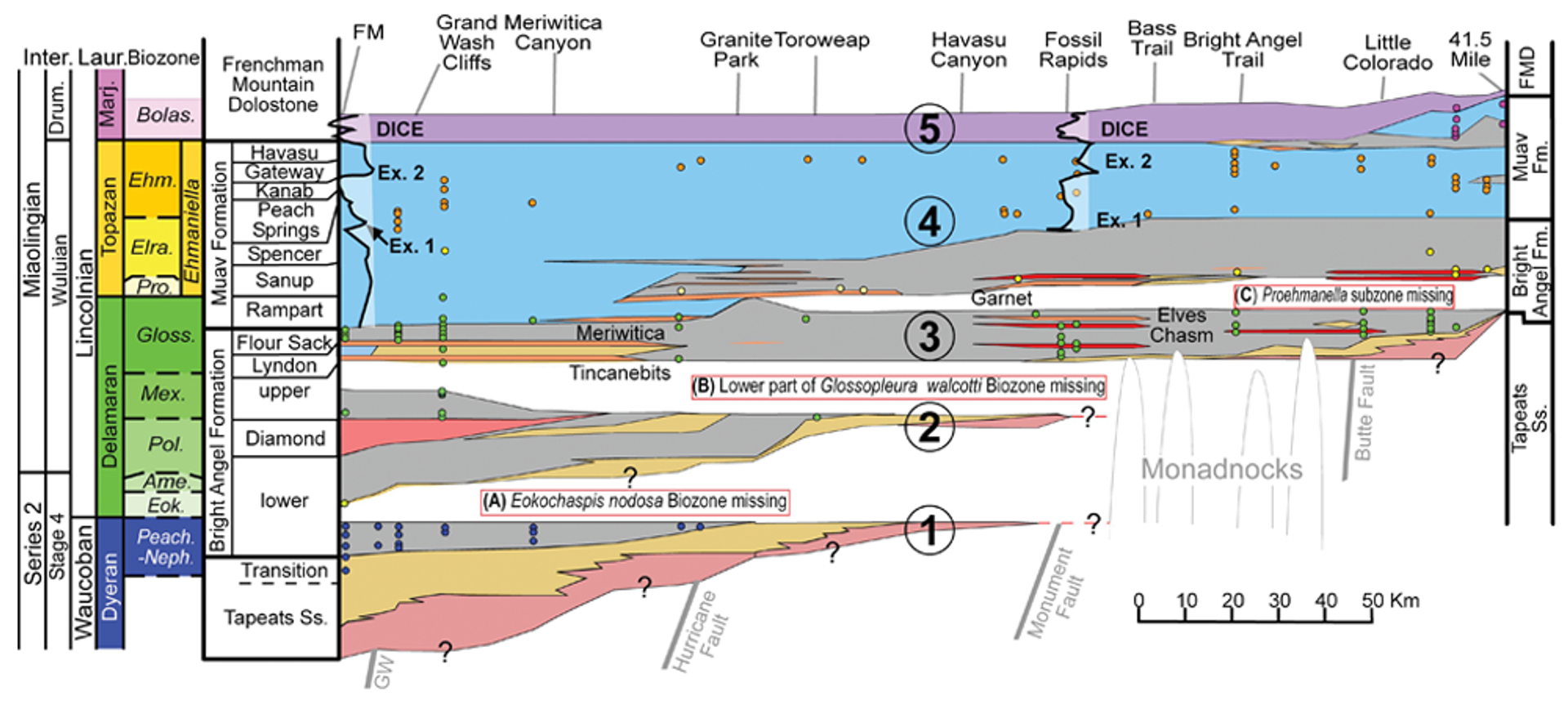
Wheeler diagram of the Tonto Group, illustrating hypothesized depositional sequences, labeled 1–5. Because the geochronology of the Sixtymile Formation is poorly constrained, it is not depicted here. Vertical axis is based on relative thickness of zones based on CONOP (CONstrained OPtimization algorithm) analysis (see text). Question marks indicate that basal clastics lack biostratigraphic and geochronologic control beyond maximum depositional ages; thus, their duration could be substantially shorter than graphically depicted here, and coarse clastics associated with deposition of sequences 1 and 2 could extend into the eastern Grand Canyon. FM—Frenchman Mountain (restored); GW—Grand Wash fault. For other abbreviations and lithologic types, see Figures 2 and 4; Tables S1 and S2; and Figures S1 and S2.
Preliminary δ13C Calibration in Grand Canyon
The δ13C profile from the Fossil Rapids area is similar to the δ13C record from Frenchman Mountain (Rowland et al., 2023; Table S3) and aids in correlation. The lowermost robust shared pattern is a −1.5‰ negative shift in the lower Ehmaniella Zone, referred to as Excursion 1 (Ex. 1; Fig. 2). This pattern is succeeded by a rise in δ13C values to near zero in the upper Ehmaniella Zone, termed Excursion 2 (Ex. 2). In the Frenchman Mountain Dolostone, there is a complex negative anomaly of two stacked 0% to ~-2.5‰ excursions in the lower Bolaspidella Zone that may represent the DICE (Howley and Jiang, 2010; Rowland et al., 2023).
Depositional Model
The most fitting paleogeographic model to explain the Tonto Group is similar to that presented by Palmer (1960) in which the Tapeats and Bright Angel formations represent the “inner detrital belt” and the Muav and Frenchman Mountain formations represent the “middle carbonate belt.” The “Rusty Brown dolostones” (RBDs) and “Bright Angel tongues” of McKee (1945; Figs. 1 and 2) are transitional facies between these belts, with the RBDs indicating transgression. In contrast, we interpret the tongues of Bright Angel Formation interbedded with the Muav Formation to indicate regression (Fig. 1). This deepening and widening of the inner detrital belt caused a landward shift of the shoreline and coeval onlapping onto the carbonate bank, resulting in a return to more normal marine conditions as evidenced by an increase in open-shelf macrofaunal taxa and siliciclastic mud (Fig. 4).
Disconformities
The majority of the Tonto Group above the Sixtymile Formation was deposited in paralic environments on a flat, stable margin of the Laurentia in a pre-vegetated, tropical setting. Given the overall low-relief topography (hundred-meter-high monadnocks notwithstanding; Fig. 4), in combination with sea-level fluctuations, the presence of unconformities within the succession is expected, especially farther inboard. Short-term hiatal surfaces within the Tapeats and Bright Angel formations are common (Rose, 2006, 2011) due to incision during channel migration of the broad braid plain and reworking of sediments by storms, tides, and intermittent exposure. However, some surfaces represent more substantial periods of erosion that were not recognized by earlier workers. These disconformities are like surfaces that have been recognized in the predominantly shelfal Delamaran sections of Nevada (McCollum and McCollum, 2011).
At least three new disconformities, labeled (A) to (C), are recognized (Fig. 3) on the basis of missing biozone intervals, erosional features, and facies changes (Sundberg and all other authors, 2024, pers. observ.; Table S1):
- At Frenchman Mountain, a thin (2 m) bioturbated sandstone containing the middle(?) portion of the E. nodosa Zone sharply overlies a bioturbated shale and sandstone facies that overlies a shale facies containing the N. multinodus Zone (Fig. 2; Table S1; Fig. S2). This disconformity between the Dyeran and Delamaran stages becomes more pronounced eastward, and eventually G. walcotti Zone trilobites appear in the shale facies, overlying the bioturbated sandstones of the lower Bright Angel Formation. Based on lithologic correlations, this disconformity appears to extend into the lower M. mexicana Zone in the central Grand Canyon. It is unlikely that many strata of the Dyeran age, if any, exist eastward.
- The disconformity between the M. mexicana and G. walcotti zones in our Rampart Cave section is expressed as an erosional surface (Fig. S2). The green shale facies, containing M. mexicana Zone trilobites, is locally incised with a relief of >1.5 m across a 5-m horizontal interval. Overlying this incised surface are bioturbated shale and sandstones that contain G. walcotti Zone fauna. Additional support for the eastward extension of this disconformity is the disappearance of shale above the Diamond Bar non-bioturbated sandstone member and progressive removal of this member eastward. The fauna of the G. walcotti Zone appear to represent only the upper part of the zone, which suggests that the hiatus represents the uppermost M. mexicana to lower G. walcotti zones.
- This disconformity lies between the G. walcotti Zone and the overlying Elrathiella subzone in the eastern Grand Canyon. An erosional boundary occurs 10 m below the fauna of the Elrathiella subzone at the base of a prominent cliff of the red sandstone facies, which overlies the G. walcotti Zone-bearing shale facies (Fig. S2). Missing is the Proehmaniella subzone, although it is present in our Diamond Creek section. Trilobites representing the Elrathiella subzone are rare in the western Grand Canyon. This contact can be traced hundreds of meters in outcrop (Fig. S2) and is inferred to be regional based on the missing biozones.
Other disconformities likely exist higher in the Muav and Frenchman Mountain formations (Rowland et al., 2023), but at present there is no paleontological or stratigraphic evidence to suggest additional breaks. In general, stratigraphic breaks are hypothesized to become more pronounced eastward due to increasing exposure and decreased subsidence rates farther east of the depocenter.
Figure 4
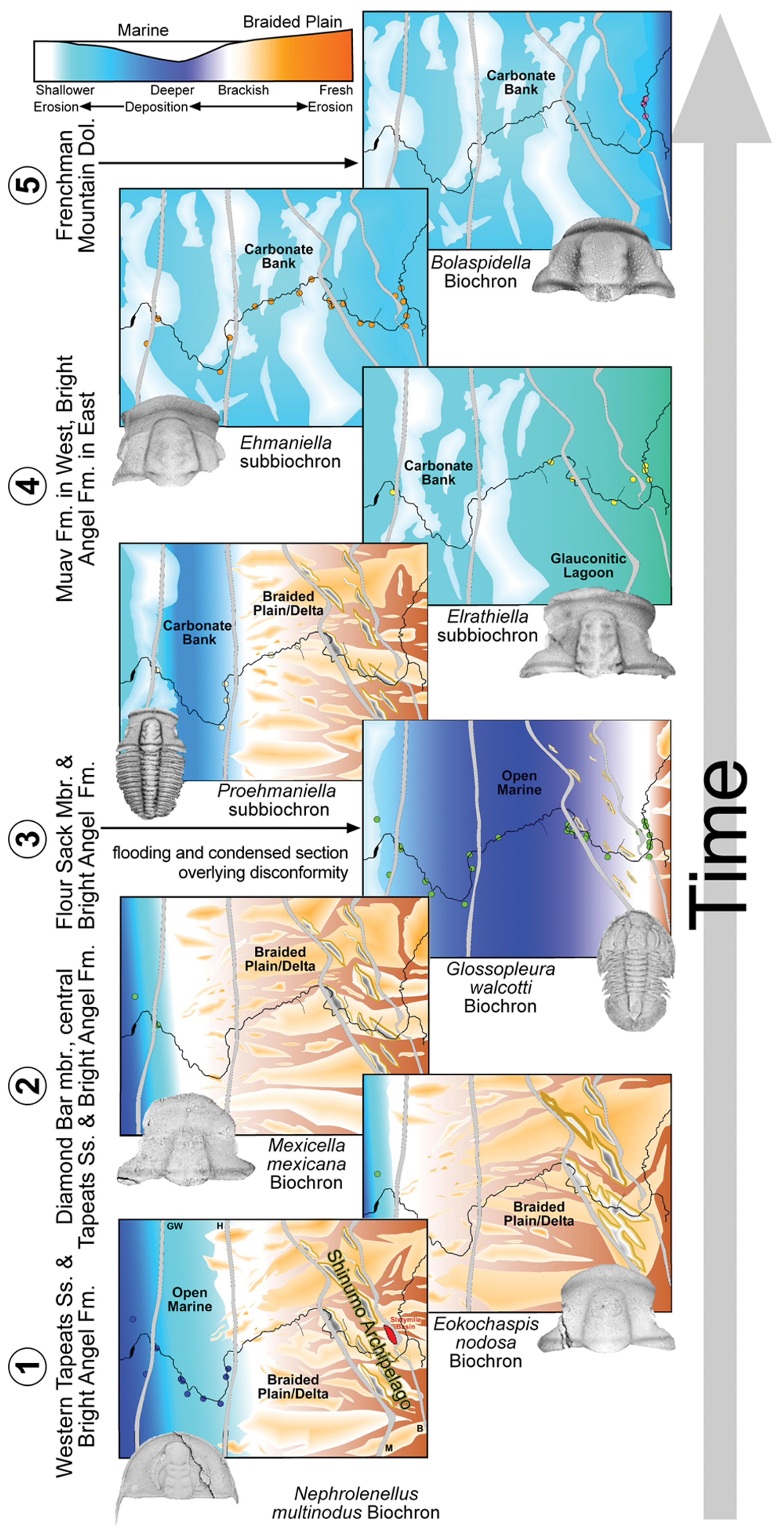
Paleogeographic maps and key trilobites of representative Tonto Group landscapes. Gray lines represent Cenozoic faults, which are labeled on lowest diagram and may have been active during Cambrian time: GW—Grand Wash; H— Hurricane; M—Monument; B—Butte.
Tonto Group Sequence Stratigraphy
Multiple stratigraphic sequences occur in the Tonto Group. The lowest are in the Sixtymile Formation, but because they have larger temporal uncertainty and limited aerial extent (Karlstrom et al., 2020), we do not treat them here. Above the Sixtymile Formation, the first succession (Sequence 1 in Fig. 3) represents the Tapeats Sandstone in its most basinward position, onlapping eastward time-transgressively in a stepwise fashion, as recognized by McKee (1945, figs. 11, 13). The lateral extent and age duration of Tapeats Sandstone are unknown in the eastern Grand Canyon due to a lack of fossils. This sequence indicates progressive retrogradation of siliciclastic facies shoreward (Fig. 4). The top of Sequence 1 (and Sequences 2 and 3) are capped by clay-rich shale and articulated trilobites, suggesting maximum flooding intervals that have been truncated by erosion (Fig. S2A–C). Sequence 2 is characterized by four sets of prograding sand bodies, culminating with the Diamond Bar member in the west. Sequence 2 is the only sequence that records an interval of delta plain progradation and a major basinward shift of the shoreline (Fig. 4). Sequence 3 represents impoundment of Tapeats sediments in the very eastern part of the field area and the first appearance of RBDs to the west. In Sequence 3, the Tincanebits and Meriwitica tongues, the black shale of the Flour Sack Member, and the Elves Chasm and Garnet tongues define a transgressive systems tract that represents more normal marine conditions.
Above the third disconformity and the conformable surface to the west is Sequence 4, the base of which is marked by onlapping and stacked bioturbated sandstone and associated RBDs (Figs. 2 and 3). Sequence 4 becomes dominated by onlapping and aggradation of the Muav Formation from west to east. This sequence marks the development of estuarine/lagoonal environments as the carbonate platform grew upward and shoreward during transgression (Fig. 4). The lower boundary of Sequence 5 coincides with the Muav-Frenchman Mountain Dolostone contact, except in eastern Grand Canyon, where the contact is between upper members of the Muav Formation. The sequence is marked by fine-grained siliciclastic material at its base in the easternmost sections (Figs. 2 and 3) and the overwhelming dominance of dolomitic facies of the Frenchman Mountain Dolostone across the canyon. Throughout the region, Sequence 5 is truncated by the sub-Mississippian or sub-Devonian unconformity. This sequence reflects marked transgression and the predominance of the middle carbonate belt (Fig. 4).
Controls on Tonto Group Deposition
The primary control on Tonto Group deposition is the rise and fall of eustatic sea level, whereby: (1) carbonate facies move landward during sea-level rise; (2) sandstones move landward during sea-level rise and prograde basinward during sea-level fall; and (3) the intervening shale facies belt widens and onlaps both the carbonate bank basinward and the shoreline moves cratonward during sea-level rise.
Other analogous Cambrian sequences are also thought to be controlled by eustatic sea-level rise (Montañez and Osleger, 1996; Haq and Schutter, 2008; Snedden and Liu, 2010; Keller et al., 2012). Younger analogs exist as well, such as the Aptian passive-margin record of the Arabian Peninsula, which has a strikingly similar depositional pattern to the Tonto Group, spans a similar duration (~14 m.y.), and hosts three unconformities (Davies et al., 2002).
McKee’s work predated plate tectonics, when geosynclinal theory suggested that “miogeosynclines” subsided due to the weight of accumulated sediment, as amplified by isostasy (Dana, 1873). Modern evidence (Angevine et al., 1990) suggests that sediment loading is a feedback on sea-level change, preexisting topography, and regional subsidence; all three likely helped create space for Tonto Group deposition.
Preexisting topography plus the existence of faults that moved in the early Cambrian are evident in eastern Grand Canyon. The Butte fault (Karlstrom et al., 2020) and other faults define a Cambrian archipelago, here named the “Shinumo Archipelago” in the Tapeats Sea (Fig. 4). These paleo-islands were completely covered by late G. walcotti time, leveling out the landscape and allowing greater landward advance of the carbonate belt (Fig. 4).
Two Cenozoic western faults, the Hurricane and Grand Wash faults, are parallel to the Cordilleran hingeline and may mimic older paleo-fault systems that mark the hinge region of the Cordilleran rift margin (Stewart and Poole, 1974). The westernmost Frenchman Mountain Dolostone thickens westward from 200 m to nearly 400 m west of the Grand Wash hingeline, suggesting an increase in accommodation space that cannot be explained solely by eustatic sea-level changes (Christie-Blick et al., 2023). Except for the Butte fault, Cambrian slip on Grand Canyon faults has not been identified, but fault associations with biozone and facies boundaries (Fig. 4) suggest they may have influenced differential accommodation space and subsequent sediment loading of western blocks and isostatic rebound of eastern blocks that influenced the positions of the inner detrital and middle carbonate belts.
A New Paradigm for the Tonto Group
We envision the controls on the Tonto Group depositional patterns to include a combination of eustasy and regional differential subsidence high on the shelf of the Cordilleran miogeocline. In contrast, McKee’s diagram (1945, Fig. 1) portrayed an interpretation of a time-transgressive eastward-migrating shoreline that deposited vertical sandstone-shale-carbonate stacking patterns as the shoreline moved landward. The then-understood longer timeframe for the Cambrian transgression, along with a gradualist thinking of continuous deposition with no unconformities, and optimistic lithofacies and fossil horizon correlation, led to this interpretation.
The collective body of Tonto Group work since McKee (1945) adds important, necessary modifications. The succession was deposited as a mosaic of sedimentary environments ranging from terrestrial to shallow-marine settings on a relatively flat landscape (Rose, 2011; Fig. 4; Table S2) rather than a progressively basinward-deepening seascape. Thus, the distribution of facies produced by these environments is better envisioned as a broad inner detrital belt consisting of fluvial braid plain, deltaic (or estuarine), tidal, and lagoonal environments in the east and a complex middle carbonate belt to the west (sensu Palmer, 1960; Fig. 4).
The succession contains at least five depositional sequences opposed to one long-term transgressive event (Fig. 4). All five sequences are floored by siliciclastic material, and all but one indicate a landward advancement of the shoreline. Biostratigraphy and comparison with other stratigraphic analogs suggest that sequences were geologically short-lived, ~1–2 m.y., and likely of different durations.
Acknowledgments
We thank Grand Canyon National Park for access to exposures and sampling permission, the National Science Foundation (grant EAR-1955078) and patrons of the Denver Museum of Nature & Science for funding, Arizona River Runners for logistical support, and Western Grand Canyon Ranch for lodging support. We acknowledge that much of this study took place on the ancestral territories of Indigenous peoples of the 11 associated Tribes that surround Grand Canyon and thank them for their continued stewardship of the lands.
References
- Angevine, C.L., Heller, P.L., and Paola, C., 1990, Quantitative Sedimentary Basin Modeling: American Association of Petroleum Geologists Shortcourse Note Series 32, 247 p.
- Boggs, S., 1995, Principles of Sedimentology and Stratigraphy (2nd ed.): Upper Saddle River, New Jersey, Prentice Hall, 774 p.
- Bond, G.C., and Kominz, M.A., 1984, Construction of tectonic subsi-dence curves for the early Paleozoic miogeocline, southern Canadian Rocky Mountains: Implications for subsidence mechanisms, age of breakup, and crustal thinning: Geological Society of America Bulletin, v. 95, no. 2, p. 155–173, https://doi.org/10.1130/0016-7606(1984)95<155:COTSCF>2.0.CO;2.
- Christie-Blick, N., Karlstrom, K., Sundberg, F.A., Schmitz, M.D., Farrell, T., Hagadorn, J.W., Kominz, M.A., Sharma, J., and Giles, S., 2023, Tectonic subsidence of the early Paleozoic passive continental margin in southwestern Laurentia re-evaluated in light of changes to the geological timescale: Geological Society of America Abstracts with Programs, v. 55, no. 6, https://doi.org/10.1130/abs/2023AM-389929.
- Cothren, H.R., Farrell, T.P., Sundberg, F.A., Dehler, C.M., and Schmitz, M.D., 2022, Novel age constraints for the onset of the Steptoean positive isotopic carbon excursion (SPICE) and the late Cambrian time scale using high-precision U-Pb detrital zircon ages: Geology, v. 50, no. 12, p. 1415–1420, https://doi.org/10.1130/G50434.1.
- Dana, J.D., 1873, On some results of the Earth’s contraction from cooling: Part II. The condition of the Earth’s interior, and the connection of the facts with mountain-making; III. Metamorphism: American Journal of Science, v. s3-6, no. 31, p. 6–14, https://doi.org/10.2475/ajs.s3-6.31.6.
- Davies, R.B., Casey, D.M., Horbury, A.D., Sharland, P.R., and Simmons, M.D., 2002, Early to mid-Cretaceous mixed carbonate-clastic shelfal systems: Examples, issues and models from the Arabian Plate: GeoArabia, v. 7, no. 3, p. 541–598, https://doi.org/10.2113/geoarabia0703541.
- Handkamer, N.M., Ichaso, A., Pratt, B.R., Mángano, M.G., and Buatois, L.A., 2023, Systematics and biostratigraphy of a new trilobite fauna collected from the subsurface Earlie Formation (Wuliuan Stage, Miaolingian Series, Cambrian) in southwestern Saskatchewan: Canadian Journal of Earth Sciences, v. 60, no. 9, p. 1307–1326, https://doi.org/10.1139/cjes-2023-0003.
- Haq, B.U., and Schutter, S.R., 2008, A chronology of Paleozoic sea-level changes: Science, v. 322, p. 64–68, https://doi.org/10.1126/science.1161648.
- Howley, R.A., and Jiang, G., 2010, The Cambrian Drumian carbon isotope excursion (DICE) in the Great Basin, western United States: Palaeogeography, Palaeoclimatology, Palaeoecology, v. 296, no. 1–2, p. 138–150, https://doi.org/10.1016/j.palaeo.2010.07.001.
- Karlstrom, K.E., Mohr, M.T., Schmitz, M.D., Sundberg, F.A., Rowland, S., Hagadorn, J., Foster, J.R., Crossey, L.J., Dehler, C., and Blakey, R., 2020, Redefining the Tonto Group of Grand Canyon and recalibrating the Series 2–Miaolingian Epoch boundary of the Cambrian time scale: Geology, v. 48, no. 5, p. 425–430, https://doi.org/10.1130/G46755.1.
- Keller, M., Lehnert, O., and Cooper, J.D., 2012, Sauk megasequence supersequences, southern Great Basin: Second-order accommodation events on the southwestern Cordilleran margin platform, in Derby, J.R., Fritz, R.D., Longacre, S.A., Morgan, W.A., and Sternbach, C.A., eds., The Great American Carbonate Bank: The Geology and Economic Resources of the Cambrian–Ordovician Sauk Megasequence of Laurentia: AAPG Memoir 98, p. 873–896, https://doi.org/10.1306/13331519M983514.
- Łabaj, M.A., and Pratt, B.R., 2016, Depositional dynamics in a mixed carbonate–siliciclastic system: Middle–Upper Cambrian Abrigo Formation, southeastern Arizona, USA: Journal of Sedimentary Research, v. 86, p. 11–37, https://doi.org/10.2110/jsr.2015.96.
- McCollum, L.B., and Sundberg, F.A., 2007, Cambrian trilobite biozonation of the Laurentian Delamaran Stage in the southern Great Basin, U.S.A.: Implications for global correlations and defining a Series 3 global boundary stratotype, in Laurie, J.R., and Paterson, J.R., eds., Papers in Honour of John H. Shergold 1938–2006: Association of Australasian Palaeontologists Memoir 34, p. 147–156.
- McCollum, M.B., and McCollum, L.B., 2011, Depositional sequences in the Laurentian Delamaran Stage, southern Great Basin, U.S.A., in Hollingsworth, J.S., Sundberg, F.A., and Foster, J.R., eds., Cambrian Stratigraphy and Paleontology of Northern Arizona and Southern Nevada: Museum of Northern Arizona Bulletin 67, p. 154–173.
- McCollum, L.B., McCollum, M.B., and Sundberg, F.A., 2011, Stops 5A, 5B, 5C, 5D and 6A: Discussion of the stratigraphy of the Laurentian Dyeran and Delamaran stage boundary interval in the Pioche- Caliente region, eastern Nevada, in Hollingsworth, J.S., Sundberg, F.A., and Foster, J.R., eds., Cambrian Stratigraphy and Paleontology of Northern Arizona and Southern Nevada: Museum of Northern Arizona Bulletin 67, p. 215–224.
- McKee, E.D., 1945, Part I. Stratigraphy and ecology of the Grand Canyon Cambrian: Carnegie Institution of Washington Publication 563, p. 3–168.
- Melzak, A., and Westrop, S.R., 1994, Mid-Cambrian (Marjuman) trilobites from the Pika Formation, southern Canadian Rocky Mountains, Alberta: Canadian Journal of Earth Sciences, v. 31, no. 6, p. 969–985, https://doi.org/10.1139/e94-086.
- Montañez, I.P., and Osleger, D.A., 1996, Contrasting sequence boundary zones developed within cyclic carbonates of the Bonanza King Formation, Middle to Late Cambrian, southern Great Basin, in Witzke, B.J., Ludvigson, G.A., and Day, J., eds., Paleozoic Sequence Stratigraphy: View From the North American Craton: Geological Society of America Special Paper 306, p. 7–21, https://doi.org/10.1130/0-8137-2306-X.7.
- Palmer, A.R., 1960, Some aspects of the early Upper Cambrian stratigraphy of White Pine County, Nevada, and vicinity, in Beottcher, J.W., Jr., and Sloan, W.W., eds., Guidebook to the Geology of East-Central Nevada: Salt Lake City, Utah, Intermountain Association Petroleum Geologists, 11th Annual Field Conference Guidebook, p. 53–58.
- Rasetti, F., 1963, Middle Cambrian ptychoparioid trilobites from the conglomerates of Quebec: Journal of Paleontology, v. 37, p. 575–594.
- Rose, E.C., 2006, Nonmarine aspects of the Tonto Group of the Grand Canyon, USA, and broader implications: Palaeoworld, v. 15, no. 3–4, p. 223–241, https://doi.org/10.1016/j.palwor.2006.10.008.
- Rose, E.C., 2011. Modification of the nomenclature and a revised depositional model for the Cambrian Tonto Group of the Grand Canyon, Arizona, in Hollingsworth, J.S., Sundberg, F.A., and Foster, J.R., eds., Cambrian Stratigraphy and Paleontology of Northern Arizona and Southern Nevada: Museum of Northern Arizona Bulletin 67, p. 77–98.
- Rowland, S.M., Korolev, S., Hagadorn, J.W., and Ghosh, K., 2023, Frenchman Mountain Dolostone: A new formation of the Cambrian Tonto Group, Grand Canyon and Basin and Range, USA: Geosphere, v. 19, no. 3, p. 719–747, https://doi.org/10.1130/GES02514.1.
- Runkel, A.C., McKay, R.M., Cowan, C.A., Miller, J.F. and Taylor, J.F., 2012, The Sauk megasequence in the cratonic interior of North America: Interplay between a fully developed inner detrital belt and the central great American carbonate bank, in Derby, J.R., Fritz, R.D., Longacre, S.A., Morgan, W.A., and Sternbach, C.A., eds., The Great American Carbonate Bank: The Geology and Economic Resources of the Cambrian–Ordovician Sauk Megasequence of Laurentia: AAPG Memoir 98, p. 1001–1011, https://doi.org/10.1306/13331526M983522.
- Schwimmer, D.R., 1973, The Middle Cambrian Biostratigraphy of Montana and Wyoming [Ph.D. dissertation]: Stony Brook, New York, Stony Brook University, 452 p.
- Sloss, L.L., 1963, Sequences in the cratonic interior of North America: Geological Society of America Bulletin, v. 74, no. 2, p. 93–114, https://doi.org/10.1130/0016-7606(1963)74[93:SITCIO]2.0.CO;2.
- Snedden, J.W., and Liu, C., 2010, A compilation of Phanerozoic sea-level change, coastal onlaps and recommended sequence designations: AAPG Search and Discovery, v. 40594.
- Stanley, S.M., and Luczai, J., 2014, Earth System History: New York, W.H. Freeman Publishing, 624 p.
- Stewart, J.H., and Poole, F.G., 1974, Lower Paleozoic and uppermost Precambrian Cordilleran miogeocline, Great Basin, western United States, in Dickinson, W., ed., Tectonics and Sedimentation: SEPM Special Publication 22, p. 28–57, https://doi.org/10.2110/pec.74.22.0028.
- Sundberg, F.A., 1994, Corynexochida and Ptychopariida (Trilobita, Arthropoda) of the Ehmaniella biozone (Middle Cambrian), Utah and Nevada: Los Angeles County Museum of Natural History Contributions in Science 446, 137 p.
- Sundberg, F.A., 2005, The Topazan Stage, a new Laurentian stage (Lincolnian Series—“Middle” Cambrian): Journal of Paleontology, v. 79, no. 1, p. 63–71, https://doi.org/10.1666/0022-3360(2005)079<0063:TTSANL>2.0.CO;2.
- Sundberg, F.A., Karlstrom, K.E., Geyer, G., Foster, J.R., Hagadorn, J.W., Mohr, M.T., Schmitz, M.D., Dehler, C.M., and Crossey, L.J., 2020, Asynchronous trilobite extinctions at the early to middle Cambrian transition: Geology, v. 48, no. 5, p. 441–445, https://doi.org/10.1130/G46913.1.
- Walther, J., 1894, Einleitung in die Geologie als historische Wissenschaft: Jena, Germany, Verlag von Gustav Fischer, 3 vols., 1055 p.
- Wanless, H.R., 1975, Carbonate tidal flats of the Grand Canyon Cambrian, in Ginsburg, R.N., ed., Tidal Deposits: Heidelberg, Germany, Springer, p. 269–277, https://doi.org/10.1007/978-3-642-88494-8_31.
- Webster, M., 2011a, Trilobite biostratigraphy and sequence stratigraphy of the Upper Dyeran (traditional Laurentian “Lower Cambrian”) in the southern Great Basin, U.S.A., in Hollingsworth, J.S., Sundberg, F.A., and Foster, J.R., eds., Cambrian Stratigraphy and Paleontology of Northern Arizona and Southern Nevada: Museum of Northern Arizona Bulletin 67, p. 121–154.
- Webster, M., 2011b, Litho- and biostratigraphy of the Dyeran-Delamaran boundary interval at Frenchman Mountain, Nevada, in Hollingsworth, J.S., Sundberg, F.A., and Foster, J.R., eds., Cambrian Stratigraphy and Paleontology of Northern Arizona and Southern Nevada: Museum of Northern Arizona Bulletin 67, p. 195–203.
- Webster, M., 2011c, Stops 5A, 5B, and 6A: Litho- and biostratigraphy of the Dyeran-Delamaran boundary interval in the Pioche-Caliente region, Nevada, in Hollingsworth, J.S., Sundberg, F.A., and Foster, J.R., eds., Cambrian Stratigraphy and Paleontology of Northern Arizona and Southern Nevada: Museum of Northern Arizona Bulletin 67, p. 203–215.