How Landslides Happen Without Heavy Rainfall: Early Strong Runoff Coincides with Weak Geomaterials
Call for mass monitoring and public education
Contributed by Kea Giles, Managing Editor, Geology
In the common understanding, heavy rainfall is the primary trigger of landslides. However, to most people’s surprise, many catastrophic landslides occur unexpectedly during periods of little or even no rainfall. For example, the Baige landslide in the upper reaches of the Jinsha River in Tibet, China, on 10 October 2018 occurred with no precipitation at all. Similarly, the Attabad mega-landslide in Pakistan on 4 January 2010 also happened without rainfall. Moreover, many landslides take place during light rain events. Such rainfall-free or low-rainfall landslides frequently cause massive disasters, catching people off guard. It is essential to understand how these landslides occur and how effective measures can be implemented to prevent such disasters.
To address this, Professor Chen Ningsheng of Yangtze University led a team of researchers from four institutions. Based on 1,118 typical catastrophic landslide cases and employing multidisciplinary methods such as big data and machine learning, the study found that up to 75.7% of landslides occur during periods of low or no rainfall. Early-stage rainfall reaches the sliding surface with a time lag through three runoff supply modes (slope surface, gully, and stream supply) and two migration stages (surface flow and subsurface flow), resulting in delayed landslide occurrence. The lag time primarily depends on three factors: early-stage rainfall amount, the Topographic Wetness Index (TWI), and landslide size. The mechanism of such landslides is the coupled effect of strong water and weak rock/soil, where interflow causes softening of loose deposits, slip-surface flow weakens the bedrock-cover interface, and return flow leads to the deterioration of the slip zone.
The team’s research, published this week in Geology, provides new insights for identifying, warning, and mitigating rainfall-free and low-rainfall landslides. For identification, attention should be paid to the exposure of groundwater and the development of weak rock/soil under strong water conditions. In terms of technical early warning, instead of relying primarily on rainfall indicators, the key warning indicators should be deformation acceleration and vibration caused by the strong water–weak rock/soil coupling. In mass monitoring and prevention efforts, public education is needed to raise awareness of the prevalence of rainfall-free and low-rainfall landslides, encouraging proactive use of deformation and vibration signals for alerts. For engineering mitigation, alongside reinforcing weak rock/soil with retaining structures, drainage measures should be strengthened.
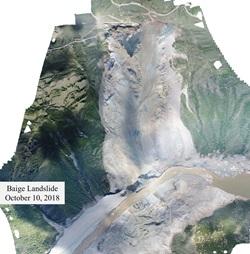
Baige landslide, 10 October 2018. Credit: Shufeng Tian
Citation
Tian, S., et al., 2026, How landslides happen without heavy rainfall: Early strong runoff coincides with weak geomaterials: Geology, https://doi.org/10.1130/G54187.1
Authors
Shufeng Tian[2], Kanglin Wu[2,3,4], Ningsheng Chen[1,2,*], Alessandro Simoni[4], Yongjian Li[1], Haixu Liu[1], Jiming Jin[1], Tao Wen[1], Taixin Peng[2], and Runing Hou[2]
Affiliations
[1] International Cooperation Center for Mountain Multi-Disasters Prevention and Engineering Safety & School of Geoscience, Yangtze University, Wuhan 430100, China
[2] Key Laboratory of Mountain Hazards and Engineering Resilience, Institute of Mountain Hazards and Environment, Chinese Academy of Sciences, Chengdu 610041, China
[3] Zijin Mining Group Co., Ltd., Shanghang, Fujian 364200, China
[4] Department of Biological, Geological and Environmental Sciences, University of Bologna, Bologna 40136, Italy
*Corresponding author: chennsh@yangtzeu.edu.cn
About the Geological Society of America
The Geological Society of America (GSA) is a global professional society with more than 18,000 members across over 100 countries. As a leading voice for the geosciences, GSA advances the understanding of Earth's dynamic processes and fosters collaboration among scientists, educators, and policymakers. GSA publishes Geology, the top-ranked geology journal, along with a diverse portfolio of scholarly journals, books, and conference proceedings—several of which rank among Amazon’s top 100 best-selling geology titles.
###
Contact Information
Kalen Landow
+1-303-357-1016
klandow@geosociety.org