
2026 J. David Lowell Field Camp Scholars Reflect on Their Experiences
Rebecca Taormina
In this article
Each year, GSA’s J. David Lowell Field Camp Scholarship helps undergraduate geology students participate in one of the most formative experiences of their education: field camp. Selected by GSA’s Professional Development Committee, each scholar receives US$3,000 to help cover the cost of field camp and other expenses associated with their field experience, as well as a brand-new, engraved Brunton compass to support their work in the field.
In 2026, 25 students were awarded J. David Lowell Field Camp Scholarships. Throughout the coming months, we will feature each of this year’s scholars and share their experiences in their own words. These students attended field camps across the United States, where they put classroom knowledge into practice, developed new technical and professional skills, explored unfamiliar landscapes, and built lasting connections with fellow geoscientists.
Here are the first of our 2026 J. David Lowell Scholars and their reflections on what field camp meant to them.
Holden Mathew Alpern
University of Florida, Gainesville, Florida
On May 8, 2026, I began my four-week field camp adventure. This was one of the most memorable experiences of my life, and I am incredibly thankful that I had the opportunity to do it, especially since that opportunity was not a given.
I’ve lived in Miami since I was eight. Although I’ve taken a few short field trips to nearby states, the Taos, New Mexico, area where we worked was about as different from Florida as one could imagine. While I studied petrography and structures in the classroom, applying that knowledge in an unfamiliar environment was a challenge, especially when hiking up and down elevations higher than the overall relief of Florida.
Throughout the trip, we mapped four areas—two sedimentary and two metamorphic—with each increasing in difficulty. I improved my ability to take and interpret measurements, my visual intuition for large-scale structures, and my ability to concentrate at 5 a.m. (through no fault but my own).
After graduating, I plan to pursue fieldwork as part of a PhD studying microorganisms in extreme environments and the geochemical traces they leave behind. I looked to field camp as a chance to prove I had what it took to do science when it wasn’t comfortable. While I certainly came away with that, I also really enjoyed mapping. It felt like solving a puzzle, and I would love to continue doing structural work.
I owe my great experience to my professor, Dr. Vogl; my TAs, Zach and Minh, for organizing it all (and putting up with me); our cook, Gabriel; and all of my friends. Everyone in my group was super cool, and having them there made each day more exciting. Overall, field camp was great. I wouldn’t change a thing, and I’m incredibly grateful to GSA for helping make this dream a reality.
Gentry Clanton
Mississippi State University, Mississippi State, Mississippi
This summer, I was able to participate in the University of Arkansas’s field camp courses thanks to the J. David Lowell Field Camp Scholarship. As part of this experience, I traveled to eight different states and four national parks to camp, conduct fieldwork, and learn about local geology.
This trip was full of “firsts” for me: my first time camping, my first time visiting a national park, my first time doing fieldwork, and my first time visiting five of the states we traveled through. Some of my favorite experiences included hiking and taking water-quality measurements at Grand Teton National Park and creating a geologic map, stratigraphic column, and cross section along the Big Hole River in southwestern Montana.
I made countless memories and learned many lessons over the six weeks of camp, and I will forever be grateful for the friends and mentors I connected with during my time there. I am incredibly thankful to the Geological Society of America for awarding me the J. David Lowell Field Camp Scholarship, which allowed me to afford the costs of field camp and have this wonderful learning experience!
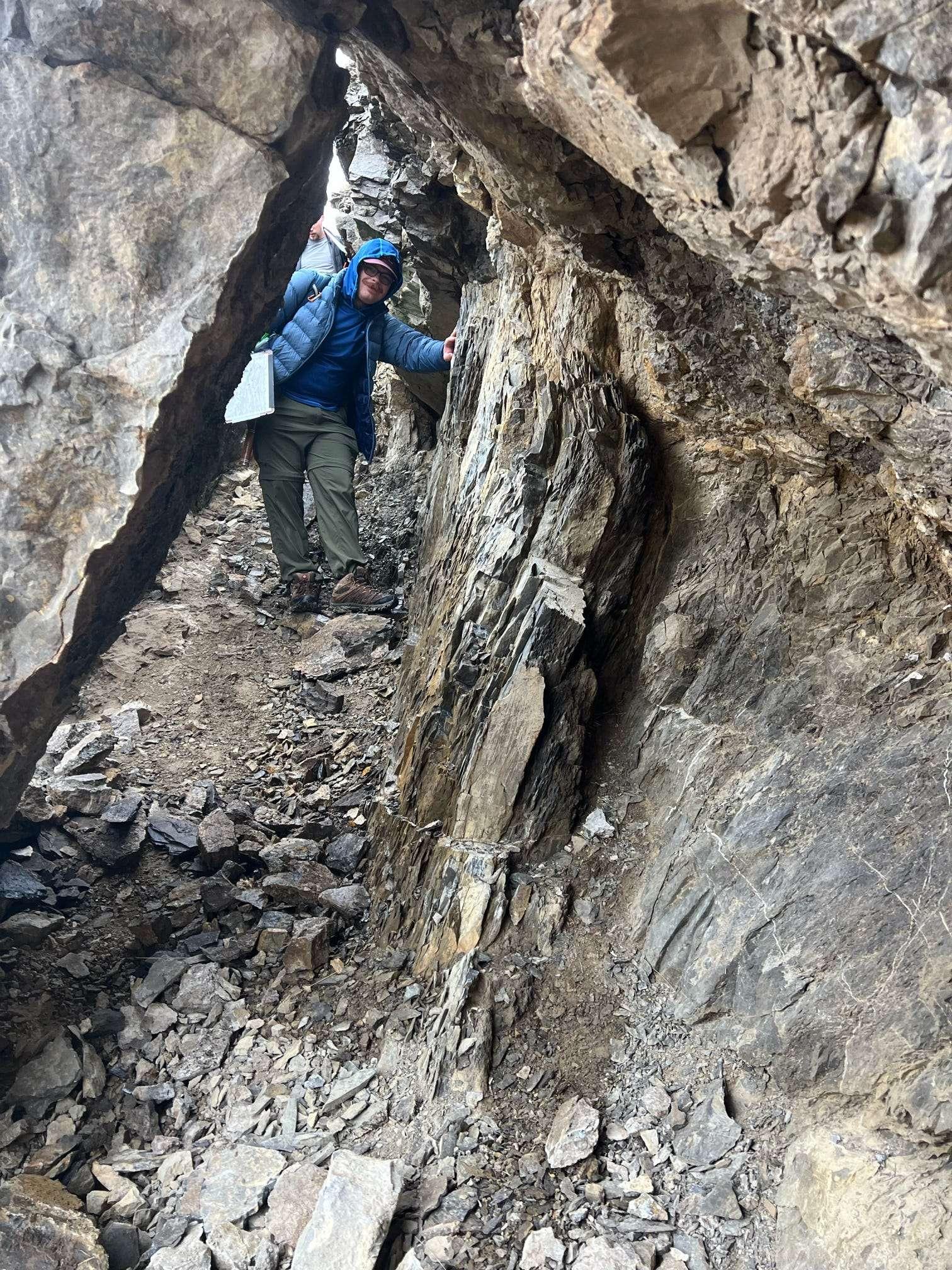
Gentry Clanton, 2026 J. David Lowell Scholar.
Morgan Leeson
The Ohio State University, Columbus, Ohio
I had the incredible opportunity to spend four weeks attending field camp with The Ohio State University in Ephraim, Utah. Field camp challenged my abilities, both physically and academically. I gained and improved my fieldwork skills, including observing stratigraphic units and their characteristics and interpreting and synthesizing structures, paleoenvironments, and geologic history. I presented my results through numerous geologic maps and cross sections.
Through our final group project, I also gained experience with 3-D visualization, GIS, GPS, and computer analysis of field data. After my field camp experience, I feel much more confident doing fieldwork and making scientific conclusions based on data gathered in the field. This course also strengthened my relationships with both my classmates and professors.
This opportunity allowed me to see so many beautiful places and deepen my appreciation for nature. While in Utah, I had the chance to visit dozens of amazing places, including Capitol Reef National Park, Zion National Park, Goblin Valley State Park, Antelope Island State Park, and Palisade State Park.
Field camp is truly an adventure that I will never forget. I am so thankful for GSA's J. David Lowell Field Camp Scholarship for making this experience possible and for my new Brunton Transit compass, which has been incredibly helpful in the field.
Morgan Leeson, 2026 J. David Lowell Scholar.
Turané McIntosh
Georgia State University, Atlanta, Georgia
First, I would like to say that I am very grateful to GSA for the support that allowed me to attend field camp. It would not have been possible without it, and this experience has made a positive change in my life.
The field camp experience was incredible. Being able to see structures discussed in the classroom and perform data-collection methods with my Brunton compass was amazing. I attended field camp in Montana, where so many geologic phenomena occur in one place, and I saw with my own eyes the rich story of its geologic history.
Faults, anticlines, synclines, and even overturned anticlines were things I had only seen in diagrams until now. Learning about the processes that formed these features over millions of years was fascinating. This experience was certainly unforgettable, and I was able to meet some brilliant friends along the journey. I would recommend this experience to anyone.
JJ Montes
Chandler-Gilbert Community College, Chandler, Arizona
This summer, I had the opportunity to participate in Arizona State University’s Planetary and Geological Studies B.S. Capstone Field Camp. During this experience, I refined my skills as a field geologist through intensive field mapping, data collection and analysis, and professional report writing.
As a class, we mapped four sectors in the Tonto National Forest near Tonto Creek and Christopher Creek. Located within Arizona’s Transition Zone, this geologically significant area provided an exceptional opportunity to study Paleozoic sedimentary rocks, crystalline basement rocks, and the geologic history of western North America.
Over the course of three weeks, ten students worked together while also developing as independent geologists. We encountered world-class examples of faults, folds, monoclines, accreted terranes, and stratigraphic sequences recording the rise and fall of ancient seas. We also explored the tectonic and volcanic processes that shaped the region.
Beyond the technical knowledge I gained, field camp taught me the value of perseverance, teamwork, and adaptability. Through long days in the field and challenges including physical exhaustion and injuries, we supported one another and continued developing our skills as geologists. We built lasting professional relationships, friendships, and memories. Most importantly, we learned that significant accomplishments are possible when people work hard together toward a shared objective.
Without the J. David Lowell Field Camp Scholarship, I would not have been able to attend. This support made it possible for me to gain invaluable field experience that will have a lasting impact on my education and future career as a geologist. Thank you for your support and investment in my future.