Leveraging the UFERN Model to Improve International Research Experiences for Undergraduates
N.D. LaDue et al.
In this article
Authors
N.D. LaDue
Department of Earth, Atmosphere, and Environment, Northern Illinois University, DeKalb, Illinois 60115, USA
C.L.B. Manning
Department of Earth, Atmosphere, and Environment, Northern Illinois University, DeKalb, Illinois 60115, USA
N. Stansell
Department of Earth, Atmosphere, and Environment, Northern Illinois University, DeKalb, Illinois 60115, USA
Abstract
The Undergraduate Field Experience Research Network (UFERN) is an interdisciplinary community of physical and social scientists interested in undergraduate field-based learning (O’Connell et al., 2022). Based on social and behavioral research on learning, a group of UFERN community members collaborated to develop the UFERN model to facilitate successful undergraduate field experiences. The model focuses on how intended student outcomes (e.g., knowledge, skills), the student contextual factors (e.g., worldview, interests, identity, prior knowledge, motivation), and program design factors (e.g., setting, orientation, interaction) influence the students’ experience and program outcomes (Fig. 1). Below, we describe how we used the UFERN model to improve and document the efficacy of an International Research Experience for Students (IRES) in Estonia (IRES Estonia).
*nladue@niu.edu
1 Supplemental Material. Text S1. Pre-trip survey administered one month prior to travel. Text S2. Post-trip survey administered two months after return from Estonia. Please visit https://doi.org/10.1130/GSAT.S.29936744 to access the supplemental material, and contact editing@geosociety.org with any questions.
CITATION: LaDue, N.D., Manning, C.L.B., and Stansell, N., 2025, Leveraging the UFERN model to improve international research experiences for undergraduates: GSA Today, v. 35, p. 22–24, https://doi.org/10.1130/GSATG614GW.1.
© 2025 The Authors. Gold Open Access: This paper is published under the terms of the CC-BY-NC license. Printed in USA.
Context
This IRES focused on assessing short- and long-term impacts of climate change in the Baltic region through investigation of water chemistry and lake sediments (e.g., pollen, isotopes). During the proposal development process, the PI, co-author Stansell, established partnerships with two regional community college (CC) geoscience faculty at Hispanic Serving Institutions (HSIs) to reach diverse, science-interested students early on their academic path (Weathers et al., 2024; Outcome 4). Engagement in undergraduate research is a predictor of success for students of color (NASEM, 2019), and this collaboration provided greater access to research experiences for CC students (Hewlett, 2018). Earth science teachers were recruited through relevant society social media posts (e.g., National Earth Science Teachers Association; Outcome 5). CC faculty advertised the opportunity in their classes, directly encouraged interested students to apply, and provided letters of recommendation. Applicants provided unofficial transcripts, a résumé, and a personal statement about how IRES Estonia would benefit their education and career goals. Stansell selected each participant for this experience.
This IRES included a short field and lab experience with a small, diverse team (Fig. 2). The 2020 COVID-19 pandemic caused the cancellation of the 2020 and 2021 field seasons. Participants selected for the 2021 field season were invited to participate in the 2022 field season.
Figure 1
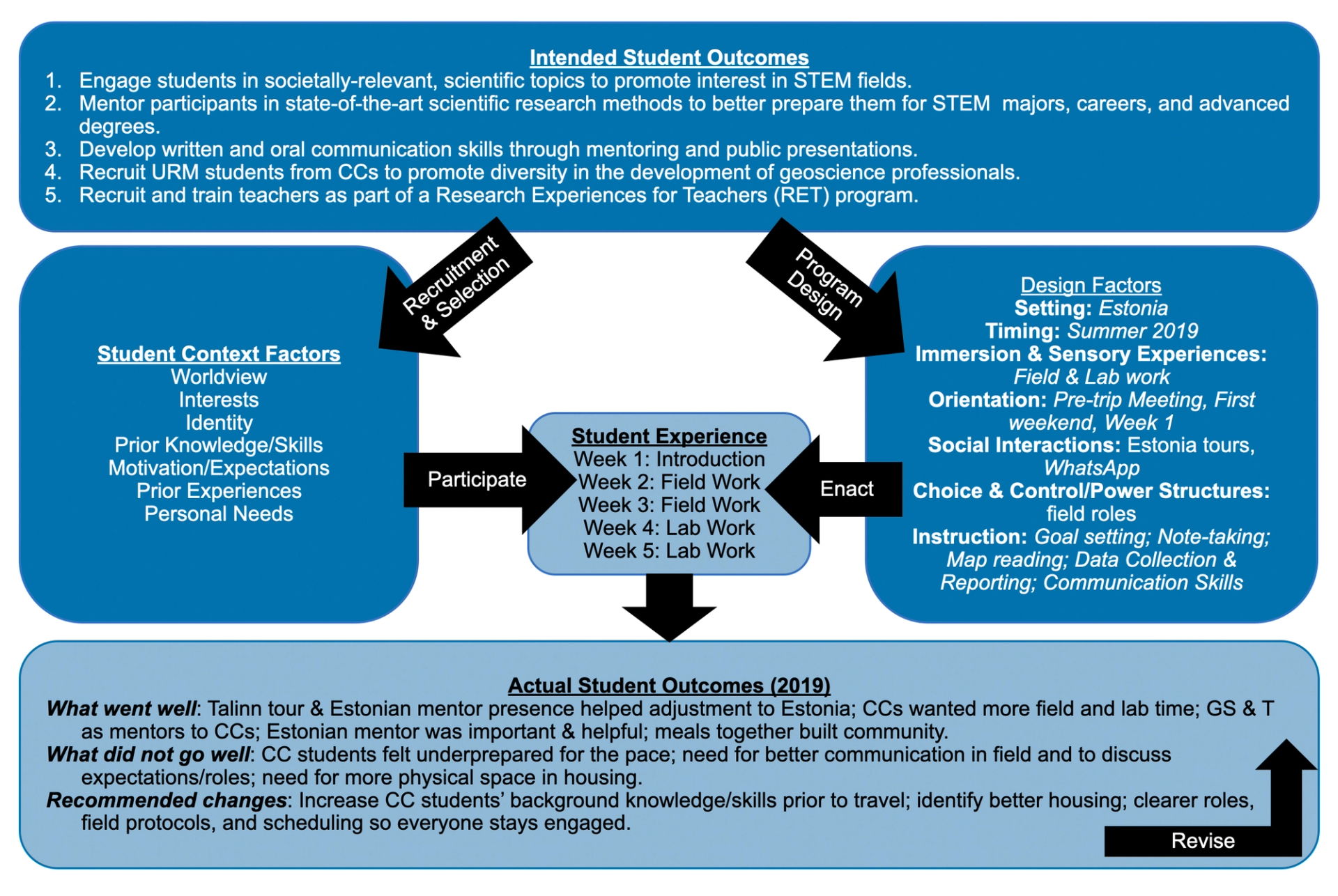
Aligning components of the IRES Estonia Project to the UFERN model.
Applying the UFERN Model
We leveraged the UFERN model (Fig. 1) after the 2019 program to assess and improve the IRES Estonia program for future years. The goals of the project were the five intended student outcomes. To assess goals 1, 2 and 3, we gathered the participants’ initial context factors using a survey assessing participants’ future goals (Lopatto, 2007), science identity, and sense of belonging in science (Findley-Van Nostrand and Pollenz, 2017; Supplemental Material File S11). The design factors of IRES Estonia included the setting (e.g., City of Estonia, fieldwork), the timing (e.g., summer, field and lab work), orientation to the experience (e.g., pre-trip meeting and survey, first weekend tours of Estonia to learn cultural norms), informal social interactions (e.g., WhatsApp, meals cooked and eaten together), power structures (e.g., scientists, graduate students, undergraduate students, teachers), and a variety of instructional models (e.g., skills training with Excel, map reading, field notetaking; Fig. 1). An orientation meeting reviewed the travel and lodging (prepaid by the grant) and the daily agenda. Stansell arranged for stipends ($500 per week) to be released prior to travel to ensure students could purchase necessary clothing and cover travel incidentals. An Estonian Ph.D. student in Stansell’s lab provided cultural support for the IRES participants during the first few days in Estonia. Once in the field, the students learned protocols for map reading, field notetaking, water sample collection, ground penetrating radar, and lake core drilling. The research team also engaged in local traditions (e.g., saunas). In the laboratory, students were taught how to format spreadsheets and analyze data. Students were invited to continue their research project ($100 weekly stipend) for the subsequent academic year.
Figure 2
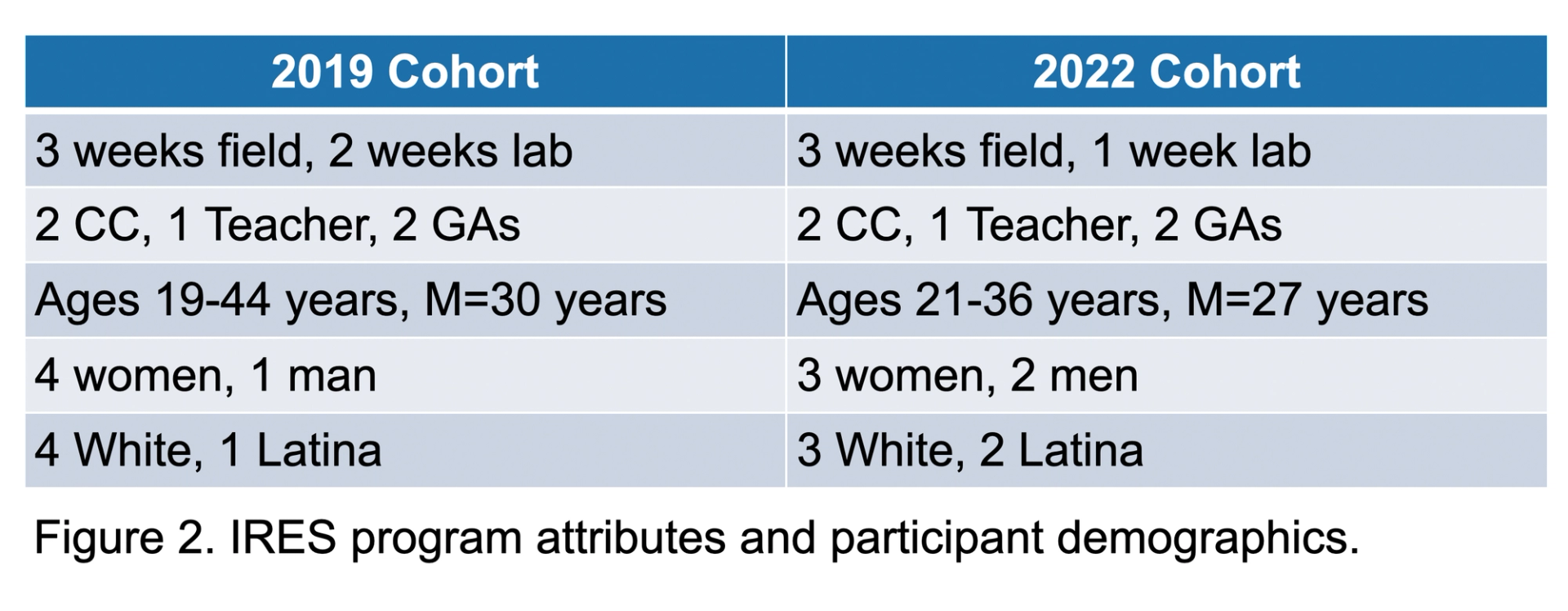
IRES program attributes and participant demographics.
The 2019 evaluation pre-trip surveys indicated that all participants had high levels of interest, motivation, and science identity that were maintained on the post-trip survey. While in Estonia, participants completed a weekly Google form to evaluate their level of comfort, the pace of the program, and any challenges they encountered. LaDue summarized and anonymized the feedback to Stansell each week. Two months after returning, each participant completed a post-trip survey (Supplemental Material File S2) and one-on-one interview (LaDue or Manning). Interview findings were summarized to inform program improvement. Based on 2019 assessment data, we categorized the actual student outcomes to identify priority areas for improvement. Participants were enthusiastic about the cultural and field-based research experience. The CC students indicated that the pace was too fast, and they wanted more lab time and background knowledge and skills. Stansell learned that CC students needed more support using common science tools (e.g., spreadsheets). Interviews indicated friction around roles and responsibilities related to significant age differences (i.e., perceived power structures) between students and the teacher that were exacerbated by cramped European-style lodging accommodations (i.e., cultural norms). Stansell engaged in UFERN workshops between the first and second field seasons to learn ways to manage field teams with diverse backgrounds.
From the 2019 field season, we learned that student context factors should drive the design factors (O’Connell et al., 2022). Therefore, the 2022 field plan focused on the need for better lodging, more clearly defined roles, and specific tasks to keep everyone engaged in the fieldwork (Fig. 1). More spacious lodging allowing for more alone time was arranged. Stansell started each field day with a discussion of roles and responsibilities, distributing duties based on experience (e.g., 2022 teacher with a hydrogeology M.S.). To enhance students’ prior knowledge, the summer 2022 students participated in an online seminar class with Stansell in spring 2022.
One-on-one interviews held after the 2022 field season revealed that the changes made to the program had a positive impact on the actual student outcomes. The pre-trip seminar built rapport with PI Stansell and between the graduate and CC students. Participants reported that the weekend of cultural activities upon first arriving in Talinn (led by the Estonian graduate student) were essential to orient them and that the roomier lodging was comfortable. Clear daily goal setting and discussion of roles helped participants stay engaged throughout fieldwork. These findings support Jolley et al.’s (2018) research on the benefits of student-centered, situated fieldwork.
Summary
The UFERN model enabled us to examine each interacting component of the program and to identify which changes were most critical. We identified the need to address power imbalances, role clarity, and culture-based expectations. Reevaluation using the model for the 2022 cohort demonstrated that improvements were effective. We recommend that program developers consider using the UFERN model to facilitate planning and evaluation.
This project met its intended goals: All four CC students continued their research after their field season, yielding three undergraduate theses and two national conference presentations. Three graduated as geology majors from four-year universities and one is currently a master’s student. The pandemic interruption between cohorts allowed for a pre-fieldwork seminar to facilitate CC students’ content knowledge and critical relationship building prior to travel. Future project developers should consider these strategies to improve their project outcomes.
Acknowledgments
This project was funded by the National Science Foundation #1827135.
References
- Findley-Van Nostrand, D., and Pollenz, R.S., 2017, Evaluating psychosocial mechanisms underlying STEM persistence in undergraduates: Evidence of impact from a six-day pre–college engagement STEM academy program: CBE Life Sciences Education, v. 16, no. 2, p. ar36, https://doi.org/10.1187/cbe.16-10-0294.
- Hewlett, J.A., 2018, Broadening participation in undergraduate research experiences (UREs): The expanding role of the community college: CBE Life Sciences Education, v. 17, no. 3, https://doi.org/10.1187/cbe.17-11-0238.
- Jolley, A., Kennedy, B.M., Brogt, E., Hampton, S.J., and Fraser, L., 2018, Are we there yet? Sense of place and the student experience on roadside and situated geology field trips: Geosphere, v. 14, no. 2, p. 651–667, https://doi.org/10.1130/GES01484.1.
- Lopatto, D., 2007, Undergraduate research experiences support science career decisions and active learning: CBE Life Sciences Education, v. 6, no. 4, p. 297–306, https://doi.org/10.1187/cbe.07-06-0039.
- National Academies of Sciences, Engineering, and Medicine (NASEM), 2019, Minority Serving Institutions: America’s Underutilized Resource for Strengthening the STEM Workforce: Washington, D.C., The National Academies Press, 254 p., https://doi.org/10.17226/25257.
- O’Connell, K., Hoke, K.L., Giamellaro, M., Berkowitz, A.R., and Branchaw, J., 2022, A tool for designing and studying student-centered undergraduate field experiences: The UFERN model: Bioscience, v. 72, no. 2, p. 189–200, https://doi.org/10.1093/biosci/biab112.
- Weathers, T., Turner, S., and Gamage, K., 2024, The benefits of empowering community college geoscience faculty: Eos, v. 105, https://doi.org/10.1029/2024EO240344.