
Celebrating the Birth of U.S. Geoheritage in Denver, Colorado
Lon D. Abbott and Terri Cook
In this article
Authors
Lon D. Abbott*
Department of Earth Sciences, University of Colorado, Boulder, Colorado 80309, USA
Terri L. Cook
Down to Earth Science, Boulder, Colorado 80305, USA
Thomas (Tom) Casadevall, chair of GSA’s U.S. Geoheritage Advisory Group, defines geoheritage as recognition of the connection between people, landscape, and Earth history (Cook and Abbott, 2015; NASEM, 2021). By that definition, geoscientists have been doing geoheritage work for a very long time. But the term geological heritage (geoheritage for short) itself was not coined until 1991 at the First International Symposium on the Conservation of our Geological Heritage, sponsored by the United Nations Educational, Scientific, and Cultural Organization (UNESCO) and held in Digne-les-Bains, France. The seminal document that emerged from that meeting, the International Declaration of the Rights of the Memory of the Earth, declared that:
“Our history and the history of the Earth cannot be separated. Its origins are our origins, its history is our history, and its future will be our future.”
Considering that shared fate, the declaration continued:
“It is time for us to learn to protect this Earth heritage, and by doing so learn about the past of the Earth, to learn to read this ‘book’, the record in the rocks and the landscape, which was mostly written before our advent” (ProGEO, 2026).
Symposium attendees recognized that none of the existing UNESCO programs, such as World Heritage Sites and Biosphere Reserves, were specifically designed to recognize and preserve sites of extraordinary geologic significance; the concept of geoparks as a mechanism for preserving that geological heritage began taking shape at that symposium (Jones, 2008).
Foundations of the Geoheritage Movement
The next major step in geoheritage preservation occurred on 6 August 1997 during a field trip connected to the 30th International Geological Conference in Beijing, China. Sixty geoscientists toured the Zhoukoudian Peking Man Site, a world-class archaeological site near Beijing first excavated in the early 20th century that has yielded Paleolithic human remains, tools, and evidence of early human use of fire. Guy Martini, a founding member of the European geopark movement, later remarked, “. . . world geoparks originated from the trip to Zhoukoudian” (Zhang and Zhang, 2023).
Groups in Europe and China seized on that inspiration and rapidly developed the geopark concept; the European Geopark Network, which initially consisted of four geoparks, was established in 2000, and in 2004 the Global UNESCO Network of Geoparks was born from the merger of the European Geopark Network and China’s National Geopark Network. By 2007 the Global Geopark network had grown to 52 members, with geoparks in Brazil, Iran, and Malaysia joining the ever-growing list (Jones, 2008).
Early U.S. participation in the geoheritage movement was primarily through activities of the U.S. National Park Service. Those of us in the U.S. are fortunate to have such an extensive national park system and a robust legal framework for protecting the extraordinary array of geoheritage sites found there. But as geoheritage preservation expanded around the world with the creation of UNESCO Global Geoparks, a structure to recognize and protect significant U.S. geoheritage sites outside national park units (Fig. 1) languished.
Geoheritage Arrives in the United States
A serendipitous turning point for U.S. geoheritage efforts occurred in 2011. Marcia McNutt, then director of the U.S. Geological Survey (USGS), was asked to give a keynote address at the First International Conference on Geoparks in Africa and the Middle East held in El Jadida, Morocco. McNutt was unable to attend, and Casadevall, who at that time chaired the U.S. National Committee for the International Union of Geological Sciences (IUGS) and was a former acting director of USGS, was asked to represent the United States and the USGS in her stead. Casadevall was so inspired by the meeting discussions that he immediately began to organize a comparable “first” geoheritage meeting for the United States (Casadevall, written comm., 2026).
Casadevall chaired an organizing committee to obtain sponsoring funds and plan the meeting structure. GSA was involved from the outset; Wesley Hill, then GSA’s geoheritage representative, was a key member of the organizing committee. National Park Service geologists, including Tim Connors and Jim Woods, contributed their expertise, with Woods serving on the organizing committee, and the National Academies of Sciences, Engineering, and Medicine (NASEM) assumed primary sponsorship of U.S. geoheritage efforts, with Ester Sztein and Lina Stankute rounding out the organizing committee. The meeting, titled America’s Geological Heritage Invitational Workshop, was held 18–19 March 2013 in Denver, Colorado, USA. Tim Badman, director of the World Heritage Program at the International Union for the Conservation of Nature (IUCN), and Jose Brilha, president of ProGEO, the European Association for the Conservation of Geological Heritage, gave keynote addresses that provided an international perspective. U.S. geoheritage experts from government agencies, universities, and state geological surveys led panel discussions that fostered awareness of geoheritage values and collaborative opportunities to conserve U.S. geoheritage sites (NASEM, 2013).
Just as Casadevall hoped, the 2013 Denver workshop catalyzed enthusiasm for and raised awareness of geoheritage in the U.S. In 2020–2021, NASEM sponsored a follow-up webinar series, “America’s Geoheritage II: Identifying, Developing, and Preserving America’s Natural Legacy,” chaired by Montana State University professor Dave Mogk. The workshop’s goals were to take stock of ongoing geoheritage efforts, reach common understanding on terminology, focus future efforts, and most importantly to continue fostering a collaborative community dedicated to preserving geoheritage sites (NASEM, 2021).
Globally, geoheritage has continued to flourish. In 2015, UNESCO formally adopted standards for creating international geoparks, leading to the current tally of 229 UNESCO Global Geoparks in 50 countries (UNESCO, 2026). U.S. participation in the international geoheritage movement has greatly increased thanks to that catalyzing 2013 workshop. In 2016, IUGS formalized its linkage to the U.S. Geoheritage Advisory Group, chaired by Casadevall since its inception. Grassroots geoheritage activities have flourished, and in 2024 GSA assumed sponsorship of the U.S. Geoheritage Advisory Group, making the society the primary entity supporting U.S. geoheritage initiatives.
Celebrating the Contributions of the “Father” of U.S. Geoheritage
Given that Denver hosted the first U.S. geoheritage meeting, and that GSA is now the hub of U.S. geoheritage efforts, it seems fitting to take stock of the status of U.S. geoheritage at GSA Connects 2026, happening 11–14 October in Denver.
GSA introduced its first geoheritage-branded technical session, “Geoheritage, Geoantiquities, and Geomorphosites,” at GSA Connects 2009 in Portland, Oregon. Geoheritage offerings at Connects have grown ever since, and there will be more geoheritage-related content at this year’s meeting than ever before. Highlights include the Pardee Keynote Symposium “Geoheritage Values in a World of Resource Extraction,” which will explore domestic, international, and indigenous perspectives on the interplay between geoheritage and humanity’s dependence on resource extraction. Other geoheritage-related technical sessions will explore the integration of geoscience history, philosophy, and geoheritage, and a session on astro-geoheritage will expand the concept beyond the bounds of Earth.
Geoheritage-focused short courses will explore geoconservation and geological mapping. It wouldn’t be GSA Connects without a plethora of field trips, with several geoheritage-focused offerings led by pioneers in the U.S. geoheritage movement. Casadevall and Herb Meyer will lead one focused on the geoheritage of the world-famous Florissant Fossil Beds National Monument, and Tim Connors will lead pre- and post-meeting trips exploring Front Range geology and paleontology. There’s also a free, fully accessible field trip to the Denver Museum of Nature and Science and Dinosaur Ridge to explore the extraordinary paleontology of that National Natural Landmark.
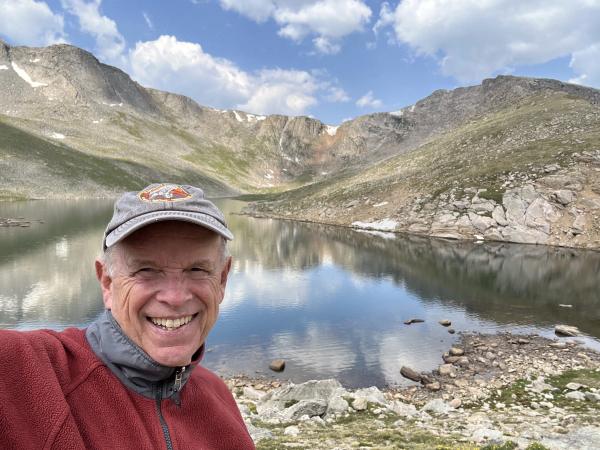
Another Connects 2026 geoheritage event will be the presentation of the 2026 GSA Public Service Award to Casadevall (Fig. 2), a volcanologist who is receiving the award for his considerable contributions to the science of mitigating volcanic hazards and for being the “father” of the U.S. geoheritage movement. His distinguished USGS career has included service as regional director of both the USGS Western and Central regions, deputy director, and acting director. He has been a leader in volcanic hazard mitigation in the U.S. and around the world, including pioneering the study of how to protect aircraft from volcanic ash plumes. Casadevall has authored many geoheritage publications, including the IUCN inventory of World Heritage volcanoes, and co-authored GSA’s position statement on geoheritage. It is a special pleasure for us to see his copious contributions recognized at this year’s meeting.
Grassroots Geoheritage Initiatives
GSA organized a geoheritage webinar series between May 2025 and January 2026 that explored how to become a geoheritage advocate. Attendance at those sessions consistently topped 400 participants—a testament to the growing enthusiasm for geoheritage conservation. Many sage observations and ideas emerged during those sessions, but one comment in particular has stuck with us. A geoscientist asserted they were 100% onboard with everything that had been said but, to paraphrase, was worried that these sessions were “preaching to the converted. . . What we need to do is convince people outside the geoscience profession of the value of geoheritage.”
Fortunately, many efforts are under way to do just that. Geoheritage efforts focus on sharing with the larger public a love and understanding for the wonders of Earth’s history and promoting responsible, sustainable geotourism that benefits local communities. The GSA geoheritage webpage (https://www.geosociety.org/what-we-do/geoheritage) contains some wonderful examples of how geoscientists and their community partners are helping to connect the public with their local geoheritage from coast to coast.
Bill Rose, Erika Vye, and their many collaborators at Michigan Technological University, and multiple community partners have built a geoheritage website (https://www.mtu.edu/greatlakes/research-highlights/geoheritage/) that explores how geology and Earth processes shape the cultures, politics, economies, history, and identity of Michigan’s Keweenaw Peninsula communities. The peninsula hosts the world’s largest accessible native copper deposit, and humans have been mining it throughout their 8,000-year history in the area. Vye will explore that history during her Connects 2026 Pardee Keynote Symposium.
The noontime lecture series will also feature a presentation about how La Veta Trails—a southern Colorado volunteer organization dedicated to connecting people to the outdoors, inspiring volunteerism, and contributing to the health and economic vitality of the Spanish Peaks region (Fig. 1)—is using geoheritage education to achieve its objectives. La Veta Trails president Marilyn Russell and geoscientist Sabrina Kainz will describe their work connecting local populations, including La Veta K–12 students and local Native American tribal members, to the area’s deep geologic history.
Highlighting Exceptional Geosites, One Meeting at a Time
GSA Connects 2026 attendees will also be able to explore impressive geoheritage sites close to Denver on their own with help from the Denver area geosites map produced by Chelsea Feeney and William (Drew) Andrews (Fig. 3). The map carries on a tradition started at Connects 2024 in Anaheim, California. Andrews, the incoming chair of GSA’s History, Philosophy, and Geoheritage Division, recalls his excitement when he first saw the Anaheim map. He had attended GSA meetings across North America throughout his career and had always wanted to combine his meeting attendance with exploration of beautiful geosites close to the meeting venues, but he never had the time to do the research required to make it happen. Now, there in his hand was an ideal guide for personal discovery of places and geologic stories he previously didn’t even know existed (Andrews, personal comm., 2026). That excitement led him to his current role helping Feeney select sites and produce a scientifically illuminating and aesthetically pleasing map.
Feeney’s GSA Connects geosite maps were instantly popular and are well on their way to becoming a Connects tradition. They are an ever-evolving fusion of scientific information and artistry. Feeney is particularly fond of the Denver map’s stratigraphic correlation chart, which places the geosites within their appropriate temporal context in the long arc of Earth history (Feeney, personal comm., 2026).
The fundamental lesson of geoheritage is that human history and Earth history cannot be separated. U.S. geoheritage activity has blossomed since that 2013 workshop in Denver. Thirteen years on, as GSA Connects returns to Denver, it celebrates collaborations spawned by that workshop between geoscientists and members of the wider community to promote geoheritage awareness and preservation. And whether you are able to attend this year’s meeting or not, the engaging, information-packed Denver geosites map will guide you to exciting discoveries about intertwined human and Earth history on your next visit to Denver.
References Cited
- Cook, T., and Abbott, L., 2015, Geoheritage: Preserving Earth’s legacy: Earth, v. 60, p. 32–39.
- Jones, C., 2008, History of Geoparks: Geological Society of London, Special Publication 300, p. 273–277, https://doi.org/10.1144/SP300.21.
- National Academies of Sciences, Engineering, and Medicine (NASEM), 2013, America’s geological heritage invitational workshop meeting summary: Washington, DC, The National Academies Press, https://www.nationalacademies.org/cdn/
- National Academies of Sciences, Engineering, and Medicine (NASEM), 2021, America’s Geoheritage II: Identifying, Developing, and Preserving America’s Natural Legacy: Proceedings of a Workshop: Washington, DC, The National Academies Press, 55 p., https://doi.org/10.17226/26316.
- materials/9fba1112-cc2f-45a8-ba40-ad5988294506.
- ProGEO, 2026, Digne-les-Bains Declaration: https://geopark.mnhn.fr/sites/geopark.mnhn.fr/files/documents/geopat3.pdf (accessed July 2026).
- UNESCO, 2026, UNESCO Global Geoparks: https://www.unesco.org/en/iggp/geoparks/about (accessed July 2026).
- Zhang, J., and Zhang, J., 2023, The history and outcomes of the 30th International Geological Congress, Beijing (1996): Episodes, v. 46, p. 309–316, https://doi.org/10.18814/epiiugs/2022/022028.
* lon.abbott@colorado.edu
CITATION: Abbott, L.D., and Cook, T.L., 2026, Celebrating the Birth of U.S. Geoheritage in Denver, Colorado: GSA Today, v. 36, p. 38–41, https://doi.org/10.1130/GSATG124GH.1
© 2026 The Authors. Gold Open Access: This paper is published under the terms of the CC-BY-NC license. Printed in USA.