Long-Term Monitoring of a Campus-Scale Geothermal Heat Pump System Using Distributed Temperature Sensing
Chloe Fandel et al.

In this article
Authors
Chloe Fandel
Department of Geology, Carleton College, Northfield, Minnesota 55057, USA
Daniel Maxbauer
Department of Geology, Carleton College, Northfield, Minnesota 55057, USA
Sarah Titus
Department of Geology, Carleton College, Northfield, Minnesota 55057, USA
Kelton Barr
Kelton Barr Consulting LLC, St. Louis Park, Minnesota 55426, USA
Jonathan Cooper
Department of Geology, Carleton College, Northfield, Minnesota 55057, USA
Bruce Duffy
Department of Physics & Astronomy, Carleton College, Northfield, Minnesota 55057, USA
Martha Larson
RMF Engineering, Baltimore, Maryland 21228, USA
Mary Savina
Department of Geology, Carleton College, Northfield, Minnesota 55057, USA
Bob Tipping
Minnesota Department of Health, St. Paul, Minnesota 55164, USA
Abstract
Geothermal heat pumps are a fast-growing technology for decarbonizing heating and cooling systems. Monitoring existing systems over time can provide useful information for how subsurface heterogeneities will impact efficiency in new systems. Carleton College (Northfield, Minnesota) installed a district-scale, closed-loop geothermal heat pump system in 2018, with over 200 vertical boreholes that extend ~150 m through Paleozoic sedimentary rocks. Fiber-optic distributed temperature-sensing cables in five boreholes provide insight into daily, seasonal, and yearly temperature patterns. At certain intervals, downhole temperature consistently deviates toward the pre-operational temperature, creating persistent pinch points across times and in all seasons, which we attribute to higher groundwater flow. Vertical wells in two borefields are grouted differently: Wells in one field only have thermal grout, while wells in the other field have an interval of pea gravel through an interval of predicted high groundwater flow. Total energy exchange data for each borefield suggest that the field with pea gravel is more efficient than the fully grouted one. There are hints that the subsurface reservoir acts like a sink (absorbing and transmitting thermal energy so that the temperature oscillates around a constant mean), rather than like a battery (storing thermal energy in summer to be released in winter),but more data are needed to fully characterize long-term patterns. The influence of groundwater flow and the long-term responses of the subsurface have implications for borefield design and highlight the importance of monitoring new geothermal systems.
*cfandel@carleton.edu
1 Supplemental Material. Figure S1. Depth and amplitude of borehole temperature deviations. Figure S2. Monthly downhole temperatures showing seasonal heat exchange. Please visit https://doi.org/10.1130/GSAT.S.30152638 to access the supplemental material; contact editing@geosociety.org with any questions.
CITATION: Fandel, C., et al., 2025, Long-term monitoring of a campus-scale geothermal heat pump system using distributed temperature sensing: GSA Today, v. 35, p. 4–10, https://doi.org/10.1130/GSATG607A.1.
© 2025 The Authors. Gold Open Access: This paper is published under the terms of the CC-BY-NC license. Printed in USA.
Introduction
Geothermal heat pumps are a promising technology for decarbonizing heating and cooling systems and are one of the fastest-growing renewable energy sources worldwide (Monschauer et al., 2023). Unlike geothermal systems that rely on high-temperature subsurface reservoirs, heat pumps leverage steady subsurface temperatures (Rybach, 2022). In temperate climates, the ground temperature is cooler than the surface air in summer but warmer in winter, providing both a heat sink and source.
Currently, most geothermal heat pumps are for single-family homes (Monschauer et al., 2023). However, district-scale installations that distribute heat to multiple buildings could play a key role in decarbonization (Vinther Pedersen, 2020; Liu et al., 2023). Examples of district-scale geothermal heat pump installations in the United States include Epic Systems (McDaniel et al., 2018), Ball State University (Siliski et al., 2016), and West Chester University (Helmke et al., 2016). Few systems have long-term monitoring, which makes it difficult to predict how they will interact with the local geologic and hydrogeologic context. This lack of monitoring can cause operational challenges down the road, as, for example, at Ball State University and at Stockton College, where long-term monitoring showed consistent increases in ground temperatures (Epstein and Sowers, 2006; Siliski et al., 2016).
Carleton College installed a district-scale geothermal heat pump system in 2018 with three borefields, one of which included fiber-optic distributed temperature-sensing (DTS) cables in five boreholes. The resulting high-resolution downhole temperature data, when combined with overall campus energy-use data, provide insight into daily, seasonal, and yearly temperature patterns in the subsurface. This system also provides a natural laboratory because the borefields have slightly different designs that allow us to compare the role of borehole design and construction on the behavior and efficiency of geothermal heat pumps.
Figure 1
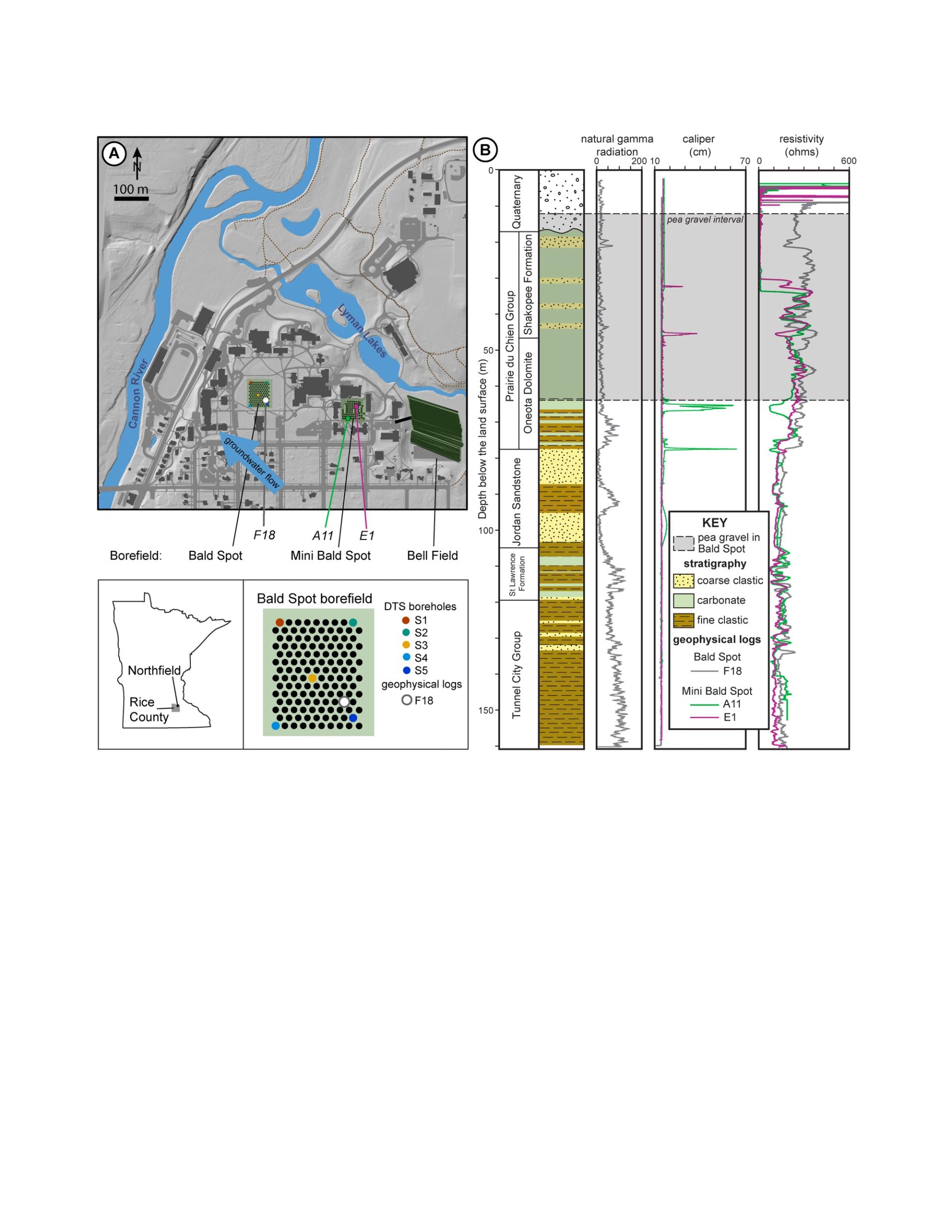
(A) Carleton College borefield and instrumentation map. Boreholes in the Bald Spot and Mini Bald Spot fields are vertical; boreholes in Bell field are horizontal. Inset: Location of Northfield in Minnesota. The center of the Bald Spot field is at 44.461025°N, 93.154706°W. (B) Stratigraphic column and geophysical logs.
Campus Geothermal System
The Carleton College district heating and cooling system consists of a closed-loop geothermal ground-source heat pump with three borefields (Bald Spot-133 bores, Mini Bald Spot-77 bores, Bell Field-95 bores), a central energy station, and a piped 49 °C hot-water heat-distribution system to campus buildings (Fig. 1A). The system captures, redistributes, and exchanges heat for campus needs through the heat pump. Additional energy needs (during the coldest and hottest days) are met by boilers and chillers in the central energy station, powered by a combination of natural gas and electricity.
The borefields each have a slightly different design. Two fields have vertical bores that extend to 158.5 m through the local bedrock with ~6 m spacing between bores. The third borefield (Bell field) consists of horizontal bores in shallow unconsolidated sediment. Here, we focus on the fields with vertical bores because they create a natural experiment. Each ~15 cm diameter borehole is connected to the others by a closed loop of polyvinyl chloride (PVC) geothermal piping. The piping travels down and up each individual borehole and contains recirculating fluid, so that heat, but not fluid, exchanges through the walls. The annular space inside the borehole is filled with a thermal grout, which minimizes the risk of contamination via vertical groundwater flow along the boreholes while maximizing the thermal conductivity of the area around the pipe. However, in the Bald Spot field, a special waiver was obtained from the Minnesota Department of Health to use pea gravel rather than grout in an interval of expected high groundwater flow (11.8–64.9 m below the surface). The local stratigraphy is the same in both fields; thus, the only major difference is the presence or absence of the pea-gravel fill interval.
Five bores in the Bald Spot field are instrumented with fiber-optic cables that record temperature at 0.1 °C, 0.25 m, and 30 min resolution (Fig. 1A; see detailed description in Supplemental Material1).
Figure 2
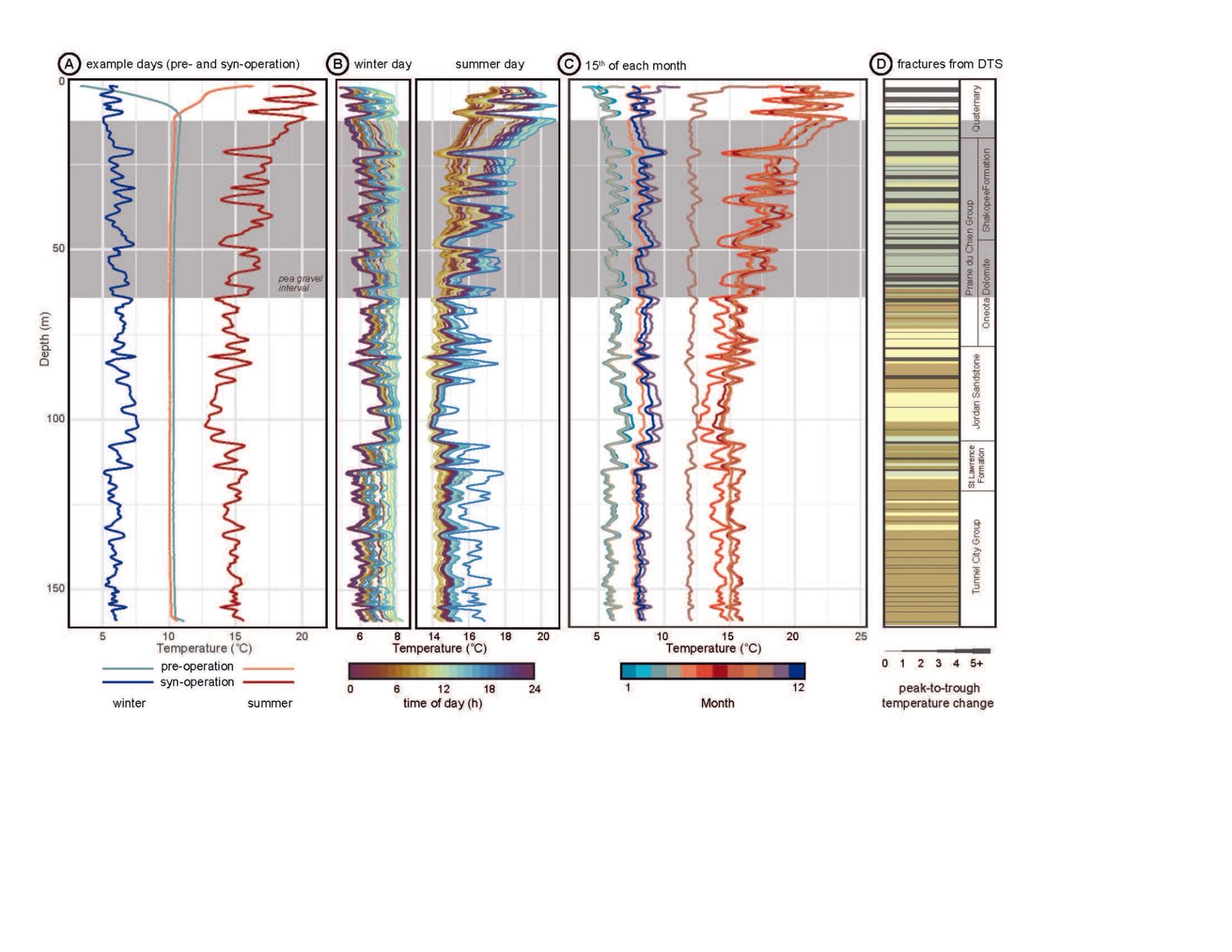
Data from borehole S1 over different time scales. (A) Downhole distributed temperature-sensing (DTS) temperature profiles for 1 h (11 a.m. to 12 p.m.) of a representative day, in winter and summer, before and during system operation. (B) Hourly profiles for a winter (left) and summer (right) day. (C) Monthly profiles (11 a.m. to 12 p.m. on the 15th day of each month). (D) Fracture locations interpreted from pinch points in September data in panel C.
Local Geology
The vertical bores pass through Cambrian–Ordovician sedimentary rocks deposited in a shallow sea. These continuous, flat-lying strata are topped by a veneer of glacial sediments.
The main aquifers are the Ordovician Prairie du Chien Group (targeted for pea-gravel fill in the Bald Spot field) and the Cambrian Jordan Sandstone (Fig. 1B). Groundwater flow through the Prairie du Chien Group (subdivided into the Shakopee and Oneota Formations) is common along extensive bedding-parallel fractures and dissolution features (Tipping et al., 2006). Several of these fractures appear in geophysical logs from the Mini Bald Spot field, where they correlate with abrupt changes in resistivity (Fig. 1B). There is also a regional-scale paleokarst horizon within the Oneota Formation (Tipping et al., 2006). Groundwater flow through the underlying Jordan Sandstone is attributed to granular characteristics of the unit as well as bedding-parallel fractures (Runkel et al., 2003).
The two deepest units beneath campus tend to have lower hydraulic conductivities than the overlying aquifers (Runkel et al., 2003). The Cambrian St. Lawrence Formation, composed of interbedded sands and carbonate rock, may have some secondary porosity due to dissolution along bedding planes (Runkel et al., 2003). Several peaks in the gamma radiation in this unit also correlate with changes in resistivity (Fig. 1B). The upper part of the Cambrian Tunnel City Group is an aquifer in the Twin Cities basin; the higher porosity and permeability in this interval are attributed to bedding-parallel fractures (Runkel et al., 2006).
Figure 3
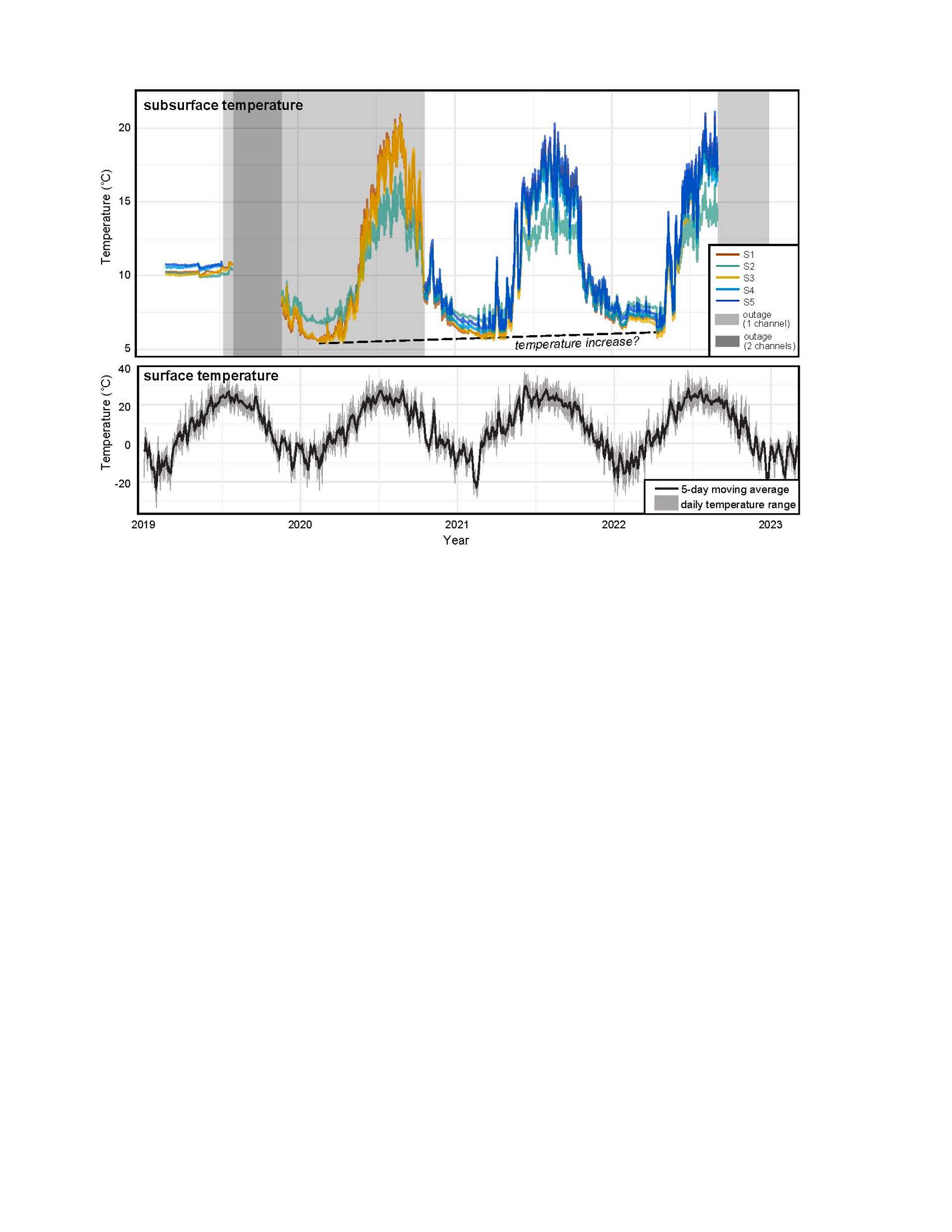
(A) Mean daily temperature for each distributed temperature-sensing (DTS) instrumented borehole. See Figure 1A for locations. (B) Mean air temperature (five-day moving average). Data: Minnesota Department of Natural Resources (2025).
Data and Interpretations
The DTS data illustrate temperature patterns in space and time. We first use downhole data to illustrate the basic operation of the system in winter and summer. Then, we show hourly and monthly snapshots from a single well along with fracture interpretations based on the temperature profiles. Last, we examine trends over several years in the Bald Spot field.
Downhole Temperatures
Figure 2A shows temperature profiles from a single borehole (S1) before and after the system was operational. The pre-operational data in winter and summer show seasonal fluctuations in the top 10 m. The amplitude of the fluctuations decreases as depth increases, until the extinction depth is reached, and the temperature remains constant at around 10 °C (Lapham, 1989; Briggs et al., 2014). This constant subsurface temperature generally represents an equilibrium slightly above the mean annual surface temperature (Carson, 1961), which in Northfield is 7.2 °C (Minnesota Department of Natural Resources, 2023). In regions with extensive winter snow cover, such as Minnesota, a difference of more than 3 °C between the mean annual air and ground temperatures is not uncommon.
The post-operational profiles show seasonal fluctuations along the entire length of the borehole. The winter curve shows cooler-than-average temperatures as buildings extract heat from the ground, while the summer curve shows warmer-than-average temperatures as buildings dump heat into the ground. Each curve contains seasonally mirrored wiggles at various depths. Wiggles away from the baseline temperature show the locations of the largest seasonal temperature fluctuations; wiggles toward the baseline show locations of the smallest fluctuations, creating pinch points. We attribute pinch points to intervals of high horizontal groundwater flow, where groundwater near the mean annual temperature brings the borehole temperature closer to the pre-operational baseline.
Next, we show temperature snapshots over a 24 h period in winter and summer (Fig. 2B). In both seasons, hourly curves show mirrored fluctuations of 2–3 °C over the course of 24 h, in response to changes in campus energy demand driven by diurnal temperature cycles at the surface. The subsurface temperature increases during the warmest part of the day in both seasons (a rightward shift in the afternoon, when heating demand is lowest in winter and cooling demand is highest in summer). The deviation from the baseline temperature is greatest during hours of peak heating/cooling demand (cold winter nights and hot summer afternoons).
The winter and summer hourly profiles are not, however, perfectly symmetric. Summer temperatures deviate farther from the baseline than those in winter and span a wider range over a single day (Fig. 2B). This pattern is likely due to the limiting condition created by the freezing point of water. Thermal energy is circulated through the system by heated or chilled water, which must be prevented from freezing. In the winter, the borehole temperature must therefore be kept above 0 °C (and, to allow for some margin of error, is actually kept above 3.9 °C). Thus, there is a limit to the amount of heat that can be extracted from the ground in winter, but no corresponding limit to the amount of heat that can be added to the ground in summer.
There are also temperature variations at the monthly scale (Fig. 2C). The overall profile is shifted toward warmer temperatures during the summer months and cooler temperatures during the winter months, with shoulder-season months closer to the baseline temperature. Deviation from the baseline is greatest during months of peak cooling/heating demand (deep winter and midsummer–early fall).
Across any time scale, pinch-point locations and relative magnitudes remain constant, as expected if they indicate horizontal intervals of high groundwater flow. Consistent with what we know about the hydrogeology of the local stratigraphy, we interpret these pinch-point intervals to be the locations of subhorizontal fractures that facilitate groundwater flow (Fig. 2D). For a single well, we show horizontal lines at each pinch point, where the line width reflects the magnitude of the temperature deviation (maximum peak-to-trough value), based on data at noon on 15 September 2021 (the warmest month of full campus occupancy). Fractures cannot always be traced across all five wells (see Supplemental Material). This may be due to a combination of factors including discontinuous fractures across the field, slight deviations in the DTS depth calibrations, and uncertainties in determining where a fracture belongs within each pinch-point interval. Large fractures appear to be present in the Shakopee Formation, which is known to have solution-widened fractures and karst development (Tipping et al., 2006). The peak-to-trough temperature differences at these pinch points in the Shakopee Formation may also be larger because they coincide with the pea-gravel interval in the Bald Spot borefield. The Jordan Sandstone has the fewest pinch points, especially in its lower coarse-clastic interval, consistent with groundwater flow via primary porosity. All other units also appear to have fractures that enhance groundwater flow.
Borefield Temperature
To examine the evolution of borehole temperature in the Bald Spot field over time, we plotted the average temperature for all five DTS wells for a 3 yr period compared to the mean annual surface temperature (Fig. 3). Though there are some data gaps due to DTS system outages, two notable patterns emerge.
First, the temperature is similar across all five wells regardless of location within the borefield. For instance, borehole S1 is not warmer than the others, even though it is downgradient in terms of local groundwater flow direction. This observation suggests that there is no significant thermal gradient across the borefield, and that the thermal influence of each borehole is localized in a small radius. The one exception to this pattern is borehole S2, which has consistently lower summer temperatures and consistently higher winter temperatures. The downhole patterns in this well (see Supplemental Material) suggest ambient upward groundwater flow from the Jordan aquifer to the lower-hydraulic-head Prairie du Chien aquifer, as also observed in an open-hole test well drilled nearby (Tipping et al., 2006). The temperature data from S2 suggest that the grout failed within the borehole, and that the pea-gravel interval in this location acts similarly to an open hole, allowing upward groundwater flow to bypass bedding-parallel fractures in the Oneota Formation.
Second, the winter temperature within the borefield appears to increase slightly over time, indicated by the dotted line in Figure 3. There is no corresponding increase in surface temperature. We return to this pattern in the discussion, but ultimately more annual data may be necessary to detect a convincing long-term trend.
Figure 4
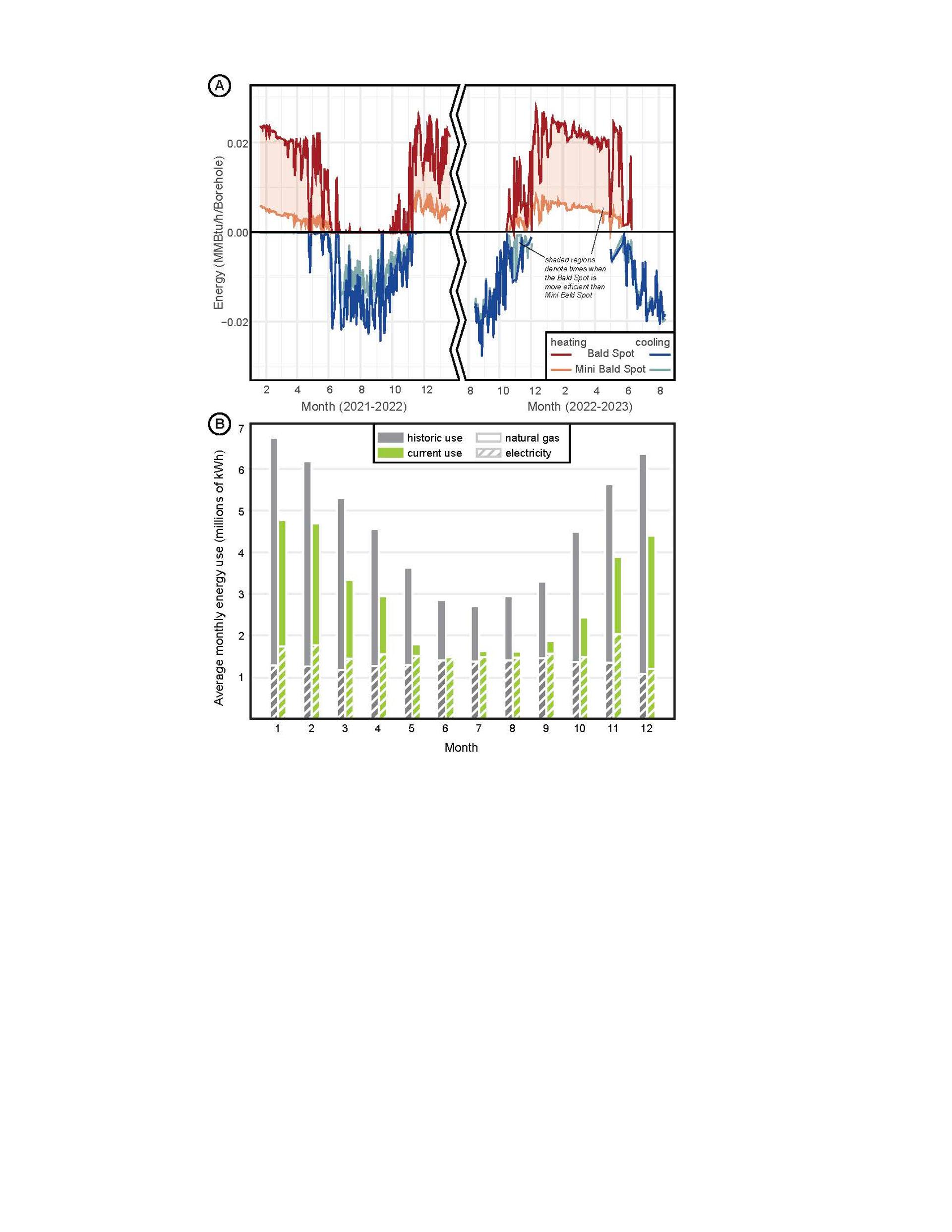
(A) Average energy flux per borehole in the Bald Spot and Mini Bald Spot fields. Energy flux in the Bald Spot field is higher magnitude than that in the Mini Bald Spot field, suggesting that the Bald Spot field is more efficient. (B) Campus energy use by source pre– and post–geothermal system. The geothermal system significantly reduced natural gas use as well as overall energy consumption.
Discussion
Pea-Gravel Effectiveness
We determined the relative efficiency of the Bald Spot and Mini Bald Spot fields by using the borehole fluid flow rate, outflow temperature, and return flow temperature for each field to calculate the total thermal energy flux in millions of British thermal units (BTUs) per hour.
The Bald Spot field provides more heating and cooling energy throughout the year compared to the Mini Bald Spot field, even when normalized by the number of bores in each field (Fig. 4A). In heating mode, the Bald Spot field boreholes provide more energy compared to the Mini Bald Spot field, as illustrated by a larger (more positive) heat flux per borehole. In cooling mode, the system pushes more thermal energy into the Bald Spot field from buildings, illustrated by consistently larger (more negative) heat flux per borehole, although the difference between the two fields is less pronounced than in winter. Normalizing the heat flux by borefield surface area or volume produces similar patterns. These data suggest that filling boreholes with pea gravel in intervals of high groundwater flow velocity can increase borefield thermal exchange efficiency, thereby improving system performance.
Overall System Performance
The geothermal system has significantly reduced overall campus energy consumption, though the data are somewhat complicated by the coronavirus disease 2019 (COVID-19) pandemic (Fig. 4B). For the five years before the system was operational (2014–2018), the average annual campus energy consumption (natural gas and electricity) was ~54.2 million kWh/yr. In 2022, the first full calendar year in which campus occupancy returned to pre-pandemic levels, total energy consumption was ~34.8 million kWh, representing a 36% reduction. This reduction occurred entirely in natural gas usage, which decreased by ~58%. This is significant because, while natural gas consumption directly and unavoidably contributes to greenhouse gas emissions, electricity can be sourced from a variety of low-carbon sources (wind, solar, etc.).
The geothermal system was projected to reduce energy use by 45%. The 10% difference between projected and actual reduction could be related, in part, to higher heating, ventilation, and air conditioning (HVAC) requirements since the pandemic, which we estimate have caused a 5%–7% increase in electricity consumption. Circulating fluid through the heat exchange system has also increased electricity consumption, and total building square footage has increased slightly over time.
What Happens to the Ground Temperature Over Time?
The system was originally modeled to act as a battery, storing thermal energy during the summer for use during the winter, rather than as a sink, where groundwater flow rapidly transmits thermal energy away from the boreholes. Our temperature data show features consistent with both possible scenarios.
Battery-like behavior is suggested by the slight increase in winter ground temperatures over time (Fig. 3) as well as the seasonal asymmetry of the downhole temperature profiles, where winter deviations from baseline temperature are smaller than those in summer (Fig. 2). We initially interpreted these data as reflecting a slowly warming borefield, acting as a battery somewhat unbalanced between winter and summer. However, conversations with the system managers revealed more complexity: The fluid temperature in the boreholes consistently approaches the freeze-protection cutoff threshold in the winter, at which point individual compressors are shut down, and boilers generate heat instead (Rob Hanson, 2023, personal commun.). This allows the subsurface temperature to recover toward the pre-operational mean, making it difficult to interpret year-to-year winter temperature trends.
Sink-like behavior is supported by the pinch points, which demonstrate the importance of groundwater flow along fractures across all time scales (Fig. 2). Groundwater flow could also explain why the system is less efficient than projected. The flow rate appears to be rapid enough, on a seasonal time scale, to remove the heat added to the ground in summer before the start of winter, making the borefield a bad battery. On a daily or hourly time scale in the winter, however, flow is too slow to bring in enough heat to keep the boreholes above the freezing shut-off temperature. The system’s capacity to absorb heat is therefore much larger than its capacity to provide heat, making it only a moderately efficient sink.
Communities considering geothermal heat pump systems have been concerned about a long-term subsurface warming trend limiting the long-term efficiency of the system (Li et al., 2009; Florea et al., 2017). Because of groundwater flow and winter shutoffs, we cannot identify any evidence of this trend at Carleton.
Advice for New District-Scale Systems
If your institution is considering installing a geothermal borefield, this may be an opportunity to set up a monitoring system to study borefield efficacy and scientific questions specific to your location, such as our pea-gravel experiment. Our advice is based on what we did well and what we wish had been possible:
- Collect baseline data about groundwater flow and the subsurface prior to construction. Monitoring wells outside the planned borefield, located up and down the groundwater hydraulic gradient, are ideal. These wells can be used for later experiments, such as hot fluid injection to observe groundwater and heat flow through the borefield (if paired with multiple DTS-instrumented boreholes).
- Install a temperature measurement system in a borehole separate from those used for the geothermal system (e.g., a monitoring well) to make data interpretation simpler. Collect geophysical measurements from this borehole, which can then be compared directly to DTS observations. Collect temperature information prior to system initiation.
- Create an accurate three-dimensional map for the geothermal working fluid pipes, borehole locations, and, if relevant, DTS cables. Take and annotate photographs.
- Be involved during drilling. Collect geophysical measurements from multiple wells including caliper logs, gamma logs, conductivity, and salinity. If possible, coordinate with your local geologic survey. Collect cuttings from wells, which can be excellent teaching resources for curriculum about the borefield. Record the specifics of borehole construction and fill.
- Consider groundwater flow when predicting the system’s efficiency. Monitoring wells set up prior to construction could inform the system design. Modeling might help to ensure, for example, that the groundwater flow rate is appropriate for the desired system behavior (battery vs. sink).
- Create (or require the installers to create) a system for read-only access to campus energy information. Useful parameters include the temperature, pressure, and flow rate of the borehole fluid as it enters and exits each borefield.
Acknowledgments
We thank Carleton geology majors who worked on this project: Natasha Dietz (2018), Emma Link (2019), Taiyi Wang (2019), Lorrine Byrne (2021), Jake Gallant (2021), Nhan Lee (2021), and Allegra Johnson McKee (2022). Instrumentation funding came from MEP Associates/Salas O’Brien, the Minnesota Ground Water Foundation, George D. (1989) and Amy Taylor Rhyneer (1990), Rob Alexander (1983), and both the Geology Department and the Dean of the College Office at Carleton College. We thank Tony Runkel, Julia Steenberg, and Andrew Retzler from the Minnesota Geologic Survey for helpful conversations about local geology. Finally, we thank Rob Hanson, Mitch Miller, and Jeff Mason at Carleton Facilities Management for their patient and helpful explanations of system operations and data.
References
- Briggs, M.A., Lautz, L.K., Buckley, S.F., and Lane, J.W., 2014, Practical limitations on the use of diurnal temperature signals to quantify groundwater upwelling: Journal of Hydrology (Amsterdam), v. 519, p. 1739–1751, https://doi.org/10.1016/j.jhydrol.2014.09.030.
- Carson, J., 1961, Soil Temperature and Weather Conditions: Argonne National Laboratory Atomic Energy Commission (AEC) Research and Development Report Meteorology ANL-6470, 244 p., https://www.osti.gov/servlets/purl/4793057.
- Epstein, C.M., and Sowers, L.S., 2006, The continued warming of the Stockton geothermal field, in Proceedings of ECOSTOCK 2006, the Tenth International Conference on Thermal Energy Storage: Galloway, New Jersey, The Richard Stockton College of New Jersey.
- Florea, L., Hart, D., Tinjum, J., and Choi, C., 2017, Potential impacts to groundwater from ground-coupled geothermal heat pumps in district scale: Groundwater, v. 55, p. 8–9, https://doi.org/10.1111/gwat.12484.
- Helmke, M.F., Wilson, J.A., Gatlin, D.C., and Moore, K.O., 2016, Thermogeologic performance of a large-scale, district geoexchange system in southeast Pennsylvania, in Osinski, G.R., and Kring, D.A., eds., Geothermal Energy: An Important Resource: Geological Society of America Special Paper 519, p. 43–50, https://doi.org/10.1130/2016.2519(03).
- Lapham, W., 1989, Use of Temperature Profiles Beneath Streams to Determine Rates of Vertical Groundwater Flow and Vertical Hydraulic Conductivity: U.S. Geological Survey Water-Supply Paper 2337, 35 p., https://doi.org/10.3133/wsp2337.
- Li, S., Yang, W., and Zhang, X., 2009, Soil temperature distribution around a U-tube heat exchanger in a multi-function ground source heat pump system: Applied Thermal Engineering, v. 29, p. 3679–3686, https://doi.org/10.1016/j.applthermaleng.2009.06.025.
- Liu, X., Ho, J., Winick, J., Porse, S., Lian, J., Wang, X., Liu, W., Malhotra, M., Li, Y., and Anand, J., 2023, Grid Cost and Total Emissions Reductions Through Mass Deployment of Geothermal Heat Pumps for Building Heating and Cooling Electrification in the United States: Oak Ridge National Laboratory Report ORNL/TM-2023/2966, 101 p., https://info.ornl.gov/sites/publications/Files/Pub196793.pdf.
- McDaniel, A., Fratta, D., Tinjum, J.M., and Hart, D.J., 2018, Long-term district-scale geothermal exchange borefield monitoring with fiber optic distributed temperature sensing: Geothermics, v. 72, p. 193–204, https://doi.org/10.1016/j.geothermics.2017.11.008.
- Minnesota Department of Natural Resources, 2023, Average Temperature for Rice County, MN, 1985 to 2023: Minnesota Climate Explorer, https://arcgis.dnr.state.mn.us/climateexplorer/main/historical (accessed December 2023).
- Minnesota Department of Natural Resources, 2025, Create a Minnesota Climate Summary Table: https://www.dnr.state.mn.us/climate/historical/summary.html (accessed September 2025).
- Monschauer, Y., Delmastro, C., and Martinez-Gordon, R., 2023, Global heat pump sales continue double-digit growth: International Energy Agency Global Energy Transitions Stocktake, https://www.iea.org/commentaries/global-heat-pump-sales-continue-double-digit-growth (accessed March 2024).
- Runkel, A.C., Tipping, R.G., Alexander, E.C., and Green, J.A., 2003, Hydrogeology of the Paleozoic Bedrock in Southeastern Minnesota: Minnesota Geological Survey Report of Investigations MGS RI-61, 105 p., https://conservancy.umn.edu/handle/11299/58813.
- Runkel, A.C., Tipping, R.G., Alexander, E.C., Jr., and Alexander, S.C., 2006, Hydrostratigraphic characterization of intergranular and secondary porosity in part of the Cambrian sandstone aquifer system of the cratonic interior of North America: Improving predictability of hydrogeologic properties: Sedimentary Geology, v. 184, p. 281–304, https://doi.org/10.1016/j.sedgeo.2005.11.006.
- Rybach, L., 2022, Global status, development and prospects of shallow and deep geothermal energy: International Journal of Terrestrial Heat Flow and Applied Geothermics, v. 5, p. 20–25, https://doi.org/10.31214/ijthfa.v5i1.79.
- Siliski, A., Florea, L., Dowling, C., Neumann, K., Samuelson, A., and Dunn, M., 2016, Petrographic and hydrogeologic investigations for a district-scale ground-coupled heat pump—Ball State University, Indiana, in Osinski, G.R., and Kring, D.A., eds., Geothermal Energy: An Important Resource: Geological Society of America Special Paper 519, p. 51–66, https://doi.org/10.1130/2016.2519(04).
- Tipping, R.G., Runkel, A.C., Alexander, E.C., Jr., Alexander, S.C., and Green, J.A., 2006, Evidence for hydraulic heterogeneity and anisotropy in the mostly carbonate Prairie du Chien Group, southeastern Minnesota, USA: Sedimentary Geology, v. 184, p. 305–330, https://doi.org/10.1016/j.sedgeo.2005.11.007.
- Vinther Pedersen, S., 2020, Heat pumps in district heating and cooling systems: International Energy Agency Technology Collaboration Programme Report HPT-AN47-SUM, https://heatpumpingtechnologies.org/annex47/.