Broadening Participation in the Geosciences: Insights and Recommendations from Recent Efforts Focusing on Transfer Students in Oregon
Shanaka de Silva et al.
In this article
Authors
Shanaka de Silva
College of Earth, Ocean, and Atmospheric Sciences, Oregon State University, Corvallis, Oregon 97331, USA
Deron Carter
Department of Physical Sciences, Linn-Benton Community College, Albany, Oregon 97321, USA
Susan Eriksson
Eriksson and Associates, Davis, California 95618, USA
Eduardo Guerrero
College of Earth, Ocean, and Atmospheric Sciences, Oregon State University, Corvallis, Oregon 97331, USA; Department of Geology and Mineral Industries, Portland, Oregon 97232, USA
Lynette de Silva
College of Earth, Ocean, and Atmospheric Sciences, Oregon State University, Corvallis, Oregon 97331, USA
Robert Duncan
College of Earth, Ocean, and Atmospheric Sciences, Oregon State University, Corvallis, Oregon 97331, USA
Dawn Wright
College of Earth, Ocean, and Atmospheric Sciences, Oregon State University, Corvallis, Oregon 97331, USA; Environmental Systems Research Institute (ESRI), Redlands, California 92373, USA
*desilvsh@oregonstate.edu
CITATION: de Silva, S., et al., 2025, Broadening participation in the geosciences: Insights and recommendations from recent efforts focusing on transfer students in Oregon: GSA Today, v. 35, p. 26–28, https://doi.org/10.1130/GSATG620GW.1.
© 2025 The Authors. Gold Open Access: This paper is published under the terms of the CC-BY-NC license. Printed in USA.
Introduction
Underrepresentation of minority groups in science, technology, engineering, and mathematics (STEM) fields, particularly in the geosciences, remains a systemic issue in the United States, resulting in low college enrollment and workforce representation (Bernard and Cooperdock, 2018; Dutt, 2020). Addressing this issue is critical for a workforce that reflects the population and enhances economic competitiveness and fosters innovation. Two-year colleges (2YCs) have diverse student populations (AACC, 2024) who are critical to the geosciences pipeline, as transfer students constitute ~27% of geoscience degree earners (Wilson, 2018). However, this can be improved since many 2YC students drop out of the pipeline because of the significant challenges faced by first-generation college attendees, single parents, and those balancing work and education, and they often experience delayed graduation rates (Wolfe, 2018).
Mentored, paid research internships are key strategies for engaging transfer students and enhancing their success (Blake et al., 2013; Hodder et al., 2015; Karsten, 2019; Di Leonardo et al., 2022). At Oregon State University, a four-year college/university (4YCU), 46% of geoscience majors from 2010 to 2020 were transfer students. During this period, two programs in Oregon funded by the U.S. National Science Foundation (NSF)—Increasing Diversity in Earth Sciences (IDES) and Linn-Benton–Oregon State Geobridge—sought to enhance the success of some of these students, thereby contributing to broadened participation in the geosciences. Herein, we share our approach and outcomes and offer insights and recommendations as a community resource.
The Programs
Our programs used holistic application evaluations and were intentionally designed to recruit participants who were potentially “at risk” due to challenges such as financial insecurity, family commitments, and the academic and social disorientation known as “transfer shock” (Thurmond, 2007).
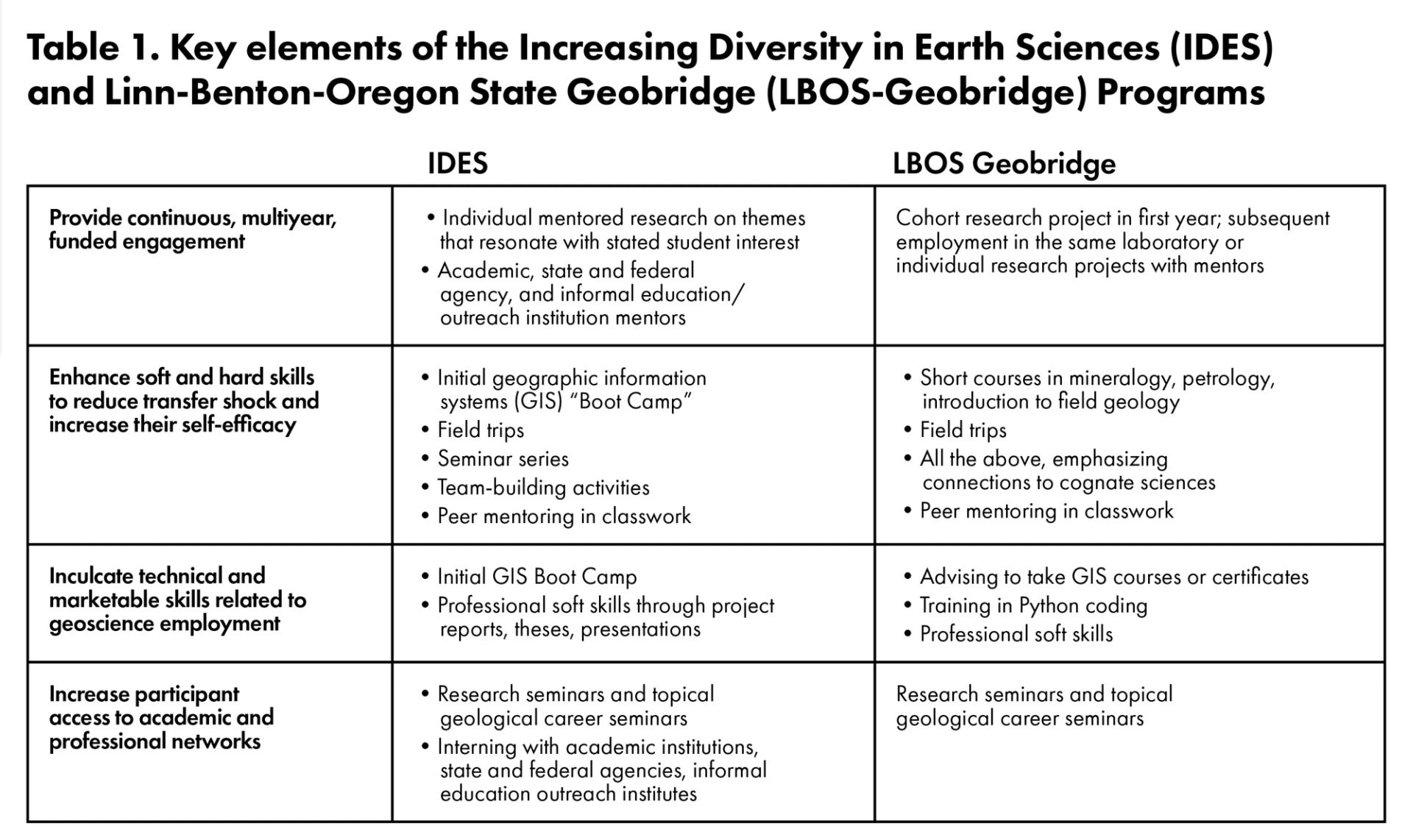
IDES and Geobridge programming (Table 1) emphasized multiyear, funded engagement to provide stability and reduce financial pressures. To help students build confidence and self-efficacy in the geosciences, the program offered focused training to develop both soft and hard skills as well as technical and marketable skills for future geoscience careers, while also expanding their academic and professional networks. Peer-mentoring and team-building activities were central efforts to fostering a sense of community, addressing the isolation many transfer students experience.
IDES, operating from 2010 to 2013 at Oregon State University, brought together two- and four-year colleges, government agencies, and outreach centers. It introduced participants to geospatial tools for exploring earth science topics and then provided two-year, individual mentored research experiences. The program recruited 41 students, 83% of whom were from underrepresented groups. Nearly 60% were female, and 47% identified as ethnic minorities. The participants’ pre-entry grade point averages (GPAs) ranged from 2.5 to 4.0, reflecting a wide range of academic backgrounds.
Building on IDES, from 2016 to 2019, Geobridge connected Linn-Benton Community College (LBCC) students to Oregon State University (OSU) through extracurricular activities to ease the transition. Cohorts worked on place-based group research projects. Participants included veterans, first-generation college students, individuals re-entering higher education, and students with disabilities. Of this diverse group, 15% were underrepresented minorities, 61% were female, and pre-entry GPAs ranged from 2.5 to 4.0.
Table 1
Outcomes
Evaluation through a mixed-method approach revealed the value of tailored, supportive approaches in addressing the needs of transfer students. In both programs, students excelled in gateway geology courses, surpassing the course average, and participants reported feeling better prepared and less disoriented upon transfer, contributing to their success in subsequent courses. In IDES, 83% of participants completed two or more years in the program, with 30 (73%) graduating with a bachelor of science (B.S.) degree within 2.5 yr. In the Geobridge program, 11 of 13 students completed two years in the program, with 7 (54%) eventually earning their B.S. degree.
In both programs, long-term research experiences improved participants’ career outlook. The continuity provided by multiyear funding provided deeper mentoring, enhanced research skills, and increased academic success. Many participants expressed heightened aspirations for graduate school and research careers, with experiences solidifying their academic interests and competitiveness. Likewise, 21 (57%) of the participants are known to have continued in earth science after obtaining their B.S. degree.
The programs strengthened students’ self-efficacy in geoscience. By introducing students to OSU faculty and peers before transferring, they developed a stronger sense of belonging, increasing their likelihood of persistence in the geoscience major. All participants reported increased confidence and clearer career pathways. Mentors recognized the value of including transfer students in research, noting their significant contributions. This led to a broader understanding of the need for inclusive recruitment, beyond traditional metrics.
The impact of IDES and Geobridge extended to the culture at both institutions, LBCC and OSU. Faculty collaboration on grant writing and program development enhanced support for transfer students. These efforts influenced OSU’s initiatives, with core elements incorporated into new programs like OSU STEM Leaders (https://stemleaders.oregonstate.edu/) and the ARC-Learn project (https://ceoas.oregonstate.edu/arc-learn).
Insights and Recommendations
IDES and Geobridge demonstrated how partnerships between 2YCs and 4YCUs can support transfer students in geosciences, providing a supportive community and strategies to help students navigate transfer shock and succeed academically (e.g., Hodder et al., 2015). We found that:
- Successful partnerships require significant investments of time and resources from both institutions, along with strong transfer agreements to ease credit transfers and lower systemic barriers.
- Collaboration between 2YC and 4YCU geoscience departments is crucial for curriculum development, advising, and fostering relationships.
- Involving geoscience employers and nonacademic institutions, such as museums and K–12 schools, exposes students to diverse career paths and professional networks, aiding their workforce transition.
- Research experiences should be tailored to meet the particular needs of transfer students. Offering local or remote participation options, along with stipends, can help to address these challenges.
- Adequate funding is vital for these programs’ success, particularly for multiyear engagements. Students often lack the resources to cover program costs and need full financial support. Funding can come from external sources, institutional support, and/or private philanthropy.
- Sustainability is a key challenge. Whereas partnerships can help to sustain efforts, continued hard support is essential once external funding ends. Embedding these initiatives into the culture and strategic plans of institutions, and incentivizing faculty involvement, is crucial for ensuring long-term success.
We hope this contribution may be useful to others seeking to foster collaborations between 2YC and 4YCU geoscience programs (SAGE, 2020) and broaden participation in geosciences as well as other STEM and non-STEM fields.
Acknowledgments
National Science Foundation awards GEO 0914707 and DUE:IUSE 1600403 provided core funding. The leadership and colleagues at Oregon State University, Portland State University, Linn-Benton Community College, Portland Community College, and Chemeketa Community College are greatly appreciated for their collaboration and support. Student support from the Oregon Space Grant Consortium and our many partner organizations was crucial. This work owes much to the generosity and collegiality of the many mentors.
References
- American Association of Community Colleges (AACC), 2024, Fast Facts 2024: Washington, D.C., American Association of Community Colleges, https://www.aacc.nche.edu/research-trends/fast-facts/ (accessed January 2025).
- Bernard, R.E., and Cooperdock, E.H.G., 2018, No progress in diversity in 40 years: Nature Geoscience, v. 11, p. 292–295, https://doi.org/10.1038/s41561-018-0116-6.
- Blake, R.A., Liou-Mark, J., and Chukuigwe, C., 2013, An effective model for enhancing underrepresented minority participation and success in geoscience undergraduate research: Journal of Geoscience Education, v. 61, no. 4, p. 405–414, https://doi.org/10.5408/12-417.1.
- Dileonardo, C., James, B.R., Ferandez, D., and Carter, D., 2022, Supporting transfer students in the geosciences from two-year colleges to university programs: New Directions for Community Colleges, v. 2022, p. 107–118, https://doi.org/10.1002/cc.20527.
- Dutt, K., 2020, Race and racism in the geosciences: Nature Geoscience, v. 13, p. 2–3, https://doi.org/10.1038/s41561-019-0519-z.
- Hodder, J., Macdonald, R., and Apple, J., 2015, Two- and four-year colleges team up to support science students: Eos (Washington, D.C.), v. 96, https://doi.org/10.1029/2015EO022645.
- Karsten, J., 2019, Insights from the OEDG program on broadening participation in the geosciences: Journal of Geoscience Education, v. 67, no. 4, p. 287–299, https://doi.org/10.1080/10899995.2019.1565982.
- SAGE, 2020, Supporting 2YC-4YC&U Transfer: Supporting and Advancing Geoscience Education at Two-Year Colleges (SAGE 2YC), https://serc.carleton.edu/sage2yc/synthesis/transfer/index.html (accessed 31 January 2025).
- Thurmond, K.C., 2007, Transfer Shock: Why Is a Term Forty Years Old Still Relevant? Retrieved from NACADA Clearinghouse of Academic Advising Resources, https://nacada.ksu.edu/Resources/Clearinghouse/View-Articles/Dealing-with-transfer-shock.aspx (accessed December 2024).
- Wilson, C., 2018, Status of Recent Geoscience Graduates 2017: Alexandria, Virginia, American Geosciences Institute, 50 p.
- Wolfe, B.A., 2018, Introductory geosciences at the two-year college: Factors that influence student transfer intent with geoscience degree aspirations: Journal of Geoscience Education, v. 66, no. 1, p. 36–54, https://doi.org/10.1080/10899995.2018.1411740.