
Science Has No Borders: A Journey from Rural China to International Geoscience
Hailiang Dong
In this article
Figure 1
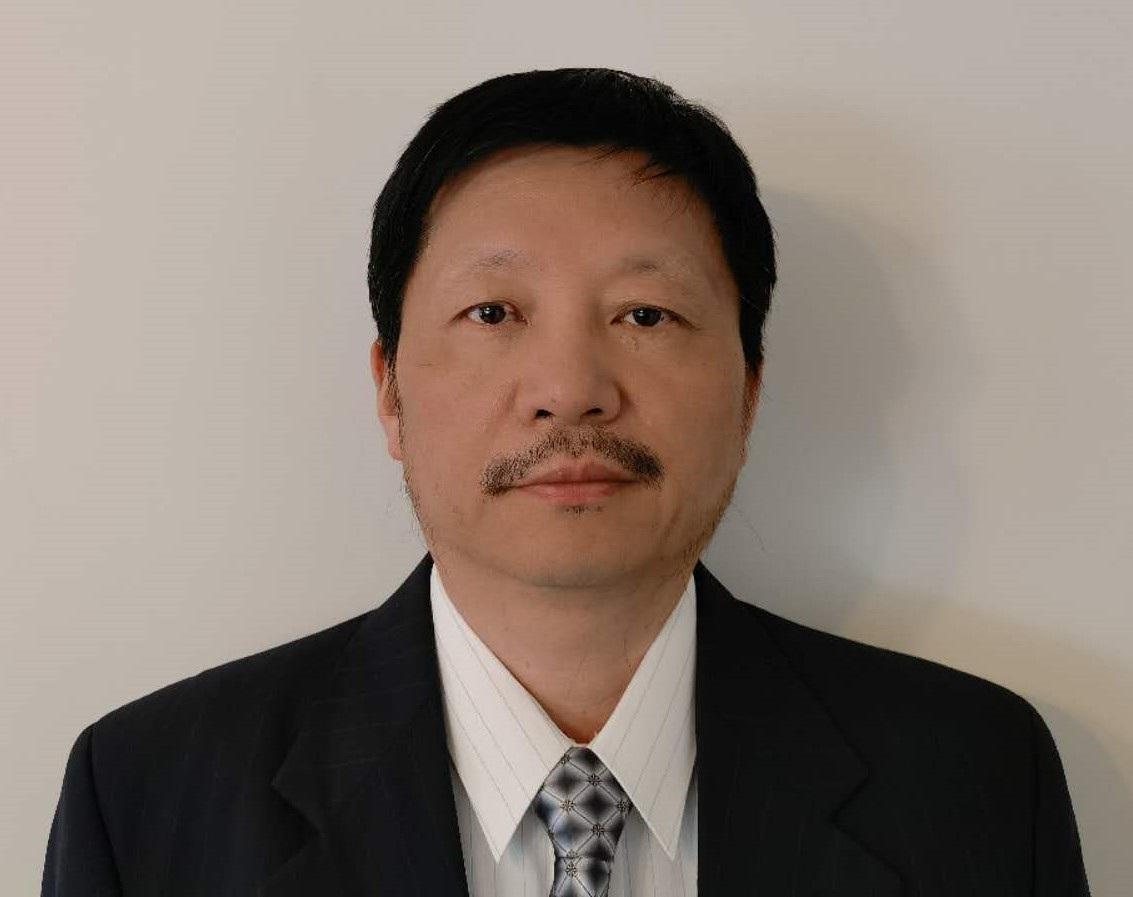
Hailiang Dong, 2025 GSA Day Medalist.
Prof. Hailiang Dong, China University of Geosciences–Beijing, 2025 Arthur L. Day Medal Awardee
When I was growing up in a small town near Ningbo City, Zhejiang Province, China, I never dreamed of becoming a scientist in the United States. As a child of three in a farmer’s family, I, like many kids of my age, stopped education after high school. Because of my low family income, I started working in a silk manufacturing factory at the age of 17. However, based on my previous college entrance examination score, I was offered an opportunity to study at a night school. That was a tough year because I was working full time and studying part time. Many times, I was working at night (night shift) while studying at the same time in a noisy environment. Through persistence and diligence, in 1984 I was admitted to Wuhan College of Geology, which was later renamed China University of Geosciences (Wuhan).
My major was mineralogy and petrology. I truly appreciated the rare opportunity to study on a college campus and spent most of my time in classrooms and libraries. Fascinated by the beautiful colors and amazing physical/chemical properties of minerals, I continued my master’s degree at China University of Geosciences (Beijing) under the mentorship of mineralogist Zhaolu Pan, where I studied the spectroscopic properties of beryls and used heat treatment to improve their gem quality. In 1990, I was fortunate to meet a visiting professor from the University of Minnesota, Tibor Zoltai. During his week-long visit, I served as an English translator for his lectures and personal conversations. That unexpected experience opened my eyes and taught me the importance of communication and cultural exchange. Prof. Zoltai encouraged me to pursue a PhD in the U.S. After much consideration, I chose the University of Michigan for my PhD.
Figure 2
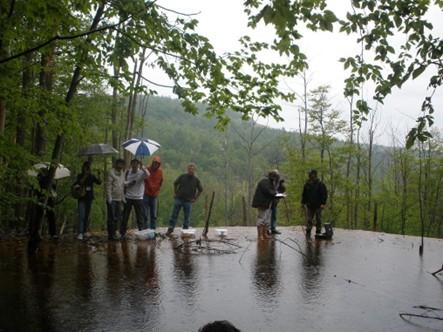
Water quality measurement during a visit to acid mine drainage near State College, Pennsylvania, USA, 2010, as part of the second China-U.S. geomicrobiology workshop.
I arrived in the town of Ann Arbor in August 1992. It was a cultural shock for someone like me who had never travelled overseas. But I was pretty quick adapting to it, thanks to my prior communication skills. Academically, I was lucky enough to have three advisors: Don Peacor, Alex Halliday, and Chris Hall. Don introduced me to the field of clay mineralogy and the wonderful tool of transmission electron microscopy, an essential technique that I am still using today. At the same time, Chris and Alex introduced me to radiogenic isotope geochemistry, first on Rb/Sr and Sm/Nd isotopes, and subsequently on 40Ar-39Ar dating of clay diagenesis. Again, I valued these rare opportunities and spent day and night in multiple labs. My first paper was published in Science in 1995, and in 1996, I was selected as a pre-doctoral fellow by the university. My PhD thesis was a good combination of all these research areas. It was not until 1996 that I went back to China for the first time to attend an International Geological Congress in Beijing. I only had a few days to see my parents after being away for four years, and felt the distance was indeed long.
Upon graduation from Michigan in 1997 and with five first-author papers, I was offered a postdoctoral position at Princeton University, initially to continue the 40Ar-39Ar research. However, during this time, Tullis Onstott, my postdoctoral advisor, was transitioning to geomicrobiology. Inspired by brilliant colleagues around me, I quickly became immersed in this exciting new and multidisciplinary field. Through projects such as bacterial transport and mineral-microbe interactions, I had the good fortune of working with microbiologists, geochemists, and hydrologists, from whom I greatly expanded my knowledge base. But the transition from radiogenic isotope geochemistry to geomicrobiology was not that easy.
In 2000, I accepted a faculty position at Miami University in Ohio and started my own research program. I was lucky to receive funding to acquire electron microscopes and to build molecular microbiology laboratories. My one-month visit to Pacific Northwest National Laboratory in the summer of 2001 was an eye-opening experience, as I not only established life-long relationships with top-notch scientists Jim Fredrickson, Ravi Kukkadapu, John Zachara, Chongxuan Liu, and others, but also learned essential techniques for studying mineral-microbe interactions and geomicrobiology.
In 2001, five years after my last trip, I made a second trip back to China. This time, I gave several lectures. That visit turned out to be fruitful as I re-established lost connections with my old classmates and colleagues. In the years following, I was invited to participate in a deep drilling project to look for microbes in high-pressure metamorphic rocks, a crazy idea at the time. With the help of my capable graduate students, along with meticulous lab work, we discovered microbes from deep rocks (down to a few kilometers) in 2005. Around that time, I started hosting visitors from China and other countries.
Figure 3
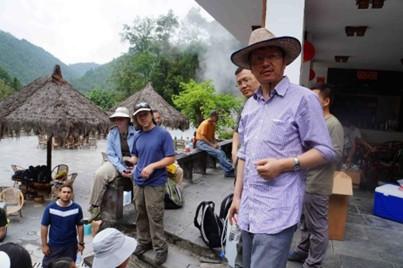
A field trip to Tengchong hot springs, sampling spring water and sediment, as well as performing in situ experiments in 2013, as part of the PIRE project.
Those early experiences strongly convinced me of the importance of international exchange and collaboration to the development of science and friendship between the two great countries. In 2007, I developed an NSF proposal to hold workshops between the U.S. and China. In 2008, I organized the first successful geomicrobiology workshop in Beijing, with emphasis on microbial life in extreme environments, followed by a field trip to Tengchong hot springs in Yunnan Province. Inspired by the great success and enthusiastic response from attendees, we subsequently organized the second workshop in 2010 at Penn State University, the third in 2012 at China University of Geosciences (Wuhan), and the fourth in 2015 at Peking University. These workshops greatly promoted research collaborations between the two countries. Over the years, I have facilitated reciprocal visits of not only scientists but also program directors of the National Science Foundations of both countries. As a result, numerous joint projects have been initiated, including a decade-long project for a Partnership for International Research and Education (PIRE) toward a holistic and global understanding of hot springs ecosystems. This project brought dozens of professors, postdocs, and students together to work in the same field and in the lab. These projects not only created academic collaborations and developed personal friendships but also promoted cultural exchange.
In the last 25 years, I have been extremely fortunate to have talented students and colleagues from both the U.S. and China who have allowed me to share the joy of their discoveries. It is through their work and enthusiasm that I developed diverse research interests, including mineral-microbe interactions, environmental remediation of organic and heavy contaminations, medical mineralogy, and life in extreme environments (subsurface, saline lakes, hot springs, desert). If there is a single most valuable thing in my career, it is the international friendship that I have helped to create and sustain.
In closing, I strongly believe that science has no borders and international collaboration is always fruitful, despite cultural challenges at times. It is a great honor for me to receive the Arthur L. Day Medal from the Geological Society of America. It is not only my personal honor, but also a recognition of all my former students, postdocs, colleagues, and visitors that I have hosted. It is their discoveries that made my academic career truly enjoyable.