
USA’s Oldest Rock? A Simple Question with a Complex Answer
Carol Frost et al.
In this article
Authors
Carol Frost
Department of Geology and Geophysics, University of Wyoming, Laramie 82071, USA
Paul Mueller
Department of Geological Sciences, University of Florida, Gainesville, Florida 32611, USA
Marion Bickford
Department of Earth and Environmental Sciences, Syracuse University, Syracuse, New York 13244, USA
Robert Stern
Department of sustainable Earth Systems Sciences, University of Texas at Dallas, Richardson, Texas 75080, USA
Abstract
Superlatives—whether tallest, longest, or fastest—are more interesting than averages. This characteristic applies to many aspects of the geosciences, where scales of time and space are beyond human experience. The deepest trench, the highest mountain, and the most expansive desert are much more interesting than average ones. Interest in superlatives also applies to the oldest rocks. In this essay, we show that the oldest rocks in the United States are 3.62–3.45 billion years old (Ga) and are found in three different states. These localities define an east-west−trending belt in the upper midcontinent that stretches ~3000 km from Wyoming through Minnesota and into the Upper Peninsula of Michigan. Complex U-Pb zircon systematics are observed in the oldest rocks from all three areas, complicating efforts to distinguish zircons that crystallized in the magma(s) that made the host rock from xenocrystic zircons incorporated by assimilating older rocks. Within these uncertainties, the oldest rock in the United States is 3.62 Ga (Eoarchean to Paleoarchean), but older, 3.8 Ga zircon-bearing felsic crust existed and may be identified by future investigations.
†M.E. Bickford passed away during preparation of this paper.
††Supplemental Material. Text S1. Analytical methods. Table S1. Zircon U-Pb isotopic data for the Watersmeet gneiss. Please visit https://doi.org/10.1130/ GSAT.S.28315214 to access the supplemental material; contact editing@geosociety.org with any questions.
CITATION: Frost, C.D., Mueller, P.A., Bickford, M.E., and Stern, R.J., 2025, USA’s oldest rock? A simple question with a complex answer: GSA Today, v. 35, p. 4–10, https://doi.org/10.1130/GSATG613A.1.
© 2025 The Authors. Gold Open Access: This paper is published under the terms of the CC-BY-NC license. Printed in USA.
Introduction
Most geoscientists are aware that Canada’s Acasta Gneiss is considered to be the oldest rock in the world (Bowring and Williams, 1999). Fewer know what is the oldest rock in the United States. In this contribution, we consider three candidates for the United States’ oldest rock (Figs. 1 and 2).
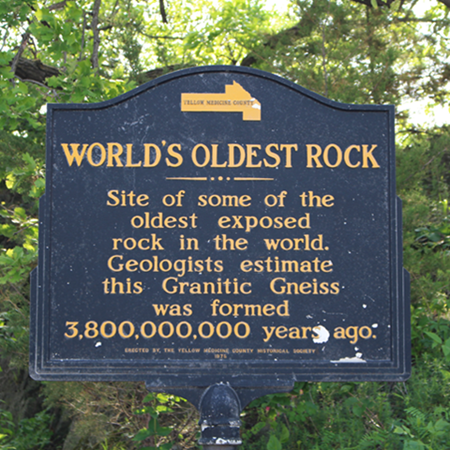
Some questions about geologic superlatives are easy to answer, but “what is the oldest rock in the USA?” is not. The 1975 vintage sign above suggests that the matter is settled, and the oldest rock in the United States, and indeed in the world, is the Morton gneiss in the Minnesota River valley. Clearly, the Morton gneiss is a rock, but as rocks go, it is a mess. A cursory look at this gneiss (Fig. 2B) makes it clear that this rock experienced a complex history involving multiple different events. How does one use radiometric dating to determine the age of a complicated rock like this? Modern geochronology of ancient rocks commonly uses the mineral zircon. However minerals are not rocks but rock constituents, and their ages do not necessarily represent when the rest of the rock formed. Can we determine when different components of a complex gneiss formed?
This contribution is aimed primarily at the scientifically literate public and students who want to learn more about old rocks and how geoscientists date them. We also made a short video on the topic, which can be found on the University of Texas at Dallas (UTD) Geoscience Studio YouTube channel (https://www.youtube.com/watch?v=-SLCzt89LRc).
Figure 1
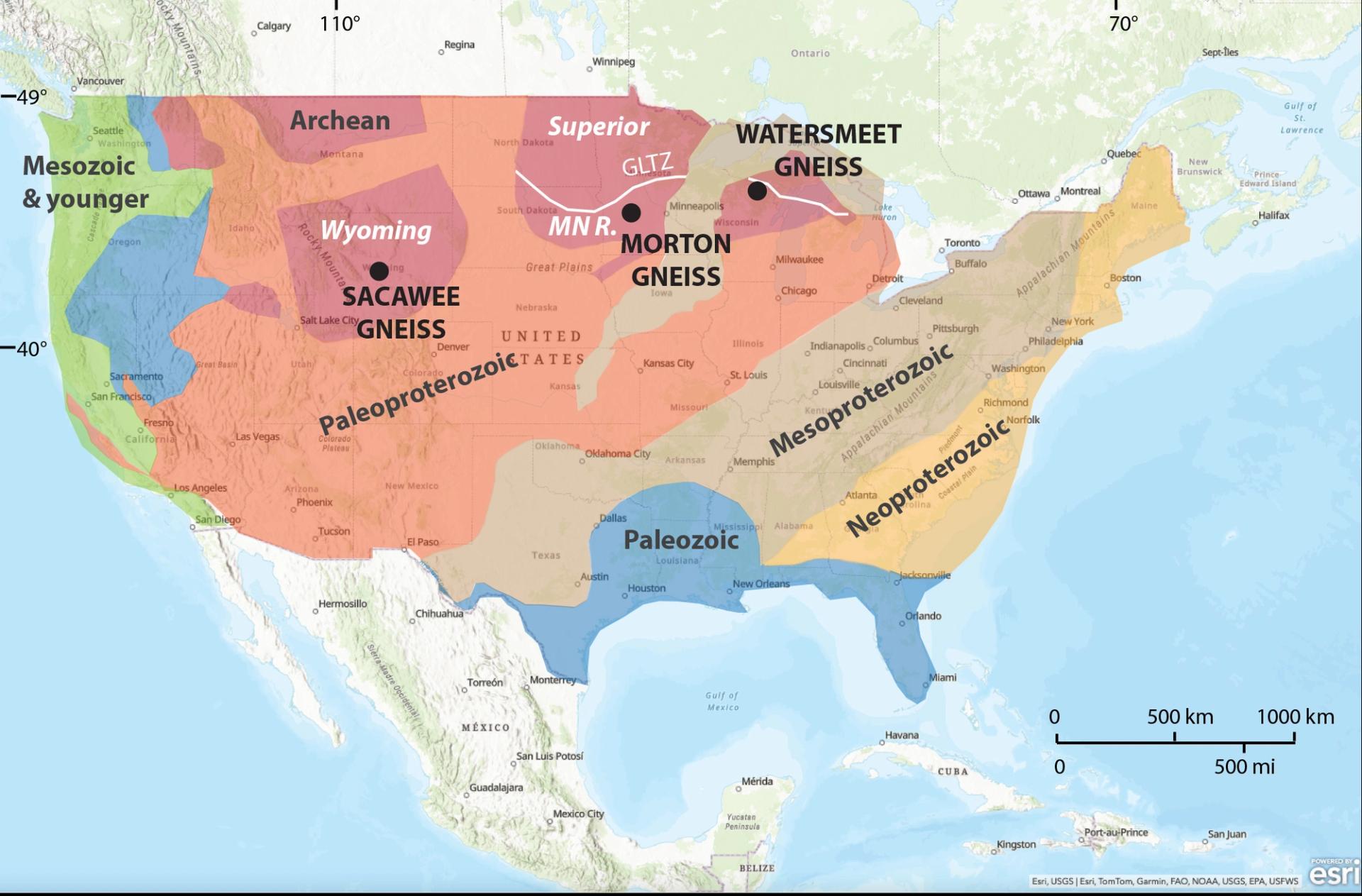
Basement map of the contiguous United States, showing locations of candidate oldest rocks discussed in this paper (modified from Lund et al., 2015), with Wyoming Province boundaries from Bedrosian and Frost (2022). GLTZ— Great Lakes tectonic zone; MN R.—Minnesota River subprovince.
Evolution of Geochronology
When the vintage sign above was erected in 1975, it was justified because some workers argued that the Morton gneiss was formed as much as 3.8 b.y. ago (Goldich and Hedge, 1974). Later research, however, suggests that the oldest igneous components in the Morton gneiss formed closer to 3.5 Ga (Bickford et al., 2006). Clearly, the age of the rock has not changed, but the accepted age changed as geochronology techniques advanced and because different radiometric methods on different minerals lock in different times and conditions. For example, early studies on the Morton and other ancient gneisses measured the K and Ar contents and Ar isotopic compositions in micas and other K-bearing minerals; this allowed Goldich et al. (1956) to estimate an age of ca. 2.4 Ga for the Morton gneiss, which we now know is much too young because these minerals lose radiogenic argon at relatively low temperatures (~300 °C; McDougall and Harrison, 1999). The science of dating rocks advanced rapidly in the last half of the twentieth century, and new techniques based on the decay of When the vintage sign above was erected in 1975, it was justified because some workers argued that the Morton gneiss was formed as much as 3.8 b.y. ago (Goldich and Hedge, 1974). Later research, however, suggests that the oldest igneous components in the Morton gneiss formed closer to 3.5 Ga (Bickford et al., 2006). Clearly, the age of the rock has not changed, but the accepted age changed as geochronology techniques advanced and because different radiometric methods on different minerals lock in different times and conditions. For example, early studies on the Morton and other ancient gneisses measured the K and Ar contents and Ar isotopic compositions in micas and other K-bearing minerals; this allowed Goldich et al. (1956) to estimate an age of ca. 2.4 Ga for the Morton gneiss, which we now know is much too young because these minerals lose radiogenic argon at relatively low temperatures (~300 °C; McDougall and Harrison, 1999). The science of dating rocks advanced rapidly in the last half of the twentieth century, and new techniques based on the decay of 87Rb to 87Sr allowed Goldich et al. (1970) to estimate an age of 3.55 Ga for whole-rock samples. These samples were collected at different spatial scales in attempts to distinguish the ages of individual components using location, color, dimensions of compositional banding, and mineralogy. However, this approach commonly yielded geologically meaningless ages (Field and Råheim, 1979) and has fallen out of use.87Rb to 87Sr allowed Goldich et al. (1970) to estimate an age of 3.55 Ga for whole-rock samples. These samples were collected at different spatial scales in attempts to distinguish the ages of individual components using location, color, dimensions of compositional banding, and mineralogy. However, this approach commonly yielded geologically meaningless ages (Field and Råheim, 1979) and has fallen out of use.
Figure 2
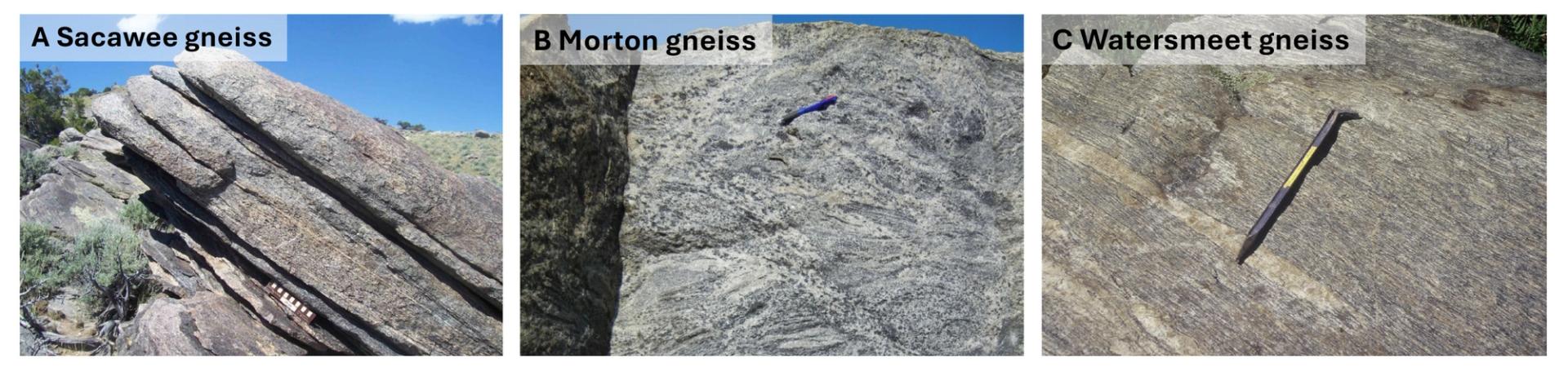
Field photographs of the candidate oldest rocks. (A) Sacawee gneiss sample 10GR2, a strongly foliated biotite trondhjemite gneiss from the Wyoming Province. Scale is 15 cm. (B) Morton gneiss from a road cut near Morton, Minnesota, in the Minnesota River valley. Pencil for scale. (C) Biotite tonalite Watersmeet gneiss from the core of the Watersmeet dome, northern Michigan. Pencil for scale. Photo credits: Images in A and B are courtesy of C. Frost; image in C is by Paul Brandes (mindat.org; Brandes, pers. comm., December 2024).
Dating zircon grains using U-Pb techniques is now celebrated as the optimal method for determining when igneous rocks formed. The decay of two isotopes of U along independent decay chains to produce different Pb isotopes means that two radiometric “clocks” are ticking in every U-bearing mineral at rates that are optimized for ancient rocks. Zircon (ZrSiO4) incorporates UDating zircon grains using U-Pb techniques is now celebrated as the optimal method for determining when igneous rocks formed. The decay of two isotopes of U along independent decay chains to produce different Pb isotopes means that two radiometric “clocks” are ticking in every U-bearing mineral at rates that are optimized for ancient rocks. Zircon (ZrSiO4) incorporates U+4 ions structurally, but the subsequent decay products do not fit in the crystal structure well. The end products of 235U and 238U decay, the Pb isotopes 207Pb and 206Pb, may leave the crystal in a process referred to as lead (Pb) loss. By comparing the ages obtained from these two chronometers, it is possible to detect processes such as Pb loss that affect age calculations. U-Pb systematics of zircons in Archean gneisses show they almost invariably experienced complex histories, including Pb loss.+4 ions structurally, but the subsequent decay products do not fit in the crystal structure well. The end products of 235U and 238U decay, the Pb isotopes 207Pb and 206Pb, may leave the crystal in a process referred to as lead (Pb) loss. By comparing the ages obtained from these two chronometers, it is possible to detect processes such as Pb loss that affect age calculations. U-Pb systematics of zircons in Archean gneisses show they almost invariably experienced complex histories, including Pb loss.
Improved laboratory protocols for determining zircon U and Pb contents and Pb isotopic compositions have enabled geochronologists to distinguish individual components of complex, migmatitic rocks such as the Morton gneiss and to determine their ages. The pioneering work of Tom Krogh (1936–2008) in the 1980s transformed zircon geochronology. Previously, the laborious procedure required separating milligram-sized groups of zircon grains followed by dissolution and chemical separation of U and Pb before analysis using a mass spectrometer. Krogh developed procedures in which zircons were distinguished by size, shape, and magnetic susceptibility, and laboratory processes by which U and Pb contents and isotopic compositions of individual grains, including physically abraded grains and parts of grains, could be measured and interpreted (Krogh, 1982a, 1982b; Davis et al., 2003). The most precise ages for ancient zircons still come from the analyses of pure fractions of U and Pb extracted from carefully selected zircon grains or parts of grains, which may have been physically abraded or chemically conditioned prior to analysis. Beginning in 1980, less precise but very useful in situ determinations of U and Pb in zircons using the secondary ion mass spectrometer (SIMS) began to supplement advancing chemical techniques (Compston, 1996). This was followed by other in situ techniques like laser ablation–inductively coupled plasma–mass spectrometry (LA-ICP-MS) and multicollector (MC) ICP-MS. U-Pb measurements of microdomains in zircons are now routinely accomplished in situ on single zircons with spot analyses as small as 5 μm (Schaltegger et al., 2015). This size is much smaller than a typical zircon, which is on the order of 100 µm (0.1 mm) long, allowing different ages to be determined in the core versus the rim of a single zircon. It is no wonder that zircon geochronology is called “the queen of geochronology” (Harley and Kelly, 2007). Regardless of the analytical particulars, U-Pb zircon geochronology remains the best way to determine ages of ancient zircons and by inference their host rocks. This reflects the unmatched physical and chemical robustness of zircon coupled with the sensitivity of the two U-Pb decay schemes. Individual zircons can survive many cycles of erosion and sedimentation, metamorphism, and partial melting. Nonetheless, not all zircons survive these events intact isotopically: Some events may add uranium, especially to zircon rims, and metamorphism causes Pb loss. The significance of ages revealed by analysis of any zircon by any method must be judged on the basis of concordance.
Concordance in zircon geochronology is when ages calculated in the Concordance in zircon geochronology is when ages calculated in the 235U-207Pb and the 238U-206Pb decay systems are identical within analytical error. These results are typically displayed on concordia diagrams (Fig. 3). The concordia curve represents the locus of all data for which the two U-Pb ages agree. Data that plot on concordia are called concordant ages, while data that fall off the curve are discordant. Discordance can range from essentially 0 to +99% and is most commonly associated with loss of radiogenic Pb from zircons; this is common when rocks were sufficiently heated by younger metamorphism. While U gain produces a mathematically identical result, it is rare. Greater discordance leads to greater age uncertainty. Discordant data are not, however, bad data; they reveal complexities in the history of these zircons, and thus in the rocks that host them. As shown in Figure 3, discordant data may define a discordia, which is a straight line connecting an array of discordant data. In coherent arrays, the intersection of a discordia with concordia can provide critical information. For example, the intersection of a well-constrained discordia with concordia yields a date equivalent to a point on the concordia diagram; these are referred to below as regressed ages. Even concordant zircon ages vary in reliability; tight groups of ages are more reliable than loose groups of ages. Geochronologists use statistical measures of the tightness of the zircon age cluster, particularly the mean square of weighted deviates (MSWD), in their interpretations. An age with a low MSWD is more reliable than one with a high MSWD. Another challenge in interpreting multiple age groupings from old, typically migmatitic, gneisses is to identify younger zircons that formed by metamorphism after the original igneous rock crystallized; these may be recognized by their low Th/U ratios (<0.1).235U-207Pb and the 238U-206Pb decay systems are identical within analytical error. These results are typically displayed on concordia diagrams (Fig. 3). The concordia curve represents the locus of all data for which the two U-Pb ages agree. Data that plot on concordia are called concordant ages, while data that fall off the curve are discordant. Discordance can range from essentially 0 to +99% and is most commonly associated with loss of radiogenic Pb from zircons; this is common when rocks were sufficiently heated by younger metamorphism. While U gain produces a mathematically identical result, it is rare. Greater discordance leads to greater age uncertainty. Discordant data are not, however, bad data; they reveal complexities in the history of these zircons, and thus in the rocks that host them. As shown in Figure 3, discordant data may define a discordia, which is a straight line connecting an array of discordant data. In coherent arrays, the intersection of a discordia with concordia can provide critical information. For example, the intersection of a well-constrained discordia with concordia yields a date equivalent to a point on the concordia diagram; these are referred to below as regressed ages. Even concordant zircon ages vary in reliability; tight groups of ages are more reliable than loose groups of ages. Geochronologists use statistical measures of the tightness of the zircon age cluster, particularly the mean square of weighted deviates (MSWD), in their interpretations. An age with a low MSWD is more reliable than one with a high MSWD. Another challenge in interpreting multiple age groupings from old, typically migmatitic, gneisses is to identify younger zircons that formed by metamorphism after the original igneous rock crystallized; these may be recognized by their low Th/U ratios (<0.1).
Figure 3
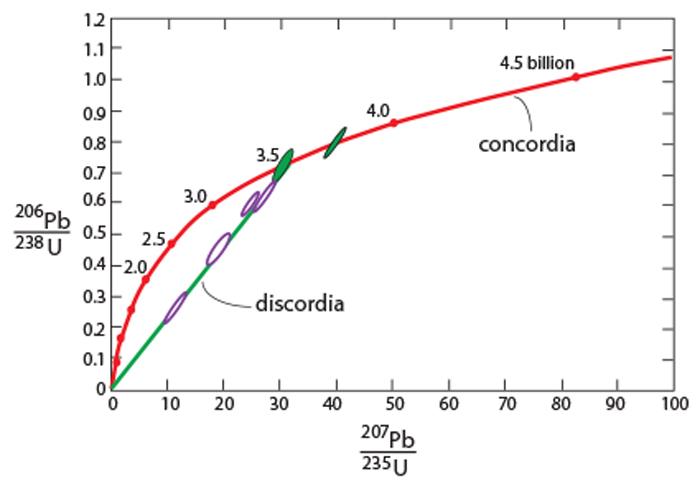
Concordia diagram, with the concordia shown as the red curve. Ages are in billions of years. Samples plotting on the concordia (green ellipses) give the same age in both the 238U/206Pb and 235U/207Pb decay systems. Arrays of discordant points (open purple ellipses) may form a chord (discordia; green line) that intersects the concordia at the crystallization age. Portions of the concordia diagram are enlarged on plots in Figure 4 to focus on the areas of the analyses.
The Candidates
Our candidates for the oldest U.S. rock are ancient gneisses with complex histories. As one might expect, these candidates do not exist in isolation but are parts of larger entities commonly referred to as age provinces, gneiss complexes, terranes, or cratons. The oldest rocks in the United States are located in the north-central part, where our three candidates are found, in (1) the Archean Wyoming Province (e.g., Condie, 1976); (2) the Minnesota River valleysubprovince of the Superior Province of the Canadian Shield (e.g., Goldich et al., 1970); and (3) the Watersmeet gneisses of the Upper Peninsula of Michigan (Peterman et al., 1980). Each of these candidates is a gneiss that was originally an igneous rock.
Wyoming Province
The Wyoming Province contains numerous indications of its antiquity (e.g., Mueller and Frost, 2006; Mogk et al., 2023). The northern part hosts ca. 3.5 Ga Paleoarchean gneiss spectacularly exposed in the rugged Beartooth Mountains and the northern Madison Range of Montana and Wyoming (Mueller et al., 1996, 2014). Detrital zircons as old as 4.0 Ga also are documented from the northern Wyoming Province (Mueller et al., 1992; Mueller and Wooden, 2012). Here, we highlight two samples of the Sacawee orthogneiss of the Granite Mountains in central Wyoming (Frost et al., 2017).
The Sacawee block comprises a narrow belt of Archean crust exposed in central Wyoming (Fig. 1; Frost et al., 2017). It is composed of quartzofeldspathic gneisses and metamorphosed mafic rocks, variably deformed and interlayered on outcrop to map scale. Gneiss protoliths were mainly biotite-bearing trondhjemites, tonalites, and granodiorites (TTG), a group of broadly granitic rocks common in the Archean (Moyen and Martin, 2012). Sacawee block gneisses are intruded to the south by 2.63–2.62 Ga granite of the Wyoming batholith and to the north by ca. 2.65 Ga foliated granite. The oldest date from the Sacawee block comes from U-Pb analyses of zircons from a strongly foliated, but compositionally homogeneous, coarse-grained biotite trondhjemite gneiss (Fig. 2A). U-Pb isotopic data from zircons using SIMS are shown in Figure 4A. A prominent grouping of 12 analyses, close to and within uncertainty of the concordia, yielded a weighted mean The Sacawee block comprises a narrow belt of Archean crust exposed in central Wyoming (Fig. 1; Frost et al., 2017). It is composed of quartzofeldspathic gneisses and metamorphosed mafic rocks, variably deformed and interlayered on outcrop to map scale. Gneiss protoliths were mainly biotite-bearing trondhjemites, tonalites, and granodiorites (TTG), a group of broadly granitic rocks common in the Archean (Moyen and Martin, 2012). Sacawee block gneisses are intruded to the south by 2.63–2.62 Ga granite of the Wyoming batholith and to the north by ca. 2.65 Ga foliated granite. The oldest date from the Sacawee block comes from U-Pb analyses of zircons from a strongly foliated, but compositionally homogeneous, coarse-grained biotite trondhjemite gneiss (Fig. 2A). U-Pb isotopic data from zircons using SIMS are shown in Figure 4A. A prominent grouping of 12 analyses, close to and within uncertainty of the concordia, yielded a weighted mean 207Pb/206Pb age of 3452 ± 3 Ma (where Ma = million years old; MSWD = 1.8), which was interpreted as the intrusive age of the granitic protolith (Frost et al., 2017). Analyses yielding slightly younger ages were interpreted as having lost Pb shortly after intrusion, and a single analysis of an older zircon suggested that this grain must have been “inherited” or entrained as the magma passed through older rocks. Clues to the identity of these older rocks were revealed in a sample of a nearby biotite tonalite gneiss. This rock contained two age populations of zircon, one group at ca. 3.4 Ga, which has been interpreted as the crystallization age, and an older group (Fig. 4B). Nine analyses of grains from this older group yielded a weighted mean 207Pb/206Pb age of 3822 ± 4 Ma (MSWD = 1.4; Frost et al., 2017). These zircons were interpreted as xenocrysts, and their age was interpreted as indicating that the protolith of the ca. 3.4 Ga gneiss intruded 3.82 Ga Eoarchean crust, although such rocks have yet to be found.207Pb/206Pb age of 3452 ± 3 Ma (where Ma = million years old; MSWD = 1.8), which was interpreted as the intrusive age of the granitic protolith (Frost et al., 2017). Analyses yielding slightly younger ages were interpreted as having lost Pb shortly after intrusion, and a single analysis of an older zircon suggested that this grain must have been “inherited” or entrained as the magma passed through older rocks. Clues to the identity of these older rocks were revealed in a sample of a nearby biotite tonalite gneiss. This rock contained two age populations of zircon, one group at ca. 3.4 Ga, which has been interpreted as the crystallization age, and an older group (Fig. 4B). Nine analyses of grains from this older group yielded a weighted mean 207Pb/206Pb age of 3822 ± 4 Ma (MSWD = 1.4; Frost et al., 2017). These zircons were interpreted as xenocrysts, and their age was interpreted as indicating that the protolith of the ca. 3.4 Ga gneiss intruded 3.82 Ga Eoarchean crust, although such rocks have yet to be found.
Minnesota River Valley
Like Wyoming Province gneisses, the ancient Morton and Montevideo gneisses of the Minnesota River valley (MRV) are dominantly tonalite, trondhjemite, and granodiorite (Bickford et al., 2006). The Minnesota River terrane is commonly described as a subprovince of the Superior Province, but it is separated from the Neoarchean (2.8–2.5 Ga) granite-greenstone belts that dominate the southern Superior Province by the Great Lakes tectonic zone (Sims et al., 1980). MRV gneisses, particularly the Morton gneiss, have been widely used as a building stone in North America (Lund, 1953, 1956).
The oldest MRV rocks have a complex history, as illustrated by a Morton gneiss sample studied by Bickford et al. (2006). A concordia diagram of SIMS U-Pb data (Fig. 4C) shows one group of zircons with a regressed age of 3516 ± 17 Ma and a second group of essentially concordant grains with a regressed age of 3360 ± 9 Ma. One concordant analysis from a rim around a ca. 3.5 Ga core yielded a concordant The oldest MRV rocks have a complex history, as illustrated by a Morton gneiss sample studied by Bickford et al. (2006). A concordia diagram of SIMS U-Pb data (Fig. 4C) shows one group of zircons with a regressed age of 3516 ± 17 Ma and a second group of essentially concordant grains with a regressed age of 3360 ± 9 Ma. One concordant analysis from a rim around a ca. 3.5 Ga core yielded a concordant 207Pb/206Pb age of 3145 ± 2 Ma, apparently reflecting zircon growth during an igneous event associated with the nearby intrusion of mafic magmas (Bickford et al., 2006). A fourth group of analyses, with a regressed age of 2595 ± 4 Ma, was obtained from rims around the 3516 Ma and 3360 Ma zircons, and this group records a Neoarchean event that affected these rocks (Fig. 4C). The zircons in the 3516 Ma group are euhedral and show well-developed oscillatory growth zones, whereas the 3360 Ma grains do not show growth zones. These relationships suggest that the Morton gneiss is an aggregate of older, ca. 3.5 Ga igneous rocks mixed with ca. 3.36 Ga igneous rocks during a deformation event 2.6 b.y. ago, which also formed young rims on the older zircons (Bickford et al., 2006).207Pb/206Pb age of 3145 ± 2 Ma, apparently reflecting zircon growth during an igneous event associated with the nearby intrusion of mafic magmas (Bickford et al., 2006). A fourth group of analyses, with a regressed age of 2595 ± 4 Ma, was obtained from rims around the 3516 Ma and 3360 Ma zircons, and this group records a Neoarchean event that affected these rocks (Fig. 4C). The zircons in the 3516 Ma group are euhedral and show well-developed oscillatory growth zones, whereas the 3360 Ma grains do not show growth zones. These relationships suggest that the Morton gneiss is an aggregate of older, ca. 3.5 Ga igneous rocks mixed with ca. 3.36 Ga igneous rocks during a deformation event 2.6 b.y. ago, which also formed young rims on the older zircons (Bickford et al., 2006).
Upper Peninsula of Michigan
An Archean gneiss terrane forms the crystalline basement in northern Wisconsin and the Upper Peninsula of Michigan (Fig. 1). Although Archean rocks form the bedrock, exposures are limited. Our candidate for the oldest rock in this terrane is the Watersmeet gneiss, exposed in the center of the 8 × 25 km Watersmeet dome. This is one of several domes that formed during and immediately after the Paleoproterozoic Penokean orogeny (ca. 1870–1830 Ma) that are cored by Archean gneissfolded with and intruded by Proterozoic rocks (Schulz and Cannon, 2007). The Watersmeet dome was deeply buried during the Penokean orogeny and now exposes the deepest crustal level in the orogen. Peterman et al. (1980) discussed the “Gneiss at Watersmeet” and estimated the tonalite gneiss to have a minimum age of 3410 Ma. Further refinement of the ages by Peterman et al. (1980) using LA-ICP-MS on zircons extracted from two of the same samples illustrated the complex history experienced by this ancient gneiss (Figs. 4D and 4E; Table S1 in the Supplemental MaterialAn Archean gneiss terrane forms the crystalline basement in northern Wisconsin and the Upper Peninsula of Michigan (Fig. 1). Although Archean rocks form the bedrock, exposures are limited. Our candidate for the oldest rock in this terrane is the Watersmeet gneiss, exposed in the center of the 8 × 25 km Watersmeet dome. This is one of several domes that formed during and immediately after the Paleoproterozoic Penokean orogeny (ca. 1870–1830 Ma) that are cored by Archean gneissfolded with and intruded by Proterozoic rocks (Schulz and Cannon, 2007). The Watersmeet dome was deeply buried during the Penokean orogeny and now exposes the deepest crustal level in the orogen. Peterman et al. (1980) discussed the “Gneiss at Watersmeet” and estimated the tonalite gneiss to have a minimum age of 3410 Ma. Further refinement of the ages by Peterman et al. (1980) using LA-ICP-MS on zircons extracted from two of the same samples illustrated the complex history experienced by this ancient gneiss (Figs. 4D and 4E; Table S1 in the Supplemental Material††). In one sample of Watersmeet tonalite gneiss, 29 of 60 analyses were <5% discordant. Those 29 analyses defined two age groups of ca. 2.64 and ca. 3.60 Ga (Fig. 4D). U-Pb ages of zircons from a second Watersmeet tonalite gneiss sample displayed substantial discordance with 207Pb/206Pb ages from 3.8 Ga to 1.3 Ga (Table S1). This discordance likely reflects Pb loss during five later igneous and metamorphic events as well as Phanerozoic uplift and erosion. Precambrian events included: (1) intrusion of the Neoarchean Carney Lake gneiss (ca. 2750 Ma; Ayuso et al., 2017, 2018); (2) crosscutting leuco-granite dikes and intrusion of the ca. 2600 Ma Puritan quartz monzonite (Peterman et al., 1980); (3) strong Penokean deformation ca. 1800 Ma (inferred from Rb-Sr whole-rock and U-Pb zircon analyses); (4) uplift of the Watersmeet dome at 1755 Ma (Peterman et al., 1980; Schneider et al., 1996); and (5) ca. 1110–1070 Ma igneous activity of the Mesoproterozoic Midcontinent Rift (Fairchild et al., 2017). Regression ages for the two aforementioned samples were 3685 ± 12 Ma and 3598 ± 12 Ma (Figs. 4D and 4E). If only the oldest, least discordant analyses are considered, weighted mean 207Pb/206Pb ages of 3623 ± 4 Ma and 3618 ± 4 Ma are obtained (see insets on Figs. 4D and 4E). Because discordance likely reflects Pb loss during later events, the least discordant analyses are considered to be the most reliable. However, because of possible early Pb loss, even these ages should be viewed as minimum ages.††). In one sample of Watersmeet tonalite gneiss, 29 of 60 analyses were <5% discordant. Those 29 analyses defined two age groups of ca. 2.64 and ca. 3.60 Ga (Fig. 4D). U-Pb ages of zircons from a second Watersmeet tonalite gneiss sample displayed substantial discordance with 207Pb/206Pb ages from 3.8 Ga to 1.3 Ga (Table S1). This discordance likely reflects Pb loss during five later igneous and metamorphic events as well as Phanerozoic uplift and erosion. Precambrian events included: (1) intrusion of the Neoarchean Carney Lake gneiss (ca. 2750 Ma; Ayuso et al., 2017, 2018); (2) crosscutting leuco-granite dikes and intrusion of the ca. 2600 Ma Puritan quartz monzonite (Peterman et al., 1980); (3) strong Penokean deformation ca. 1800 Ma (inferred from Rb-Sr whole-rock and U-Pb zircon analyses); (4) uplift of the Watersmeet dome at 1755 Ma (Peterman et al., 1980; Schneider et al., 1996); and (5) ca. 1110–1070 Ma igneous activity of the Mesoproterozoic Midcontinent Rift (Fairchild et al., 2017). Regression ages for the two aforementioned samples were 3685 ± 12 Ma and 3598 ± 12 Ma (Figs. 4D and 4E). If only the oldest, least discordant analyses are considered, weighted mean 207Pb/206Pb ages of 3623 ± 4 Ma and 3618 ± 4 Ma are obtained (see insets on Figs. 4D and 4E). Because discordance likely reflects Pb loss during later events, the least discordant analyses are considered to be the most reliable. However, because of possible early Pb loss, even these ages should be viewed as minimum ages.
Despite the multiphase history of the Watersmeet gneiss, there are indications of even older crust. Three analyses from the tonalite gneiss lie outside the error envelopes of the proposed ages and are viewed as xenocrysts derived from older crust (3822 ± 8 Ma, 3764 ± 16 Ma, and 3687 ± 9 Ma; see inset in Fig. 4E).
A similar history is preserved in the Archean Carney Lake gneiss, exposed east of the Watersmeet gneiss in northern Michigan. Like the Watersmeet gneiss, it contains concordant and discordant zircons that define regression ages of around 1000 Ma, 2750 Ma, and 3750 Ma (Ayuso et al., 2017, 2018). Detrital zircons up to ca. 3.8 Ga have been reported from Paleoproterozoic (Huronian) sedimentary rocks in the region (Craddock et al., 2013), requiring an older source rock. These data suggest that continental crust began to form in what is now the Upper Peninsula of Michigan by around 3.8 Ga, but like the 3.8 Ga crust of the Wyoming Province, the oldest crust was largely subsumed in younger magmas.
Figure 4
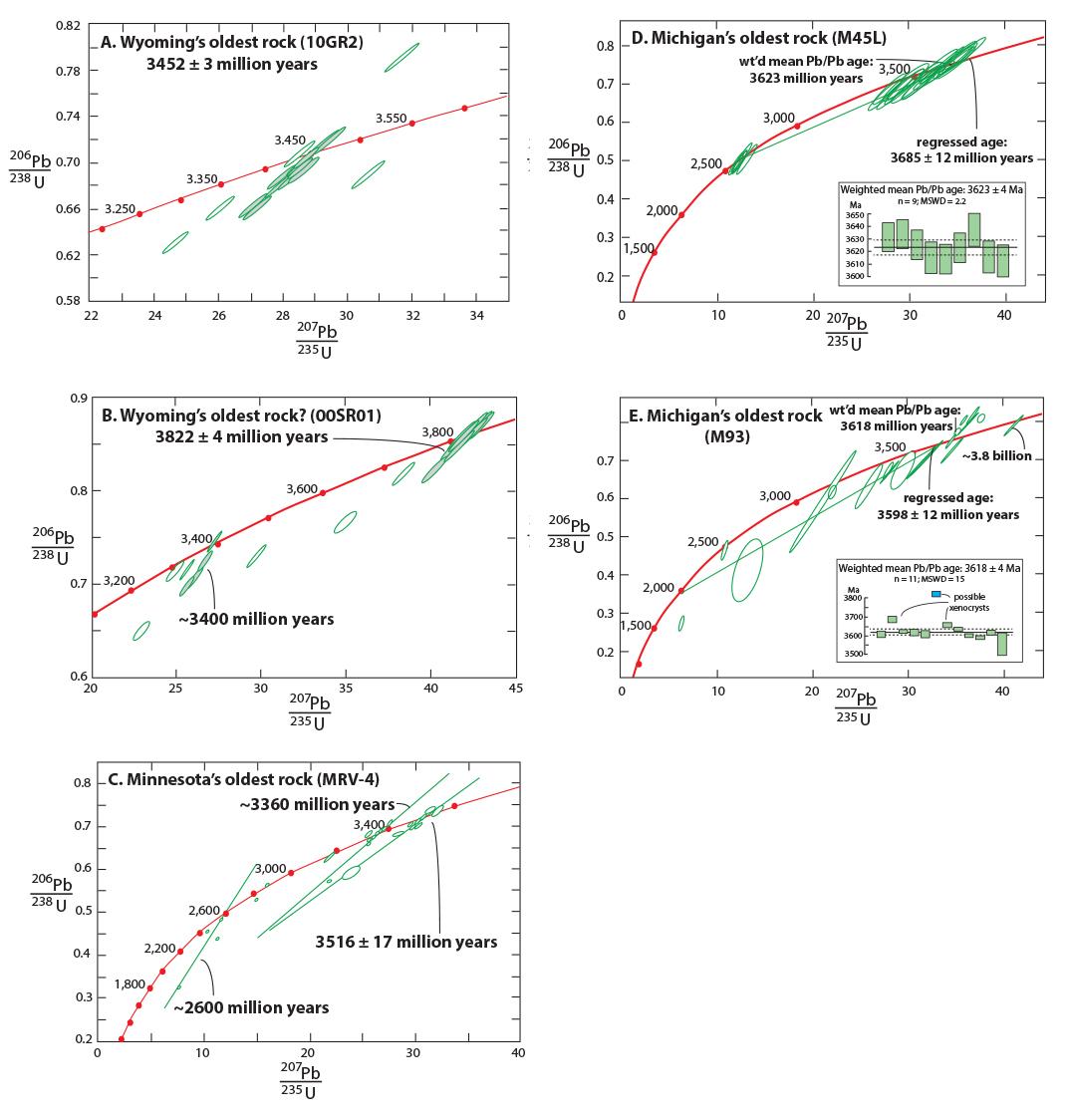
Concordia diagrams of the candidate oldest rocks in the United States. (A) Sacawee gneiss sample 10GR2 from the Wyoming Province. (B) Tonalite gneiss sample 00SR01 from the Wyoming Province, 20 km east of sample 10GR2. Data for both samples from Frost et al. (2017). (C) Morton gneiss sample MRV-4 from the Minnesota River subprovince. Data are from Bickford et al. (2006). (D) Watersmeet gneiss sample M45L. (E) Watersmeet gneiss sample M93 from northern Michigan. Samples of Watersmeet gneiss were collected by Z.E. Peterman and zircon U-Pb analyses were conducted by P.A. Mueller by laser ablation–inductively coupled plasma–mass spectrometry (LA-ICP-MS). Analytical methods and data are provided in the Supplemental Material. Many analyses are strongly discordant. Data in part D show the 29 of 60 analyses from M45L are <5% discordant (48%), and data in part E show that 20 of 80 analyses from M93 that are <10% discordant (25%). Insets show weighted mean 207Pb/206Pb ages of the oldest concordant analyses. In the case of M93 (Fig. 4E), three analyses (3822 ± 8 Ma, 3764 ± 16 Ma, and 3687 ± 9 Ma) lie outside the error envelopes of the weighted mean ages and are interpreted as xenocrysts derived from yet older crust. The 3822 Ma analysis was not included in the weighted mean age. MSWD—mean square of weighted deviates.
Discussion and Conclusions
Our interrogation of the oldest rocks in the United States and their zircons unearthed many devilish complexities. Interpretations are easy when multiple zircons give the same concordant age, but that is not the case for ancient rocks such as these. So many different zircons analyzed from each of the candidates yielded different ages. This age range is of particular concern when (1) analyzed zircons are discordant, requiring a regression age; (2) there are limited geochemical data to help define groups of discordant analyses (such as petrographic and trace-element characteristics or O and/or Hf isotopic data on the grains; e.g., Drabon et al., 2024); and (3) there is no corroborating evidence to allow younger dates to be interpreted based on the ages of “known” events in the region. Answering the apparently simple question of “Which is and where is the oldest rock in the United States?” requires an honest appraisal of various possible interpretations.
So, which is the oldest rock in the United States? Is it the Watersmeet gneiss in Michigan, which contains near-concordant groups of zircons giving ages of 3623 ± 4 and 3618 ± 4 Ma? Or is it the Wyoming Sacawee gneiss that contains 3822 ± 4 Ma zircons? We can’t be sure, but based on our analyses, we propose that the Watersmeet gneiss wins the prize for the oldest rock, at >3.6 Ga. The 3822 Ma zircons, interpreted as xenocrysts in the Sacawee gneiss, are important because they tell us about the presence of even older, Eoarchean crust. The Morton gneiss—no longer the oldest rock in the world, or in the United States—nevertheless serves as an outstanding example of how U-Pb zircon data can be used to unravel complex Archean histories from a single sample.
Moving beyond superlatives to science, it is useful to consider the implications of ~3.5-b.y.-old crust in multiple locations across the northern United States. The similar Archean histories between the southern margins of the Superior and Wyoming cratons suggest that these areas once were part of a single crustal block. Archean gneiss in northern Michigan may be part of the Minnesota River subprovince (Sims, 1980; Bickford et al., 2007). Although the Minnesota River subprovince has long been grouped with the Superior Province of Canada, its Archean geologic history has more in common with the Wyoming Province than with adjacent parts of the Superior Province (Schmitz et al., 2018). In fact, it has been proposed that the Wyoming Province lay south of the Minnesota River subprovince until ca. 2.1 Ga, when it rifted away and rotated to its present location farther west (Ernst and Bleeker, 2010). Taken together, the Archean rocks of the Wyoming-Minnesota-Michigan block represent the oldest continental crust in the United States, the nucleus around which the younger rocks of the nation were assembled. That’s a superlative worth knowing!
Acknowledgments
We dedicate this paper to the many geoscientists who made major contributions to geochronology in general and specifically to the study of America’s oldest rocks, including Samuel Goldich, Zell Peterman, andMarion “Pat” Bickford. This paper and accompanying outreach video were supported by National Science Foundation grant EAR-2042243 to C. Frost and S. Swapp. We acknowledge thoughtful reviews by Barb Dutrow and Aaron Satkoski. This is University of Texas at Dallas (UTD) geoscience contribution 1725.
References
- Ayuso, R.A., Schulz, K.J., Cannon, W.F., Woodruff, L.G., Vasquez, J.A., and Jackson, J., 2017, Evidence for the presence of Eoarchean crust in northern Michigan, in Proceedings of 63rd Annual Meeting Program and Abstracts, Part 1: St. Paul, Minnesota, Institute on Lake Superior Geology, p. 9–10.
- Ayuso, R.A., Schulz, K.J., Cannon, W.F., Woodruff, L.G., Vazquez, J.A., Foley, N.K., and Jackson, J., 2018, New U-Pb zircon ages for rocks from the granite-gneiss terrane in northern Michigan, in Proceedings of 64th Annual Meeting Program and Abstracts, Part 1: St. Paul, Minnesota, Institute on Lake Superior Geology, p. 7–8.
- Bedrosian, P.A., and Frost, C.D., 2022, Geophysical extent of the Wyoming Province: Insights into ancient subduction and craton stability: GSA Bulletin, v. 135, no. 3–4, p. 725–742, https://doi.org/10.1130/B36417.1.
- Bickford, M.E., Wooden, J.L., and Bauer, R.L., 2006, SHRIMP study of zircons from early Archean rocks in the Minnesota River valley: Implications for the tectonic history of the Superior Province: GSA Bulletin, v. 118, p. 94–108, https://doi.org/10.1130/B25741.1.
- Bickford, M.E., Wooden, J.L., Bauer, R.L., and Schmitz, M.D., 2007, Paleoarchean gneisses in the Minnesota River valley and northern Michigan, USA, in Van Kranendonk, M., Smithies, R.H., and Bennett, V.C., eds., Earth’s Oldest Rocks: Amsterdam, Netherlands, Elsevier, Developments in Precambrian Geology 15, p. 731–750, https://doi.org/10.1016/S0166-2635(07)15061-1.
- Bowring, S.A., and Williams, I.S., 1999, Priscoan (4.00–4.03 Ga) ortho-gneiss from northwestern Canada: Contributions to Mineralogy and Petrology, v. 134, p. 3–16, https://doi.org/10.1007/s004100050465.
- Compston, W., 1996, SHRIMP: Origins, impact and continuing evolution: Journal of the Royal Society of Western Australia, v. 79, p. 109– 117, https://ia801506.us.archive.org/15/items/biostor-256574/ biostor-256574.pdf.
- Condie, K.C., 1976, The Wyoming Archean Province in the western United States, in Windley, B.F., ed., The Early History of the Earth: London, Wiley, p. 499–511.
- Craddock, J.P., Rainbird, R.H., Davis, W.J., Davison, C., Vervoort, J.D., Konstantinou, A., Boerboom, T., Vorhies, S., Kerber, L., and Lundquist, B., 2013, Detrital zircon geochronology and provenance of the Paleoproterozoic Huron (approximately 2.4–2.2 Ga) and Animikie (approximately 2.2–1.8 Ga) Basins, southern Superior Province: The Journal of Geology, v. 121, p. 623–644, https://doi.org/10.1086/673265.
- Davis, D.W., Krogh, T.E., and Williams, I.S., 2003, Historical development of zircon geochronology: Reviews in Mineralogy and Geochemistry, v. 53, p. 145–181, https://doi.org/10.2113/0530145.
- Drabon, N., Kirkpatrick, H.M., Byerly, G.R., and Wooden, J.L., 2024, Trace elements in zircon record changing magmatic processes and the multi-stage build-up of Archean proto-continental crust: Geochimica et Cosmochimica Acta, v. 373, p. 136–150, https://doi.org/10.1016/j.gca.2024.03.014.
- Ernst, R., and Bleeker, W., 2010, Large igneous provinces (LIPs), giant dyke swarms, and mantle plumes: Significance for breakup events within Canada and adjacent regions from 2.5 Ga to the present: Canadian Journal of Earth Sciences, v. 47, p. 695–739, https://doi.org/10.1139/E10-025.
- Fairchild, L.M., Swanson-Hysell, N.L., Ramezani, J., Sprain, C.J., and Bowring, S.A., 2017, The end of Midcontinent rift magmatism and the paleogeography of Laurentia: Lithosphere, v. 9, p. 117–133, https://doi.org/10.1130/L580.1.
- Field, D., and Råheim, A., 1979, A geologically meaningless Rb-Sr total rock isochron: Nature, v. 282, p. 497–499, https://doi.org/10.1038/282497a0.
- Frost, C.D., McLaughlin, J.F., Frost, B.R., Fanning, C.M., Swapp, S.M., Kruckenberg, S.C., and Gonzalez, J., 2017, Hadean origins of Paleoarchean continental crust in the central Wyoming Province: GSA Bulletin, v. 129, p. 259–280, https://doi.org/10.1130/B31555.1.
- Goldich, S.S., and Hedge, C.E., 1974, 3,800-Myr granitic gneiss in south-western Minnesota: Nature, v. 252, p. 467–468, https://doi.org/10.1038/252467a0.
- Goldich, S.S., Nier, A.O., Baadsgaard, H., and Hoffman, J.H., 1956, KGoldich, S.S., Nier, A.O., Baadsgaard, H., and Hoffman, J.H., 1956, K40/ Ar40 dating of the Precambrian rocks of Minnesota [abs.], in 1956 Annual Meeting Program: New York, Geological Society of America, p. 52–53, 40/ Ar40 dating of the Precambrian rocks of Minnesota [abs.], in 1956 Annual Meeting Program: New York, Geological Society of America, p. 52–53, https://doi.org/10.1130/GSAB-67-1811.
- Goldich, S.S., Hedge, C.E., and Stern, T.W., 1970, Age of the Morton and Montevideo Gneisses and related rocks, southwestern Minnesota: GSA Bulletin, v. 81, p. 3671–3695, https://doi.org/10.1130/0016-7606(1970)81[3671:AOTMAM]2.0.CO;2.
- Harley, S.L., and Kelly, N.M., 2007, Zircon tiny but timely: Elements, v. 3, p. 13–18, https://doi.org/10.2113/gselements.3.1.13.
- Krogh, T.E., 1982a, Improved accuracy of U-Pb zircon dating by selection of more concordant fractions using a high gradient magnetic separation technique: Geochimica et Cosmochimica Acta, v. 46, p. 631–635, https://doi.org/10.1016/0016-7037(82)90164-8.
- Krogh, T.E., 1982b, Improved accuracy of U-Pb zircon ages by the creation of more concordant systems using an air abrasion technique: Geochimica et Cosmochimica Acta, v. 46, p. 637–649, https://doi.org/10.1016/0016-7037(82)90165-X.
- Lund, E.H., 1953, Morton granite gneiss: Economic Geology, v. 48, p. 46–52, https://doi.org/10.2113/gsecongeo.48.1.46.
- Lund, E.H., 1956, Igneous and metamorphic rocks of the Minnesota River valley: GSA Bulletin, v. 67, p. 1475–1490, https://doi.org/10.1130/0016-7606(1956)67[1475:IAMROT]2.0.CO;2.
- Lund, K., Box, S.E., Holm-Denoma, C.S., San Juan, C.A., Blakely, R.J., Saltus, R.W., Anderson, E.D., and DeWitt, E.H., 2015, Basement Domain Map of the Conterminous United States and Alaska: U.S. Geological Survey Data Series 898, 41 p., https://doi.org/10.3133/ ds898.
- McDougall, I., and Harrison, T.M., 1999, Geochronology and Thermochronology by the 40Ar/McDougall, I., and Harrison, T.M., 1999, Geochronology and Thermochronology by the 40Ar/39Ar Method (2nd ed.): Oxford, UK, Oxford University Press, 269 p., 39Ar Method (2nd ed.): Oxford, UK, Oxford University Press, 269 p., https://doi.org/10.1093/oso/9780195109207.001.0001.
- Mogk, D., Frost, C., Mueller, P., Frost, B., and Henry, D., 2023, Crustal genesis and evolution of the Archean Wyoming Province: Continental growth through vertical magmatic and horizontal tectonic processes, in Whitmeyer, S.J., Williams, M.L., Kellett, D.A., and Tikoff, B., eds., Laurentia: An Evolving Continent: Geological Society of America Memoir 220, p. 1–24, https://doi.org/ 10.1130/2022.1220(01).
- Moyen, J.F., and Martin, H., 2012, Forty years of TTG research: Lithos, v. 148, p. 312–336, https://doi.org/10.1016/j.lithos.2012.06.010.
- Mueller, P.A., and Frost, C.D., 2006, The Wyoming Province: A distinctive Archean craton in Laurentian North America: Canadian Journal of Earth Sciences, v. 43, p. 1391–1397, https://doi.org/10.1139/e06-075.
- Mueller, P.A., and Wooden, J.L., 2012, Trace element and Lu-Hf systematics in Hadean–Archean detrital zircons: Implications for crustal evolution: The Journal of Geology, v. 120, p. 15–29, https://doi.org/10.1086/662719.
- Mueller, P.A., Wooden, J.L., and Nutman, A.P., 1992, 3.96 Ga zircons from an Archean quartzite, Beartooth Mountains, Montana: Geology, v. 20, p. 327–330, https://doi.org/10.1130/0091-7613(1992)020%3C0327:GZFAAQ%3E2.3.CO;2.
- Mueller, P.A., Wooden, J.L., Mogk, D.W., Nutman, A.P., and Williams, I.S., 1996, Extended history of a 3.5 Ga trondhjemitic gneiss, Wyoming Province, USA: Evidence from U-Pb systematics in zircon: Precambrian Research, v. 78, p. 41–52, https://doi.org/ 10.1016/0301-9268(95)00067-4.
- Mueller, P.A., Mogk, D.W., Henry, D.J., Wooden, J.L., and Foster, D.A., 2014, The plume to plate transition: Hadean and Archean crustal evolution in the northern Wyoming Province, USA, in Dilek, Y., and Furnes, H., eds., Evolution of Archean Crust and Early Life: Berlin, Springer, p. 23–54, https://doi.org/10.1007/978-94-007-7615-9_2.
- Peterman, Z.E., Zartman, R.E., and Sims, P.K., 1980, Tonalitic gneiss of early Archean age from northern Michigan, in Morey, G.B., and Hanson, G.N., eds., Selected Studies of Archean Gneisses and Lower Proterozoic Rocks, Southern Canadian Shield: Geological Society of America Special Paper 192, p. 125–134, https://doi.org/10.1130/ SPE182-p125.
- Schaltegger, U., Schmitt, A.K., and Horstwood, M.S.A., 2015, U-Th-Pb zircon geochronology by ID-TIMS, SIMS, and laser ablation ICP-MS: Recipes, interpretations, and opportunities: Chemical Geology, v. 402, p. 89–110, https://doi.org/10.1016/j.chemgeo.2015.02.028.
- Schmitz, M.D., Southwick, D.L., Bickford, M.E., Mueller, P.A., and Samson, S.D., 2018, Neoarchean and Paleoproterozoic events in the Minnesota River valley subprovince, with implications for southern Superior craton evolution and correlation: Precambrian Research, v. 316, p. 206–226, https://doi.org/10.1016/j.precamres.2018.08.010.
- Schneider, D., Holm, D., and Lux, D., 1996, On the origin of early Proterozoic gneiss domes and metamorphic nodes, northern Michigan: Canadian Journal of Earth Sciences, v. 33, p. 1053–1063, https://doi.org/10.1139/e96-080.
- Schulz, K.J., and Cannon, W.F., 2007, The Penokean orogeny in the Lake Superior region: Precambrian Research, v. 157, p. 4–25, https://doi.org/10.1016/j.precamres.2007.02.022.
- Sims, P.K., 1980, Boundary between Archean greenstone and gneiss terranes in northern Wisconsin and Michigan, in Morey, G.B., and Hanson, G.N., eds., Selected Studies of Archean Gneisses and Lower Proterozoic Rocks, Southern Canadian Shield: Geological Society of America Special Paper 192, p. 113–124, https://doi.org/10.1130/ SPE182-p113.
- Sims, P.K., Card, K.D., Morey, G.B., and Peterman, Z.E., 1980, The Great Lakes tectonic zone—A major crustal structure in central North America: GSA Bulletin, v. 91, p. 690–698, https://doi.org/ 10.1130/0016-7606(1980)91<690:TGLTZA>2.0.CO;2.