
In this article
Authors
Ken L. Ferrier
kferrier@wisc.edu
University of Wisconsin–Madison, Department of Geoscience, Madison, Wisconsin, USA 53706
Eva M. Golos
University of Wisconsin–Madison, Department of Geoscience, Madison, Wisconsin, USA 53706
Marianne Haseloff
University of Wisconsin–Madison, Department of Geoscience, Madison, Wisconsin, USA 53706
In 2023, the Department of Geoscience at the University of Wisconsin–Madison began reviewing the curriculum requirements for its undergraduate major, motivated by ongoing discussions about the state of geoscience education and nationwide decline in enrollment (e.g., Keane, 2022; Mosher and Keane, 2021). The committee conducting the review (including this article’s authors) was charged with answering several questions, including: What gaps do our course requirements have relative to geoscience programs at other institutions? If we added new course requirements, would that put our major out of step with geoscience programs nationally?
Answering these questions first required determining how many courses (and which ones) geoscience students must take in geoscience and cognate fields (e.g., math, physics, chemistry) at peer institutions. To obtain a representative picture of these requirements, we compiled course requirements for geoscience majors at fifty R1 universities across the United States. To facilitate comparisons among programs, we restricted the compilation to majors with the name Geology or the major with the name closest to it (e.g., Geoscience, Earth Science). The resulting compilation represents a snapshot of course requirements for geoscience students at these institutions as of 2024, when the data were compiled. The data set is now publicly available, as is a methods paper describing how the data were collected (Ferrier et al., 2024a, 2024b). Here, we summarize the main observations from this compilation.
The first quantity of interest in these data is the credit load: the minimum number of credits with which the major could be completed. Some of the variation in credit load among institutions is due to differing conventions for counting credits. Institutions on quarter systems tend to require ~50% more credits to complete an undergraduate degree than those on semesters, and courses are worth different numbers of credits at different institutions (e.g., most courses are worth three or four credits at UW–Madison, nine or twelve credits at MIT, 100 credits at the University of Chicago, and effectively one credit at Brown University, which counts courses, not credits). To account for these variations, we normalized the number of credits required for the major by the number of credits required to complete the degree at each institution. We refer to these as normalized credit loads.
The most striking feature of the normalized credit load data is that they vary widely—by more than a factor of two (Fig. 1). Two endmember programs serve to illustrate this range. At the upper end of the spectrum is Penn State, where the requirements for the major satisfy 78% of the credits required to complete the degree. This approach has the advantage of ensuring that students receive a broader scientific training than is required by many other programs. It also has the disadvantage of giving students less flexibility to explore courses outside the major and little room to complete a second major, should they want to.
Figure 1
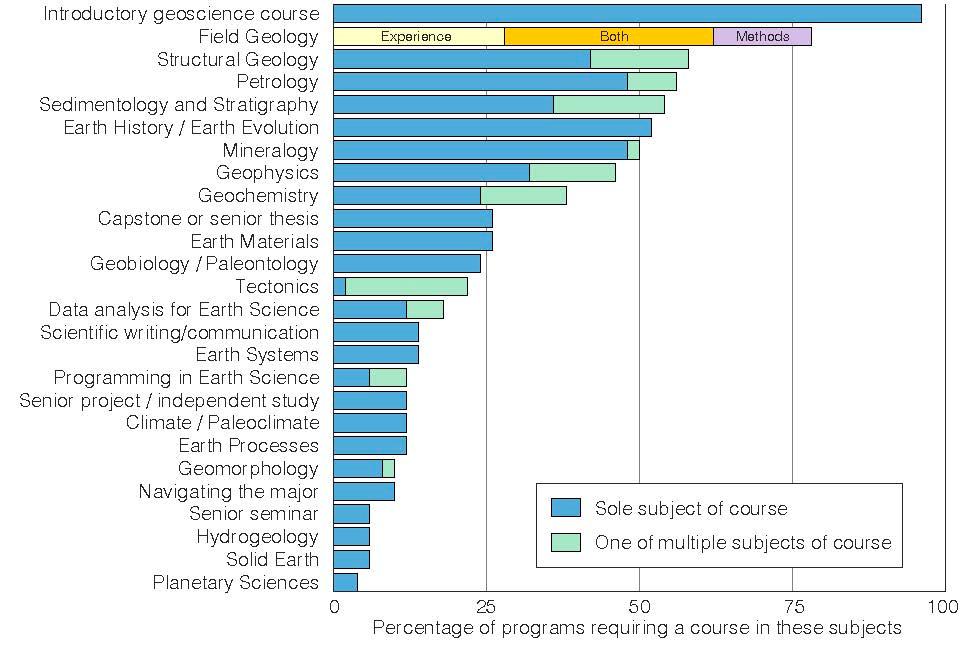
Minimum credits required to complete the major normalized by credits required to complete the degree, for courses that must be taken in the home geoscience department (blue), cognate courses outside it (purple), and courses that could be taken inside or outside it (green; Ferrier et al., 2024a).
At the other end of the spectrum is Columbia University, where the requirements for the major satisfy 37% of the credits required for the degree. In this approach, students have more flexibility in designing their education outside their major. They can, however, complete a geoscience major with only half of the normalized credit load in geoscience and cognate fields that is mandated in programs at the upper end of the spectrum.
The second quantity of interest is the frequency with which different subjects are required. Among geoscience subjects, the only near-universal requirement is an introductory geoscience course, which is required by 96% of programs (Fig. 2). The second most common requirement is a field geology course, which is required by 78% of programs, either in the form of a field experience course (e.g., summer field camp) or a field methods course (e.g., a non-summer term course with periodic day trips to the field).
Figure 2
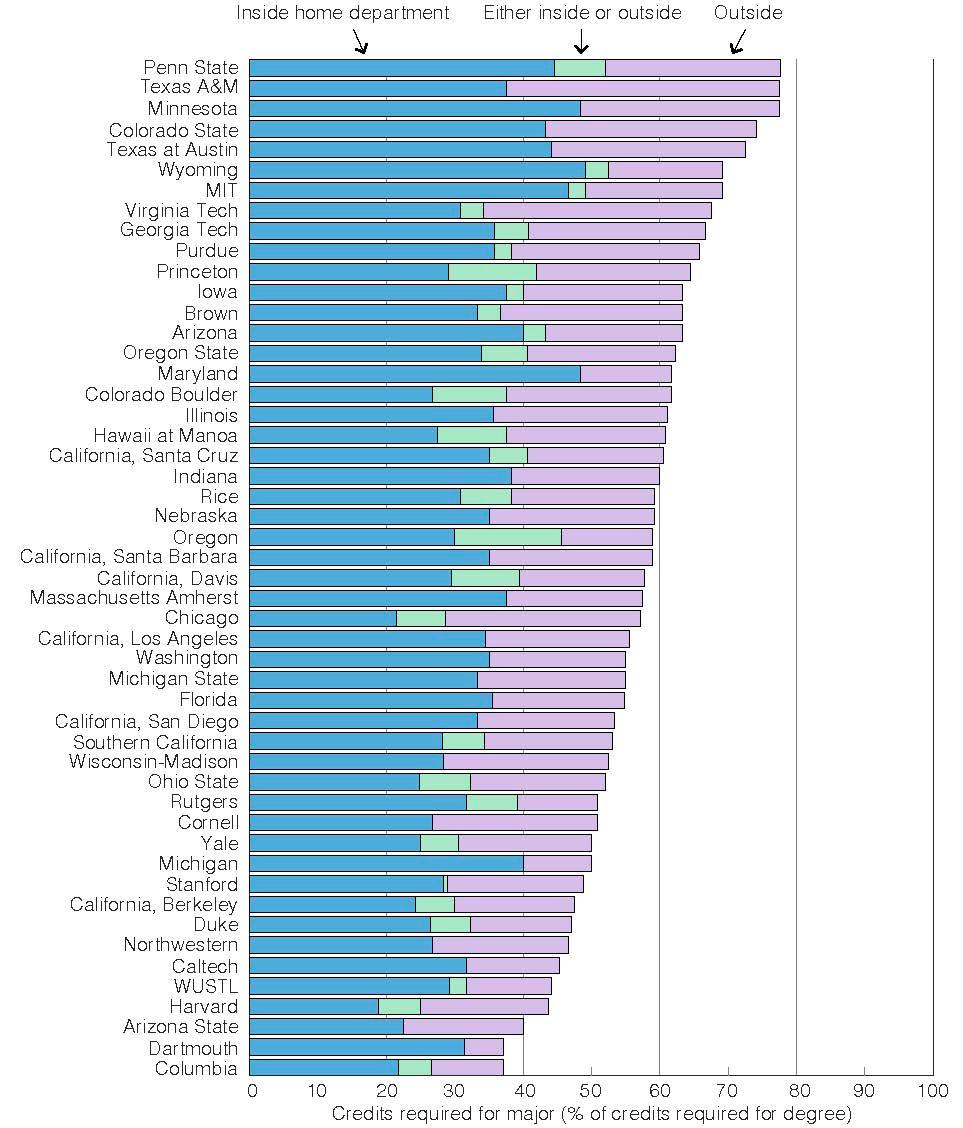
Percentage of programs requiring various geoscience subjects (Ferrier et al., 2024a). Blue indicates that the topic is the course’s sole subject (e.g., a course titled “Structural Geology”), while green indicates that it is one of multiple topics (e.g., a course titled “Structural Geology and Global Tectonics”). In the Field Geology bar, yellow indicates a Field Experience course, purple indicates a Field Methods course, and orange indicates that both Field Experience and Field Methods courses are required.
Beyond those two subjects, there is little consensus. The seven next most frequently required subjects are often considered components of a classical geoscience education, but even these are required by only about half of the compiled programs: structural geology (required by 58% of programs); petrology (56%); sedimentology and stratigraphy (54%); earth history (52%); mineralogy (50%); geophysics (46%); and geochemistry (38%). Other geoscience subjects are required yet less frequently.
Together, the data in Figure 2 indicate that there is more agreement about which subjects are not required than those that are required. Our data collection efforts failed to identify the universal components of geoscience curricula because there is no universal geoscience curriculum. Instead, there is tremendous variety.
Despite the lack of consensus, there is much that can be learned from these data. The patterns in Figures 1 and 2 are fingerprints of the choices departments have made in designing their majors. That these fingerprints differ so much from one another is testament to the value departments place on independence in deciding which subjects are essential and how many courses students should take. The net result of these independent decisions is that students at some institutions are required to take a very different slate of courses than those at other institutions. Geoscience programs are not cookie cutters.
The data in this compilation raise additional questions beyond those answered by Figures 1 and 2. How do the fingerprints in Figures 1 and 2 differ from those for geoscience majors at other types of institutions (e.g., primarily undergraduate institutions), or geoscience majors in other countries, or majors in other subjects (e.g., geological engineering)? How quickly are these fingerprints changing? Which requirements are becoming more widely adopted, and how rapidly? These data cannot answer these questions on their own, but they provide a quantitative point of reference for future studies aimed at these questions.
We hope these data will be useful for many geoscientists, including undergraduate students who are considering career paths after graduation (e.g., Summa et al., 2017) and who would like to compare their coursework to students at other institutions. In our home department, these data are informing ongoing discussions about potential changes to our curriculum. We hope they will be similarly useful to faculty and staff in other geoscience departments.
References Cited
- Ferrier, K.L., Golos, E.M., and Haseloff, M., 2024a, Geoscience undergraduate major course requirements [Data set]: https://doi.org/10.5281/zenodo.12010539.
- Ferrier, K.L., Golos, E.M., and Haseloff, M., 2024b, A dataset of course requirements for undergraduate geoscience majors at 50 R1 universities in the United States: Data in Brief, v. 57, https://doi.org/10.1016/j.dib.2024.110904.
- Keane, C., 2022, Geoscience enrolment and degrees continue to decline through 2021: Geoscience Currents Data Brief 2022–010.
- Mosher, S., and Keane, C., eds., ,2021, Vision and Change in the Geosciences: The Future of Undergraduate Geoscience Education: American Geosciences Institute, 184 p.
- Summa, L., Keane, C., and Mosher, S., 2017, Meeting changing workforce needs in geoscience with new thinking about undergraduate education: GSA Today, v. 27, no. 9, p. 60–61, https://doi.org/10.1130/GSATG342GW.1.
CITATION: Ferrier, K.L., Golos, E.M., and Haseloff, M., 2026, There is no universal geoscience curriculum: GSA Today, v. 36, p. 30–31, https://doi.org/10.1130/GSATG631GW.1.
© 2026 The Authors. Gold Open Access: This paper is published under the terms of the CC-BY-NC license. Printed in the USA.