
In this article
Authors
Robert Hatcher Jr.
Department of Earth and Planetary Sciences, University of Tennessee, 602 Strong Hall, Knoxville, Tennessee 37996-1526, USA; Present address: 107 Goldengate Lane, Oak Ridge, Tennessee 37830, USA.
Abstract
Geology students learn three classes of rocks: igneous, sedimentary, and metamorphic, which fit neatly into the rock cycle. A fourth class of rocks—fault rocks derived from the other three classes—does not fit into any of the three, or the rock cycle. Fault rocks have unique textures produced from the surface into the mantle by heterogeneous simple shear in fault and shear zones, and along faults in impact structures—and these textures strongly modify existing fabrics. Mylonites form over a range of temperatures, pressures, and strain rates at both high-temperature and low-temperature retrograde conditions and at high temperatures under prograde conditions, both involving crystal-plastic deformation and grain-size reduction. Cataclasites also form largely in near-surface environments at low temperatures and pressures by heterogeneous simple shear along shallow faults and in their associated damage zones. They produce fragments that are progressively reduced in size without changes in mineralogy or internal composition. Pseudotachylite forms under high strain rates by frictional heating in fault zones and impact structures. Hypervelocity (bolide) impacts produce faults bearing abundant cataclasite, pseudotachylite, unique rocks and microstructures, and ultrahigh-pressure minerals. Slickensides on movement surfaces contain minerals that crystallize over a range of temperatures. Quartz precipitates from fluids on moving fault surfaces following pressure dissolution at elevated temperatures. These also are fault rocks/minerals. Fault rocks should be provided the recognition they deserve as a separate class.
*bobmap@utk.edu
CITATION: Hatcher, R.D., Jr., 2025, Fault rocks: A fourth class of rocks: GSA Today, v. 35, p. 4-9, https://doi.org/10.1130/GSATG608A.1.
© 2025 The Author. Gold Open Access: This paper is published under the terms of the CC-BY-NC license. Printed in USA.
Figure 1
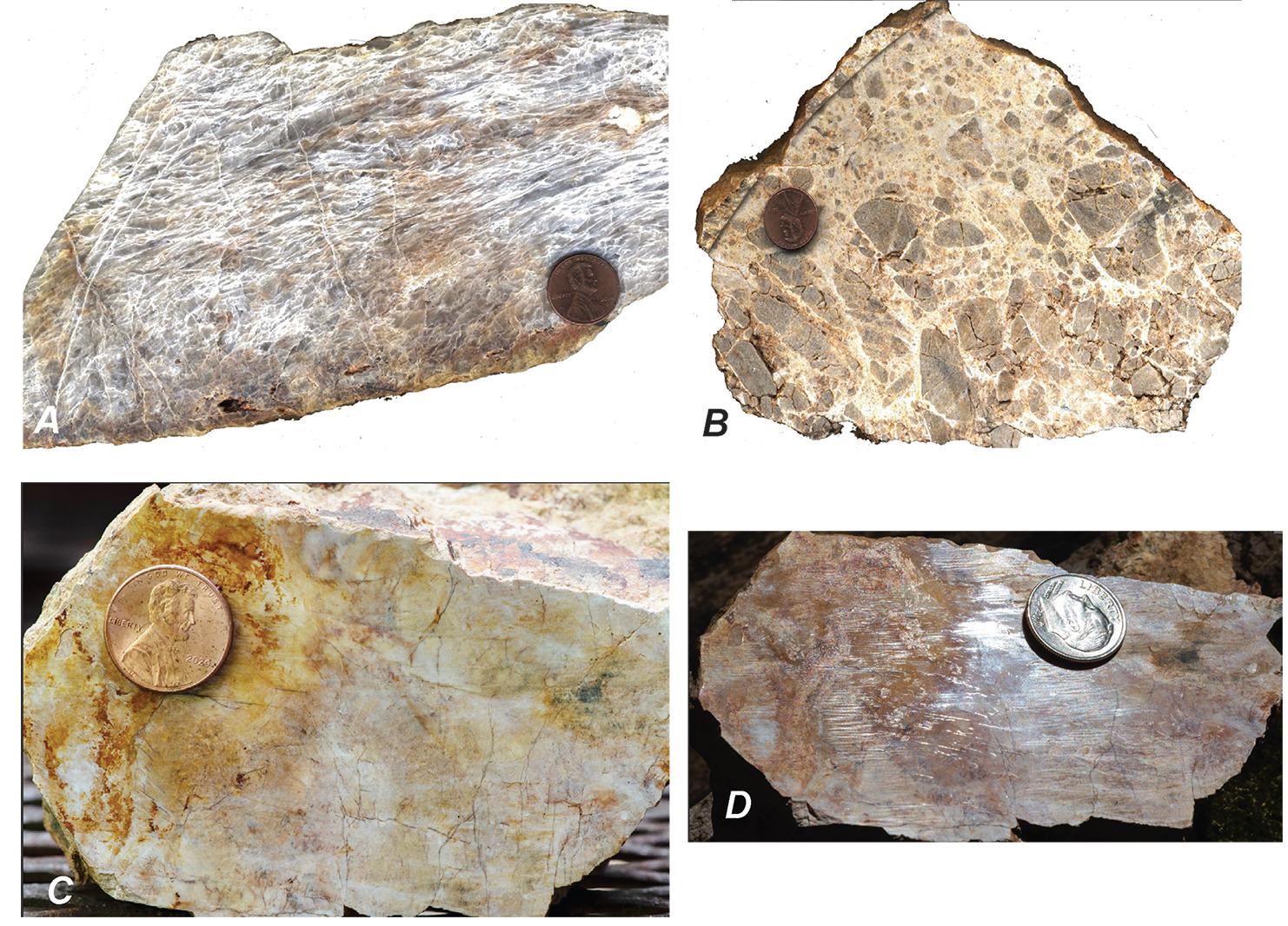
Similar starting materials produce two different types of fault rocks: quartz mylonite and cataclasite. (A) Quartz mylonite from the Towaliga fault zone, central Georgia Piedmont, south of Jackson, Georgia. Protolith was either quartzite or vein quartz. Note well-developed dextral S-C fabric indicating dextral motion. White mineral is feldspar. Specimen long axis is 13.5 cm. (B) Quartz arenite cataclasite from the Appalachian Valley and Ridge near Harrisonburg, Virginia. Specimen long axis is 18.6 cm. (C) Slickensided clear mirror quartz coating a fault surface in anchizone Chilhowee quartzite near the Great Smoky fault in southeastern Tennessee. The quartz likely formed along mesoscale faults from precipitation of silica gel dissolved by pressure dissolution under higher temperatures at greater depths. Clear slickensided quartz surface is visible in incident light. Striae are faintly visible in the upper part of the photo to the right of the coin, and in the lower right-hand corner of image. (D) Striae of highly reflective quartz surface in direct sunlight. White lines delimit slight weathering along joints.
Introduction
From Geology 101, geologists are taught there are three classes of rocks: igneous, sedimentary, and metamorphic. This tripartite subdivision was completed when Charles Lyell in 1833 suggested the term “metamorphism” for the process and “metamorphic rocks” as the products. The other two classes had been recognized for centuries, although the origin of igneous rocks was debated until Nicholas Desmarest around 1763 demonstrated in the French Auvergne region that volcanic rocks crystallized from melt. James Hutton in 1785 demonstrated from observations in Scotland that granite crystallized from magma and intruded other rocks. These three classes were ingrained in geologic thought by the late eighteenth and early nineteenth centuries and remain an integral part of geologic thought. We also are taught that all rocks fit nicely into the rock cycle—and most do.
There is, however, a class of rocks, derived from the other classes, that does not fit any of the three traditional classes: fault rocks (Fig. 1). This class includes the two best-known fault rock types, mylonite (including phyllonite) and cataclasite, but it also includes less common pseudotachylite and other rocks that form in fault/shear zones and faults in hypervelocity impacts. The environments where fault rocks are produced range from the surface to the base of the lithosphere. Add the range of temperatures and pressures of rocks and fluids, and the variable of strain rate of active faults (e.g., during the earthquake cycle), and it is easy to understand why fault rocks do not fall into the usual three classes. Mylonite was first defined by Lapworth (1885) from his observations along the Moine and Arnabol thrusts in Scotland. Many geologists since have considered faults and mylonites to be the products of brittle deformation, despite the ductile character of mylonite embodied in Lapworth’s original definition.
My purpose here is to present the case for the fourth class—fault rocks—and to advocate that they should be recognized as a separate class—equal in stature with the other long-established rock classes. My intent is not that these ideas should be incorporated into introductory courses. They are produced by processes that operate in unique environments along faults, in mostly simple shear (less frequently pure shear), and they have unique textures (Fig. 2). Some consider mylonite a type of metamorphic rock (e.g., Brodie et al., 2007; Fettes and Desmons, 2007; Trouw et al., 2010), and it is (with additional attributes discussed herein), but where does that leave pseudotachylite, fault rocks formed by cataclasis, and rocks formed along faults in hypervelocity impacts (e.g., suevite, impactite, tektites, etc.)?
Sibson (1977) provided a framework and physical model for a strike-slip fault that is identified on the surface but penetrates the entire crust into the lithosphere. Near the surface, such a model fault is relatively narrow in cross section and would produce cataclasite possibly with a narrow damage zone. Deeper in the crust, however, the fault zone widens as crystal-plastic deformation becomes dominant until the fault becomes a ductile shear zone dominated by mylonite (and phyllonite). Sibson’s model follows the standard mechanical model for the crust and upper mantle, which follows Byerlee’s law for linear elastic behavior in the upper crust and plastic (or viscoplastic) flow laws below the brittle-ductile transition.
Sheath folds are common to abundant in fault/shear zones. They too mostly form in an environment dominated by high strain and heterogeneous simple shear. Their recognition is partly a function of visible strain markers, as well as rheology. Ideally, sheath folds are most easily recognized in rocks where prominent layering, either (transposed?) bedding or compositional layering, is present. Sheath folds form from progressive amplification of incipient asymmetric buckle folds, where the axial surfaces evolve with increasing strain from parallelism with the x-y plane of the strain ellipsoid to maximum strain and extreme elongation of the hinge lines parallel to the x axis of the strain ellipse (where axial surfaces remain in the x-y plane; Hudleston, 1986; Mies, 1993).
Figure 2
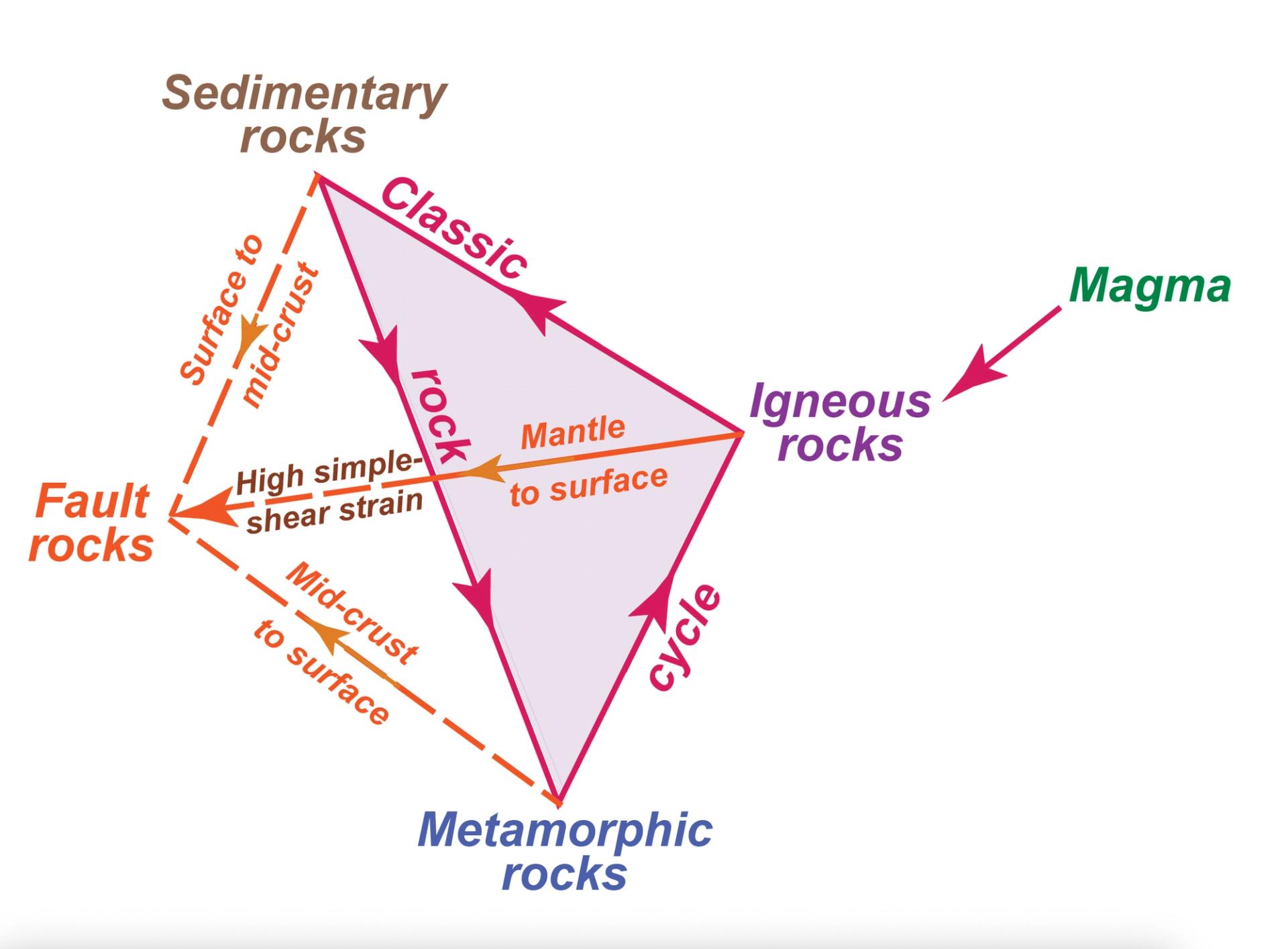
Rock tetrahedron integrating fault rocks with the standard rock cycle end members, and the corresponding environments.
Classifications
My purpose here is to not erect yet another classification of either mylonites or fault rocks. Trouw et al. (2010) provided excellent examples of fault rock textures and microtextures, employing a simple classification. Many attempts have been made to classify fault rocks (e.g., Lapworth, 1885; Waters and Campbell, 1935; Higgins, 1971; Bell and Etheridge, 1973; Lister and Snoke, 1984; Wise et al., 1984; Schmid and Handy, 1991; Passchier and Trouw, 2005; Brodie et al., 2007). Until we recognized that they form both above and below the brittle-ductile transition, many geologists assumed, based on strict interpretation of Lapworth’s original definition of mylonite, that all fault rocks form under brittle conditions.
Wise et al. (1984) attempted to address the spectrum of fault rocks by employing the basic fault rock types (Fig. 3) and emphasizing strain rate and recovery rate without augmenting the already crowded jargon. This scheme and that of Wintsch and Dunning (1985) readily incorporated the field-experimental, temperature-calibrated processes of primarily quartz recovery/recrystallization of Stipp et al. (2002a, 2002b), which has been widely adopted (Fig. 3).
Textural Differences
The basis of most fault rock classifications lies in differences in texture, influenced by fluids, mechanics, and mineralogy. Mylonites were first recognized by their textures, which contrast with those of the rocks from which they were derived (Lapworth, 1885). Fault rocks in ductile fault zones, particularly retrograde fault rocks and some cataclasites, may contrast markedly with protolith rocks because of changes in mineral composition produced by water. Important changes also occur in rock texture by decreasing grain size in both prograde and retrograde mylonites and cataclasites, with the ultimate products being relatively uniform-textured, frequently banded and lineated, ultramylonite and gouge (Hatcher et al., 2017, their fig. 4; Merschat et al., 2023, their fig. 4).
Figure 3
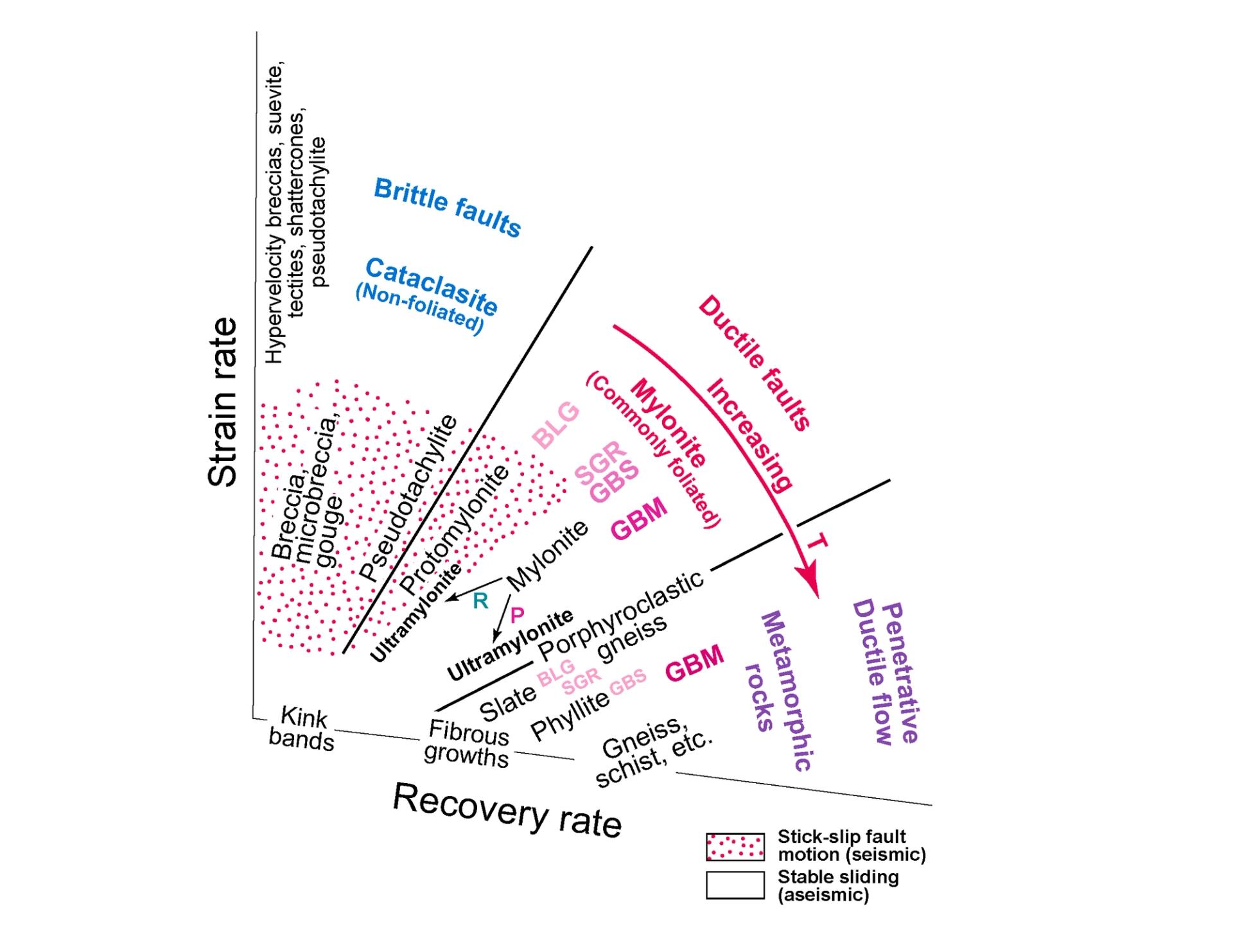
Strain rate versus recovery rate of fault and related rocks (modified from Wise et al., 1984; with suggestions from R. Wintsch). Mylonite (in red type) refers to the entire class of fault rocks formed from quartzofeldspathic rocks. Phyllonite may form from pelitic protoliths or by hydration and retrogression of quartzofeldspathic rocks, and commonly contains an S-C fabric. T—temperature; P—prograde; R—retrograde. Quartz microstructural development with increasing strain and temperature: BLG—bulging; SGR—subgrain rotation recrystallization; GBS—grain-boundary sliding; GBM—grain-boundary migration recrystallization. Quartz microstructure terminology is from Stipp et al. (2002b).
Fluids in Fault/Shear Zones
The role of fluids, mostly water, in lubricating faults has been known for almost a century, by applying Terzaghi’s equation for the role of fluids in shear resistance of soils to faults (e.g., Hubbert and Rubey, 1959),
τ = μ(σn – Pw) = μS, (1)
where τ is shear stress, μ is the coefficient of friction, σn is normal stress, Pw is fluid pressure, and S is effective normal stress. The abundance of micas and other hydrous phases in ductile fault zones, such as the Alpine fault in New Zealand and the Brevard fault in the Appalachians (e.g., Hatcher et al., 2017), has long provided hints that large volumes of fluids flux through ductile shear zones during movement. Sinha et al. (1988), however, provided quantitative evidence from the Brevard fault zone in southwestern North Carolina, not only that very large volumes of fluids move through ductile shear zones, but also that fluids are responsible for the mobility of silica on a massive scale, along with changes in both major- and trace-element mineral compositions.
Nature of Fault Rocks
Although Lapworth (1885) first defined mylonite from his observations of fault rocks in the Northwest Highlands of Scotland, processes related to mylonite formation were not well understood until the latter half of the twentieth century. Fault rocks have been known and written about since before Lapworth (1885) published his paper defining mylonite. His definition recognized that mylonites possess “fluxion” structure, acknowledging their ductile character, and recognized the importance of grain-size reduction in the formation of mylonite. Nevertheless, Lapworth emphasized the brittle nature of many fault rocks and included them in the broad class of mylonites. Other geologists who studied fault rocks during the first half of the twentieth century emphasized Lapworth’s focus on brittle behavior, but many acknowledged the evidence for ductile flow in the fine-grained representatives of these rocks, and even in Lapworth’s definition (see Waters and Campbell, 1935). The following is directly from Lapworth (1885, p. 558–559):
… The old planes of schistosity become obliterated, and new ones are developed; the original crystals are crushed and spread out, and new secondary minerals, mica and quartz, are developed. The most intense mechanical metamorphism occurs along the grand dislocation (thrust) planes, where the gneisses and pegmatites resting on those planes are crushed, dragged, and ground out into a finely laminated schist (Mylonite, Gr. mylon, a mill) composed of shattered fragments of the original crystals of the rock set in a cement of secondary quartz, the lamination being defined by minute inosculating lines (fluxion lines) of kaolin or chloritic material and secondary crystals of mica. Whatever rock rests immediately upon the thrust-plane, whether Archaean, igneous, or Palaeozoic, &c. [sic], is similarly treated, the resulting mylonite varying in colour and composition according to the material from which it is formed. The variegated schists which form the transitional zones between the Arnaboll gneiss and Sutherland mica-schists are all essentially mylonites in origin and structure, and appear to have been formed along many dislocation planes…They show the fluxion-structure of the mylonites; but the differential motion of the component particles seems to have been less, while the chemical change was much greater…
Many earlier researchers recognized and described varieties of “mylonite” (sensu lato) and attempted to address the observed microstructures (Waters and Campbell, 1935). Today, a definition of mylonite emphasizes ductile, crystal-plastic deformation as the dominant process involved in mylonite formation in an environment of heterogeneous simple shear. This requires they form at depths and temperatures above 350 °C where quartz will flow (Stipp et al., 2002a, 2002b; Trouw et al., 2010; see also Fig. 2). Fault zones are the best places to find evidence of large amounts of simple shear parallel to the shear zone boundaries, so ductile shear (fault) zones are dominated by mylonite, and brittle faults are dominated by cataclasite, but faults with complex movement histories may produce mylonite overprinted by cataclasite. Fracturing (cataclastic behavior) of minerals that behave as hard objects in mylonites, such as feldspar and garnet, have higher temperature-pressure thresholds for ductile deformation. Evaporites and glacial ice also form mylonite at near-surface conditions.
Another common misconception about mylonites is that all mylonites are products of retrograde processes. Retrogression is common in many shear zones (e.g., Hatcher et al., 2017, their fig. 4), because many shear zones form at lower ambient temperatures in the presence of fluids than the conditions that formed the protoliths. So, many high-grade minerals are recrystallized and hydrated at lower temperatures, retrograding biotite and garnet to chlorite, plagioclase and kyanite to sericite, etc. Retrograde mineral reactions are accompanied by grain-size reduction (Lapworth, 1885), with ultramylonite being the end product. A parallel sequence can be identified at high temperatures within prograde and retrograde fault zones (e.g., Merschat et al., 2023, their fig. 4), with both processes resulting in grain-size reduction. A megacrystic granite may undergo deformation at high subsolidus temperatures (postcrystallization), e.g., under middle- to upper-amphibolite-grade conditions, with feldspar megacrysts becoming progressively rounded and smaller, developing tails of recrystallized feldspar and quartz, while the groundmass continues to recrystallize. Grain-size reduction of megacrysts continues until the product is a recrystallized ultramylonite. Without tailed megacryst shear-sense indicators, it is difficult to distinguish the ultra-mylonite or the groundmass of intermediate products from fine- to medium-grained granitoid, conglomerate, or metagraywacke.
This contrasts with cataclasite (breccia, gouge) that forms in fault zones and in hypervelocity impact structures at shallow depths as products of brittle deformation or at high strain rates (Fig. 2A). Cataclasite is produced by fracturing and reduction of the grain size of minerals without recrystallization or alteration of the mineral composition (Fig. 2B). Interestingly, brittle deformation producing cataclasite frequently overprints mylonite in fault zones, suggesting the fault was either unroofed from the depth where ductile deformation dominated, and was deformed brittlely, or increased strain rate forced the deformation process into brittle behavior at the original depth. Fault gouge or ultracataclasite may undergo cataclastic flow in the interstices between larger fragments at temperatures below the threshold for quartz recrystallization, but recrystallization may occur in carbonate rocks.
Tectonic stylolites are common in both carbonate and quartz-rich rocks, accompanying pressure dissolution in the transition in pressure-temperature conditions below massive ductile and crystal-plastic behavior. These conditions doubtlessly overlap with tectonic anchizone (subgreenschist facies) conditions at the threshold of pressure-dissolution cleavage formation. This process involves quartz dissolution at grain boundaries, diffusion of dissolved solids at grain contacts, or precipitation at grain boundaries or by diffusive transport into open pore spaces or fractures (Gundersen et al., 2002). Parallel recrystallization of illite into sericite also appears here.
Figure 4
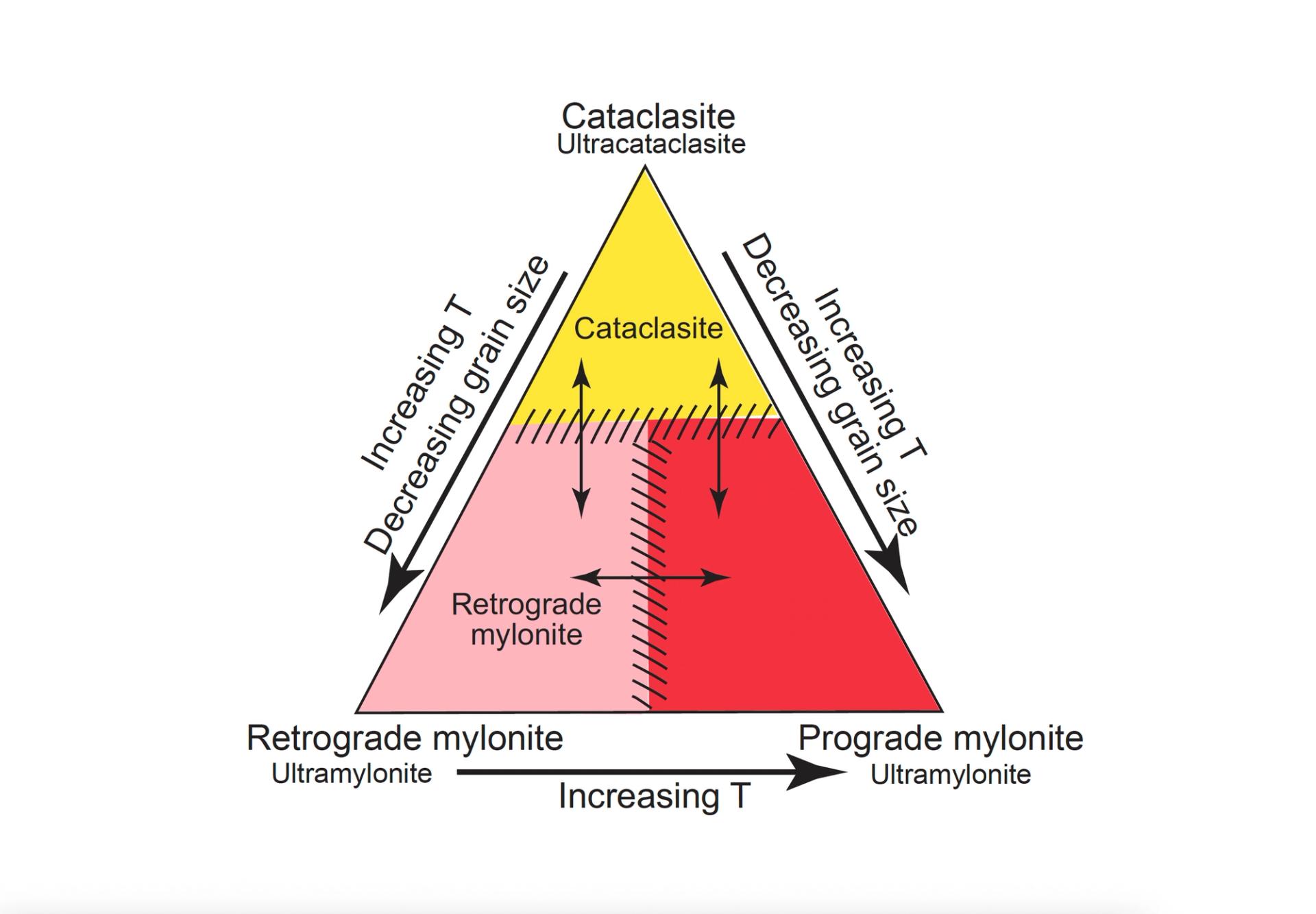
Tetrahedral diagram of interrelationships between various classes of fault rocks. Cataclasite is the dominant product of fault movement under near-surface and hypervelocity impact conditions. Ductile conditions and mylonitization begin as temperature increases to the threshold of quartz plasticity (~350 °C).
Many brittle faults have knife-sharp contacts that contain very narrow zones of cataclasite, if any, whereas others contain broad damage zones from a few centimeters to tens to hundreds of meters wide. Ductile shear zones range from microscopic to kilometers in width. This is where other rock types become fault rocks.
Faults may be weakened at low temperatures by fault zone–dissolved amorphous silica gel that coats fault surfaces, dehydrates, and either solidifies into chalcedonic quartz (Hemley et al., 1988; Brady and Walther, 1990; Nakamura et al., 2012; Kirkpatrick et al., 2013) or crystallizes into shiny slickensided surfaces of clear (“mirror”) quartz (Figs. 1C and 1D). This material is neither mylonite nor cataclasite, but the product of low-temperature brittle deformation and quartz pressure dissolution and redeposition during fault movement. This texture has also been identified along faults where the material deposited on the mirror surface consists of calcite, and possibly other minerals, attesting to formation under anchizone to lower-greenschist-facies condition (Pozzi et al., 2018). So, how should fault-generated materials like this be considered in the context of being solely the product of metamorphic processes? Moreover, this material does not fit any existing classification for mylonites. Similarly, while they are products of faulting, how do tectonic stylolites, which form under shallow burial conditions, fit into a scheme describing mylonites? Also, what about deformation bands (e.g., Davis, 1999) and scaly fabrics (e.g., Moore, 1986) that form in unconsolidated sediments in subduction zones and elsewhere? These, too, are largely the products of fault-related deformation.
Faults in hypervelocity impacts produce a unique suite of rocks and textures that are frequently called impactites. While pseudotachylite occurs in fault zones, it is also common in impact structures, along with suevite, melt breccia (Gulick et al., 2019), shatter cones, shocked quartz (Horton et al., 2009, their fig. 8C), and stishovite, along with geochemical anomalies.
Discussion
Fault rocks are impossible to place in the rock cycle because they form in unique solid-state environments (with or without fluids) as products of heterogeneous simple shear over a range of temperatures and pressures. Fault rocks comprise a unique group linked by several common threads. They: (1) are derived from other rocks; (2) are mostly the products of heterogeneous simple shear; (3) involve grain-size reduction; and (4) are produced in fault zones and impact structures with textures that contrast texturally and frequently compositionally with the rocks from which they are derived. Depth in the crust, and strain rate, determine whether or not cataclasite or mylonite forms (Fig. 3). Strain rate, however, can influence the nature of fault rocks.
Resulting fabrics are unique and largely controlled by the depth in Earth where they form. Add the variables of deformation rate along faults, fluids, and hypervelocity impacts (Fig. 3), and it is easy to understand why fault rocks do not fall into our usual three classes.
The ductile environment of heterogeneous simple shear produces unique textures, such as asymmetric porphyroclasts, S-C fabrics, sheath folds, and intrafolial folds. These also form in pure shear via transposition, producing rotated porphyroclasts and other textures.
Hypervelocity impacts involve surface protoliths and are the products of strain rates so high (10+6 to 10+8 s–1; Melosh, 1989; Zwiessler et al., 2017) that cataclasis is inevitable, with accompanying melting preserved as pseudotachylite, produced from heat generated too rapidly for dissipation by normal heat-conduction and fluid-flow processes. Well-mapped impacts reveal a plethora of radial and concentric faults and fault rocks (e.g., Wilson and Stearns, 1968). In contrast, geologic strain rates of 10−14 to 10−15 s–1 calculated from naturally deformed rocks (Fagereng and Biggs, 2019) accompany ductile flow in the deep crust. Here, recovery and recrystallization processes can proceed to produce fault rocks with textures that contrast with those of metamorphic rocks that form predominantly by pure shear (Fig. 3).
Fault-related rocks and textures are derived from a broad spectrum of lithologies, pressure-temperature conditions, and fluid availability, but they fit into a unique suite of phenomena related to faulting. Because of their textures, contrasting modes of formation with different protoliths, variable pressure-temperature conditions, and their parallel processes of formation, fault rocks deserve recognition as a separate class of rocks equal in status to the other established classes.
Acknowledgments
Support for the past 30-plus years that has enabled me to conduct research and think without boundaries was provided by the University of Tennessee Science Alliance Center of Excellence, in addition to support from several federal agencies and private companies. The manuscript evolved into a much more focused paper via critical reviews by Robert P. Wintsch and an anonymous reviewer.
References
- Bell, T.H., and Etheridge, M.A., 1973, Microstructures of mylonites and their descriptive terminology: Lithos, v. 6, p. 337–348, https://doi.org/10.1016/0024-4937(73)90052-2.
- Brady, P.V., and Walther, J.V., 1990, Kinetics of quartz dissolution at low temperatures: Chemical Geology, v. 82, p. 253–264, https://doi.org/10.1016/0009-2541(90)90084-K.
- Brodie, K., Fettes, D., and Harte, B., 2007, Structural terms including fault rock terms, in Fettes, D., and Desmons, J., eds., Metamorphic Rocks, a Classification and Glossary of Terms: Cambridge, UK, Cambridge University Press, p. 24–31.
- Davis, G.H., 1999, Structural Geology of the Colorado Plateau Region of Southern Utah, with Special Emphasis on Deformation Bands: Geological Society of America Special Paper 342, 157 p., https://doi.org/10.1130/SPE342.
- Fagereng, Å., and Biggs, J., 2019, New perspectives on ‘geological strain rates’ calculated from both naturally deformed and actively deforming rocks: Journal of Structural Geology, v. 125, p. 100–110, https://doi.org/10.1016/j.jsg.2018.10.004.
- Fettes, D., and Desmons, J., 2007, Metamorphic Rocks, a Classification and Glossary of Terms: Cambridge, UK, Cambridge University Press, 244 p.
- Gulick, S.P.S., et al., 2019, The first day of the Cenozoic: Proceedings of the National Academy of Sciences of the United States of America, v. 116, p. 19,342–19,351, https://doi.org/10.1073/pnas.1909479116.
- Gundersen, E., Renard, F., Dysthe, D.K., Bjørlykke, K., and Jamtveit, B., 2002, Coupling between pressure solution creep and diffusive mass transport in porous rocks: Journal of Geophysical Research, v. 107, p. 2317–2337, https://doi.org/10.1029/2001JB000287.
- Hatcher, R.D., Jr., Huebner, M.T., Rehrer, J.R., Acker, L.L., Fullagar, P.D., Liu, A., and Goad, P.L., 2017, Geologic and kinematic insights from far-traveled horses in the Brevard fault zone, southern Appalachians, in Law, R.D., Stowell, H.T., and Thigpen, J.R., eds., Linkages and Feedbacks in Orogenic Processes: Geological Society of America Memoir 213, p. 313–351, https://doi.org/10.1130/2017.1213(13).
- Hemley, R.J., Jephcoat, A.P., Mao, H.K., Ming, L.C., and Manghnani, M.H., 1988, Pressure-induced amorphization of crystalline silica: Nature, v. 334, p. 52–54, https://doi.org/10.1038/334052a0.
- Higgins, M.W., 1971, Cataclastic Rocks: U.S. Geological Survey Professional Paper 687, 97 p., https://doi.org/10.3133/pp687.
- Horton, J.W., Jr., Kunk, M.J., Belkin, H.E., Aleinikoff, J.N., Jackson, J.C., and Chou, I-M., 2009, Evolution of crystalline target rocks and impactites in the Chesapeake Bay impact structure, ICDP-USGS Eyreville B core, in Gohn, G.S., Koeberl, C., Miller, K.G., and Reimold, W.U., eds., The ICDP-USGS Deep Drilling Project in the Chesapeake Bay Impact Structure: Results from the Eyreville Core Holes: Geological Society of America Special Paper 458, p. 277–316, https://doi.org/10.1130/2009.2458(14).
- Hubbert, M.K., and Rubey, W.W., 1959, Role of fluid pressure in mechanics of overthrust faulting: Part 1: Geological Society of America Bulletin, v. 70, p. 115–166, https://doi.org/10.1130/0016-7606(1959)70[115:ROFPIM]2.0.CO;2.
- Hudleston, P.J., 1986, Extracting information from folds in rocks: Journal of Geological Education, v. 34, p. 237–235, https://doi.org/10.5408/0022-1368-34.4.237.
- Kirkpatrick, J.D., Rowe, C.D., White, J.C., and Brodsky, E.E., 2013, Silica gel formation during fault slip: Evidence from the rock record: Geology, v. 41, p. 1015–1018, https://doi.org/10.1130/G34483.1.
- Lapworth, C., 1885, The highland controversy in British geology; its causes, course and consequence: Nature, v. 32, p. 558–559.
- Lister, G.G., and Snoke, A.W., 1984, S-C mylonites: Journal of Structural Geology, v. 6, p. 617–638, https://doi.org/10.1016/0191-8141(84)90001-4.
- Melosh, H.J., 1989, Impact Cratering: A Geologic Process: New York, Oxford University Press, 245 p.
- Merschat, A.J., Hatcher, R.D., Jr., Giorgis, S.D., Byars, H.E., Mapes, R.W., Gatewood, M.P., and Wilson, C.G., 2023, Tectonics, geochronology, and petrology of the Walker Top Granite, Appalachian Inner Piedmont, North Carolina: Implications for Acadian and Neoacadian orogenesis: Geosphere, v. 19, p. 19–46, https://doi.org/10.1130/GES02315.1.
- Mies, J.W., 1993, Structural analysis of sheath folds in the Sylacauga Marble Group, Talladega slate belt, Alabama: Journal of Structural Geology, v. 15, p. 983–993, https://doi.org/10.1016/0191-8141(93)90171-6.
- Moore, J.C., ed., 1986, Structural Fabrics in Deep Sea Drilling Project Cores from Forearcs: Geological Society of America Memoir 166, 160 p., https://doi.org/10.1130/MEM166.
- Nakamura, Y., Muto, J., Nagahama, H., Shimizu, I., Miura, T., and Arakawa, I., 2012, Amorphization of quartz by friction: Implication to silica-gel lubrication of fault surfaces: Geophysical Research Letters, v. 39, https://doi.org/10.1029/2012GL053228.
- Passchier, C.W., and Trouw, R.A.J., 2005, Microtectonics (2nd ed.): Heidelberg, Germany, Springer-Verlag, 366 p., https://doi.org/10.1007/3-540-29359-0.
- Pozzi, G., De Paola, N., Nielsen, S.B., Holdsworth, R.F., and Bowen, L., 2018, A new interpretation for the nature and significance of mirror-like surfaces in experimental carbonate-hosted seismic faults: Geology, v. 46, p. 583–586, https://doi.org/10.1130/G40197.1.
- Schmid, S.M., and Handy, M.R., 1991, Towards a genetic classification of fault rocks: Geological usage and tectonophysical implications, in Müller, D.W., McKenzie, J.A., and Weissert, H., eds., Controversies in Modern Geology, Evolution of Geological Theories in Sedimentology, Earth History and Tectonics: London, Academic Press, p. 339–361.
- Sibson, R.H., 1977, Fault rocks and fault mechanisms: Journal of the Geological Society, v. 133, p. 191–213, https://doi.org/10.1144/gsjgs.133.3.0191.
- Sinha, A.K., Hewitt, D.A., and Rimstidt, J.D., 1988, Metamorphic petrology and strontium isotope geochemistry associated with the development of mylonites: An example from the Brevard fault zone, North Carolina: American Journal of Science, v. 288-A, p. 115–147.
- Stipp, M., Stunitz, H., Heilbronner, R., and Schmid, S., 2002a, Dynamic recrystallization of quartz: Correlation between natural and experimental conditions, in De Meer, S., Drury, M.R., De Bresser, J.H.P., and Penncock, G.M., eds., Deformation Mechanisms, Rheology and Tectonics: Current Status and Future Perspectives: Geological Society, London, Special Publication 200, p. 171–190, https://doi.org/10.1144/GSL.SP.2001.200.01.11.
- Stipp, M., Stünitz, H., Heilbronner, R., and Schmid, S.M., 2002b, The eastern Tonale line: A “natural laboratory” for crystal-plastic deformation of quartz over a temperature range from 250 to 700° C: Journal of Structural Geology, v. 24, p. 1861–1884, https://doi.org/10.1016/S0191-8141(02)00035-4.
- Trouw, R.A.J., Passchier, C.W., and Wiersma, D.J., 2010, Atlas of Mylonites—and Related Microstructures: Berlin, Springer-Verlag, 322 p., https://doi.org/10.1007/978-3-642-03608-8.
- Waters, A.C., and Campbell, C.D., 1935, Mylonites from the San Andreas fault zone: American Journal of Science, v. S5-29, no. 174, p. 473–503, https://doi.org/10.2475/ajs.s5-29.174.473.
- Wilson, C.W., Jr., and Stearns, R.G., 1968, Geology of the Wells Creek Structure, Tennessee: Tennessee Division of Geology Bulletin 68, 238 p.
- Wintsch, R.P., and Dunning, J., 1985, The effect of dislocation density on the aqueous solubility of quartz and some geologic implications: A theoretical approach: Journal of Geophysical Research, v. 90, p. 3649–3657, https://doi.org/10.1029/JB090iB05p03649.
- Wise, D.U., Dunn, D.E., Engelder, J.T., Geiser, P.A., Hatcher, R.D., Jr., Kish, S.A., Odom, A.L., and Schamel, S., 1984, Fault-related rocks: Suggestions for terminology: Geology, v. 12, p. 391–394, https://doi.org/10.1130/0091-7613(1984)12<391:FRSFT>2.0.CO;2.
- Zwiessler, R., Kenkmann, T., Poelchau, M.H., Nau, S., and Hess, S., 2017, On the use of a split Hopkinson pressure bar in structural geology: High strain rate deformation of Seeberger sandstone and Carrara marble under uniaxial compression: Journal of Structural Geology, v. 97, p. 225–236, https://doi.org/10.1016/j.jsg.2017.03.007.