In this article
Authors
Molly Stroud
Department of Geosciences, Virginia Tech, Blacksburg, Virginia 24061, USA
George Allen
Department of Geosciences, Virginia Tech, Blacksburg, Virginia 24061, USA
J. Minear
Cooperative Institute for Research in Environmental Sciences, University of Colorado–Boulder, Boulder, Colorado 80309, USA
Julia Cisneros
Department of Geosciences, Virginia Tech, Blacksburg, Virginia 24061, USA
Laurence Smith
Department of Earth, Environmental and Planetary Sciences, Brown University, Providence, Rhode Island 02912, USA
Abstract
Earth-observing satellites have revolutionized the field of fluvial geomorphology by providing large-scale and spatially contiguous observations. The recently launched Surface Water and Ocean Topography (SWOT) satellite’s novel interferometric synthetic aperture radar (inSAR) instrument delivers global measurements of several key geomorphic parameters, such as river surface water elevation, slope, and width, and thus presents the opportunity to study fluvial processes in new ways. Here we explore the utility of the SWOT satellite for advancing understanding of fluvial geomorphology across river systems in the United States, specifically focusing on water surface elevation variations in large braided rivers, temporally dynamic shear stress in bedrock rivers, and the processes associated with knickpoints and dam failures. We also discuss other relevant potential applications of SWOT satellite data related to fluvial geomorphology beyond the scope of these early explorations. By providing global multitemporal observations of several key variables in fluvial geomorphology, SWOT represents a major advance in our ability to quantify, monitor, and understand fluvial systems and their dynamics.
*Corresponding authors: Molly Stroud, mollystroud@vt.edu; George Allen, geoallen@vt.edu
CITATION: Stroud, M., et al., 2025, SWOT satellite: A new tool for fluvial geomorphology: GSA Today, v. 35, p. 4–9, https://doi.org/10.1130/GSATG630A.1.
© 2025 The Authors. Gold Open Access: This paper is published under the terms of the CC-BY-NC license. Printed in the USA.
SWOT: A New Tool
Satellite remote sensing has long been used to study fluvial geomorphology, allowing for large-scale quantification of surface processes and changes (Smith and Pain, 2009). In recent decades, the field of fluvial geomorphology has undergone a notable increase in the use of geographic information systems (GISs), digital elevation models (DEMs), and satellite image analysis, although classical methods including field measurements and formulae remain the most commonly applied tools (Piégay et al., 2015). When studying fluvial systems over large areas and over extended time periods, satellite remote sensing provides unparalleled insight into Earth’s river processes and dynamics, often representing the only feasible way to contiguously observe very large systems (Marcus and Fonstad, 2010).
Figure 1
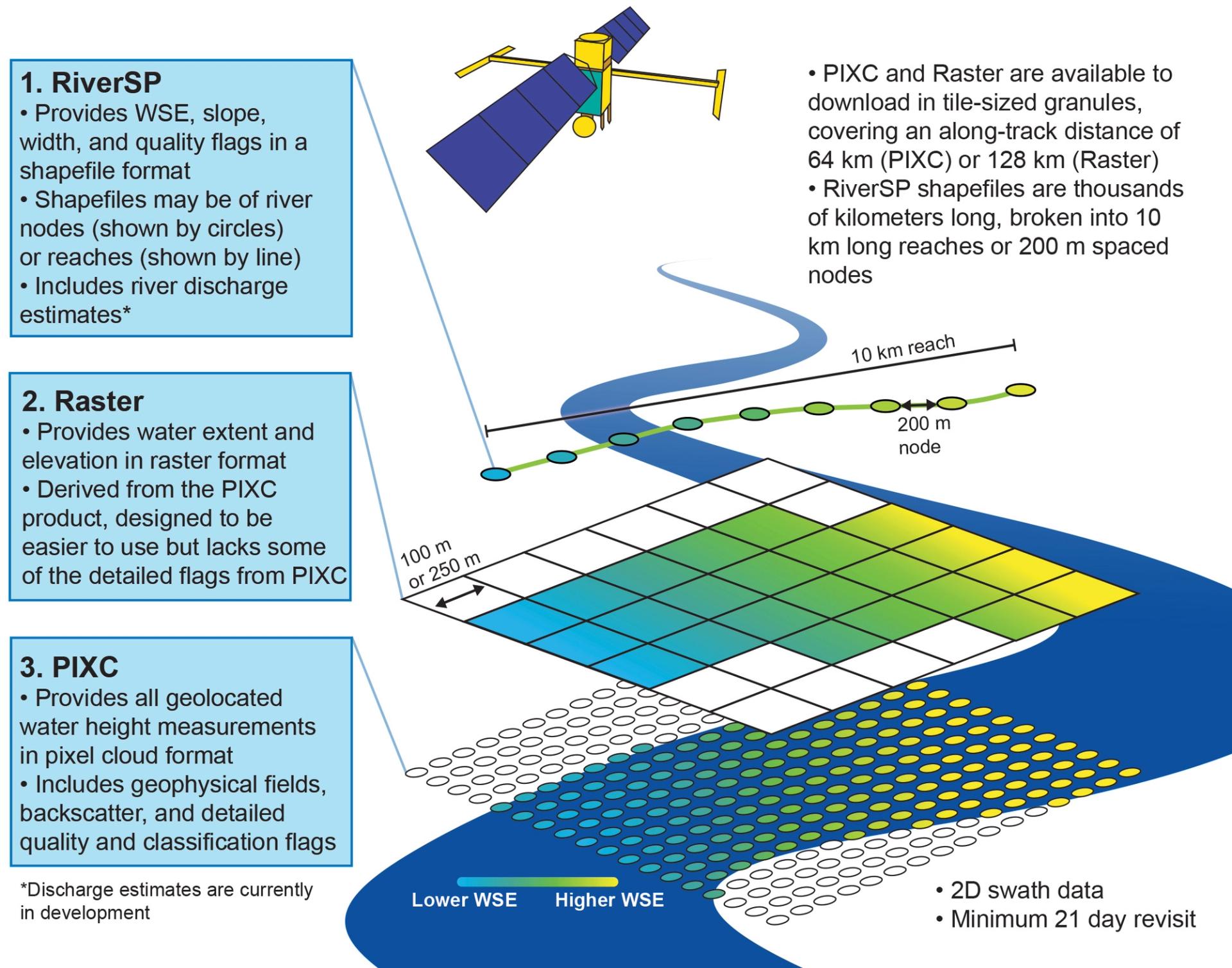
Three Surface Water and Ocean Topography (SWOT) satellite data products that are most relevant to fluvial geomorphology: the River Single Pass Vector Product (RiverSP), Raster Product, and Pixel Cloud Product (PIXC). Also shown are their relevant contents and formatting, such as water surface elevation (WSE) and quality flags.
The Surface Water and Ocean Topography (SWOT) satellite, launched in December 2022, has the potential to transform the field of fluvial geomorphology by providing new data that are unlike what past satellite missions have offered. SWOT produces high-precision images of surface water topography, enabling a new suite of analyses in fluvial geomorphology. SWOT was primarily designed for oceanography and inland hydrology applications and uses a Ka-band synthetic aperture radar to provide simultaneous measurements of both the elevation and extent of surface water over two 50-km-wide swaths (Fu et al., 2024). These same observations can also be readily utilized for fluvial geomorphology applications. The measured water surface elevation (WSE) is an important geomorphic variable in itself, and it can be used to estimate other variables including river slope and river discharge, both of which are related to sediment transport processes (Wolman and Miller, 1960; Bagnold, 1966; Howard et al., 1994).
Unlike past imaging radar satellites, SWOT’s Ka-band and near-nadir look angle are particularly suited to observe water bodies, since water acts as a specular reflector at this frequency and backscatters most of the emitted energy toward the satellite (Biancamaria et al., 2016). Thus, SWOT fills a key observational gap in current satellite missions. Existing spaceborne light detection and ranging (LiDAR) missions, for example, produce highly accurate water elevation estimates, but they only collect data along a few narrow profiles, limiting their spatial coverage and observation frequency. SWOT’s swath measurements not only provide global coverage but also allow for a comparatively dense spatiotemporal analysis of water bodies, opening the door for a more comprehensive understanding of Earth’s water bodies than ever before (Fig. 1).
Figure 2
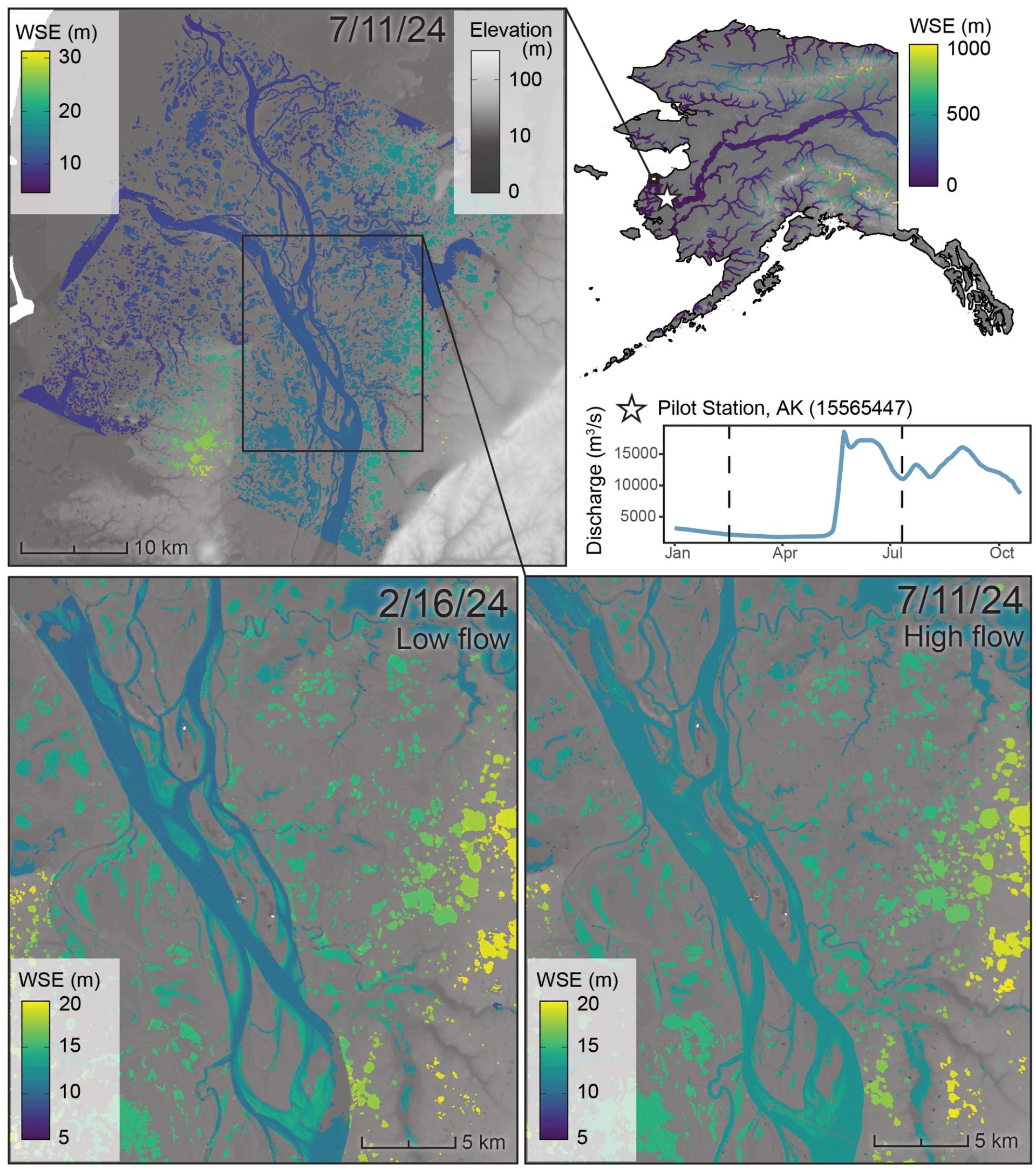
Surface Water and Ocean Topography (SWOT) Pixel Cloud Product (PIXC) data over the Yukon-Kuskokwim Delta in Alaska (AK). Upper-left inset shows a PIXC image from July 2024. Three lower insets show a closer view of the Yukon River during low-flow and high-flow conditions as well as the change raster showing the water surface elevation (WSE) differences between the two dates. The difference in WSE may also be seen at the nearby gauge hydrograph at Pilot Station, indicated by the star. In addition to the Yukon River and its tributaries, SWOT records many small lakes and ponds throughout the landscape, which exhibit less WSE change than the river, as seen in the change raster. Lake levels and river-lake interactions may also be studied with SWOT. Pilot Station is located at 61.9336°, –162.8830°.
The SWOT mission provides a variety of data formats freely available to users—the most useful for fluvial geomorphologists being the high-rate data products, which are designed for inland water bodies and are available in three formats: vector, raster, and pixel cloud (a point cloud of water mask pixels). Figure 1 illustrates these data products and their resolutions, as well as other pertinent information regarding their use. While SWOT’s vertical accuracy is still being assessed, early studies have found the WSE estimates to have an overall weighted root mean square error (RMSE) of <10 cm (Maubant et al., 2025). SWOT’s mission requirements specify that rivers as narrow as 100 m and lakes as small as 250 m × 250 m must be observable. However, recent research has found that rivers as narrow as 40 m and lakes as small as ~100 m × 100 m can be accurately observed with SWOT (Maubant et al., 2025). Early and ongoing work indicates that SWOT may observe ice well in inland waters, and SWOT can accurately estimate sea-ice height (Kacimi et al., 2025). A product not shown in Figure 1 is the official SWOT river discharge product, which is currently being developed and will be freely available to users upon completion (Durand et al., 2023). For further information on accessing and visualizing SWOT data, including Python workflows, the National Aeronautics and Space Administration (NASA) SWOT Cookbook (podaac.github.io/tutorials/quarto_text/SWOT.html) is a helpful resource.
New Applications
Here we showcase several examples of the SWOT mission’s data products and how they may be applied to the field of fluvial geomorphology, and we conclude with suggestions for other future work.
Large River Dynamics
Large rivers can have processes and patterns that differentiate them from smaller rivers and streams; for example, they often have greater internal complexity, more anabranching, and a wider range of channel planforms (Ashworth and Lewin, 2012). These complexities can make predicting their geomorphic behavior difficult, and much work has been dedicated to modeling and quantifying the morphology of large and braided rivers (Williams et al., 2016). Still, there remain many unanswered questions. For example, can intrachannel WSE variations help us understand channel path adjustments and avulsions (Wang et al., 2023; Gearon et al., 2024)? How do water-level variations affect sediment transport and deposition? Can water surface slope predict the formation or termination of river branches in multithreaded rivers?
SWOT can help us to answer these questions. SWOT observes large rivers with great spatial detail, and the Pixel Cloud Product (PIXC) product may be used to study multidimensional cross-channel patterns and changes. For example, Figure 2 shows SWOT observations over the Yukon River on the Yukon-Kuskokwim Delta in Alaska. Here, the Yukon River WSE is much higher in July than in February due to increased flow from snowmelt. Although multiple U.S. Geological Survey (USGS) gauges are located along the Yukon, they are at fixed points and do not offer comparable spatial dimensionality. SWOT enables us to observe intrachannel WSE variations and see how they change with different flows. These variations can advance understanding of river confluence dynamics (Biron et al., 2002) as well as meanders and bed shear stress distributions (Dietrich and Whiting, 1989). For example, Dietrich and Whiting (1989) showed that variations in WSE across a meander correlate with bed shear stress distributions, and thus can indicate where a river may be morphologically adjusting due to scour or deposition. Further, SWOT provides access to temporally dynamic global river slopes for the first time, which can be used to easily identify areas of low surface slope, which are commonly associated with anabranching (Wang et al., 2022). SWOT’s global river slope observations may also be used for other applications: For example, Langhorst et al. (2019) demonstrated how the concavity of a river elevation profile can spatially correlate with underlying structural geology that may not be otherwise apparent on the surface.
Bed Shear Stress
SWOT’s novel observations can also be used to estimate key parameters that relate to sediment transport in rivers. For example, channel bed shear stress, a fundamental measure of a river’s ability to move bed material, may be calculated using the following equation (Bagnold, 1966):
τ = γRS,(1)
where τ is the shear stress, γ is the specific density of water, R is the hydraulic radius, here approximated as mean depth, and S is the slope of the water surface. Shear stress can change significantly with varying flows, and SWOT, in combination with bathymetric information, provides the data necessary to estimate absolute shear stress along Earth’s large rivers through time and space. While bathymetric data are necessary to calculate absolute shear stress, SWOT data may still be used to calculate temporal variations in relative shear stress values in locations without bathymetry data. Although these relative values cannot be used to calculate absolute shear stress, or other absolute parameters like the diameter of bed-load particles moved, they may be used to understand areas of relative high and low shear stress along a river reach (as river bathymetry data are not available for most of Earth’s rivers). Other related parameters, such as stream power, may also be calculated with SWOT’s discharge product.
Figure 3 shows an example of shear stress calculations along the Klamath River in northern California using the SWOT RiverSP node product. The Klamath River is currently a site of great interest due to the ongoing removal of a series of dams along its upper reaches. Here, we estimated absolute shear stress through time and space using SWOT data paired with a 2018 USGS topobathymetry survey (Curtis and Benthem, 2022). SWOT reveals that the temporal and spatial variability in shear stress along the Klamath River scales positively with mean shear stress (Figs. 3B and 3C). The temporal variability of bed shear stress has implications for hydraulic engineering as well as riparian ecology, and it has long been estimated through modeling approaches (Lamouroux et al., 1992). With sufficient sediment supply, areas of higher shear stress have the potential to mobilize and transport a wider range of sediment grain sizes than locations with lower shear stress, which can result in areas of erosion and deposition (Fernandez Luque and Van Beek, 1976). Natural river variability, like the variability in shear stress observed here, has historically created challenges in estimating sediment transport in rivers (Recking et al., 2024). However, with the launch of SWOT, we now have the first global direct observations that enable repeated and spatially contiguous shear stress estimates.
Figure 3
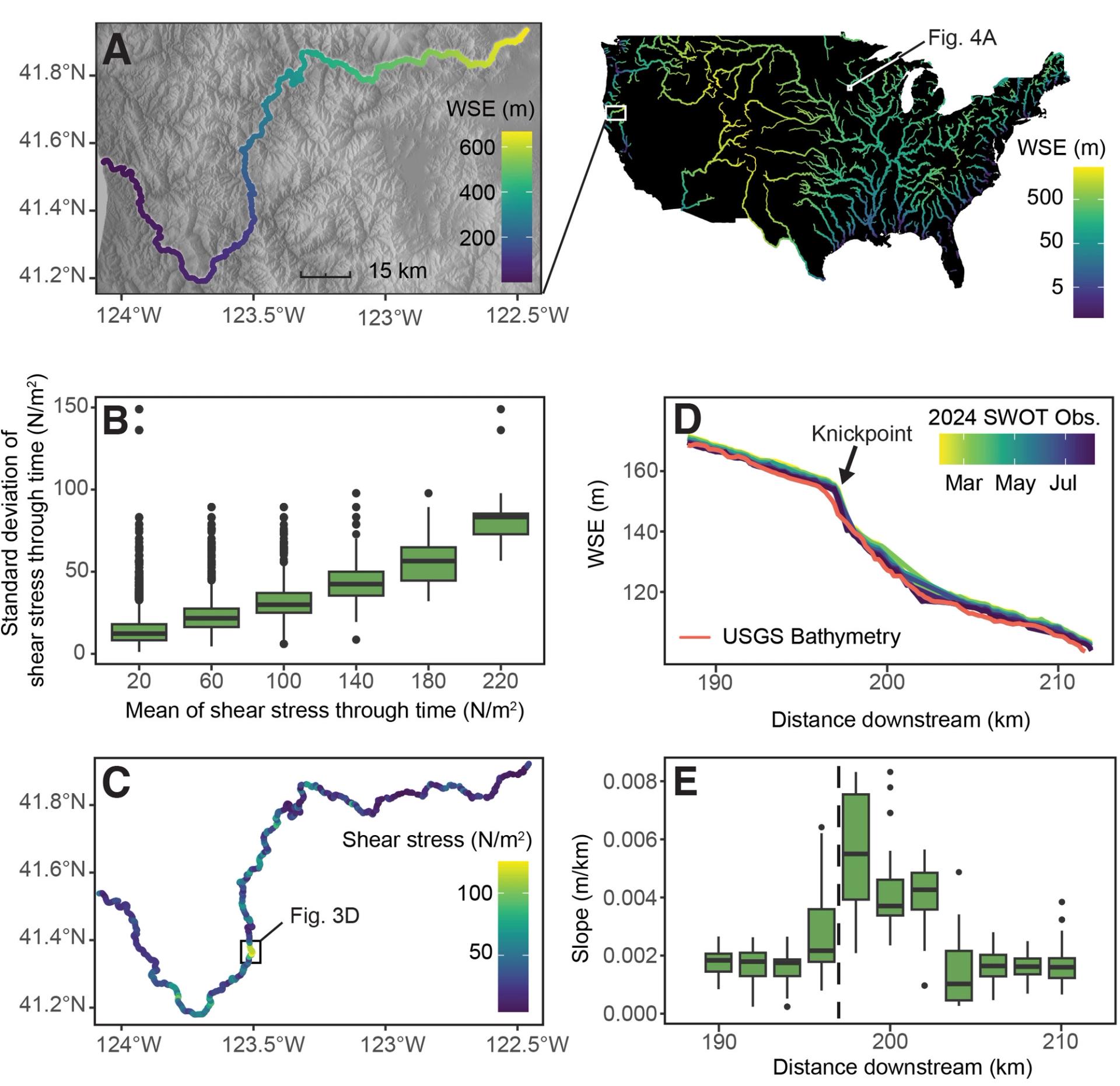
Analysis of bed shear stress with Surface Water and Ocean Topography (SWOT) satellite data from February to September 2024. (A) Water surface elevation (WSE) along the Klamath River in northern California. Mean WSE values were calculated from SWOT RiverSP node data. (B) Binned mean shear stress scales positively with standard deviation of shear stress over time. (C) Mean shear stress estimation along the Klamath over time. (D) Long profile showing knickpoint along the Klamath River from SWOT observations, paired with U.S. Geological Survey (USGS) bathymetry from 2018. (E) Klamath surface slope values upstream and downstream of the knickpoint over time. The knickpoint is marked by the dashed black line.
Knickpoints
SWOT observations also offer new insights into long-studied fluvial geomorphology features like knickpoints, which are abrupt increases in downstream slope along a channel profile (Gardner, 1983). These features serve as key indicators of landscape and catchment response to external perturbations, including spatial changes in the erosional resistance of the channel substrate, climate variations, or a relative fall in base level due to tectonic uplift (Kirby and Whipple, 2012). While knickpoints may be detected using existing DEMs, some of the most interesting knickpoints are active features of the landscape that propagate upstream over time. Knickpoint migration is thought to range from 0.001 and 0.1 m yr–1 (van Heijst and Postma, 2001), but newly formed knickpoints—such as those resulting from dam removals, aggregate mining pits, or earthquake-generated fault scarps—may migrate significantly faster. Past studies of knickpoint formation and migration have primarily relied on fieldwork, airborne LiDAR surveys, or a combination of the two (Major et al., 2012; Martin et al., 2024), and thus direct, real-time observations are rare for these often unpredictable events.
SWOT provides novel data for observing both persistent knickpoints and the formation and migration of new knickpoints. In Figure 3D, for example, SWOT captured an existing knickpoint on the Klamath River near Somes Bar, California, revealing the dynamic behavior of the bed shear stress and water surface slope around the feature. For the first time, we can track how the water surface slope changes around the knickpoint using satellite observations. At this knickpoint, we find that the slope immediately downstream varies over twice as much as the slope upstream (Fig. 3E). These dynamics are undetectable with a single LiDAR survey or static DEM. SWOT’s repeated WSE measurements, by contrast, have the temporal resolution necessary to characterize the hydrodynamics of both fixed and slowly migrating knickpoints.
SWOT also enables the unprecedented characterization of knickpoint formation and migration events with high temporal and spatial detail. For example, in late June 2024, SWOT captured the Rapidan Dam’s partial failure on the Blue Earth River in Rapidan, Minnesota (Fig. 4). The river profile changed dramatically due to the failure, and the SWOT RiverSP node product provided detailed multitemporal WSE data before, during, and after the dam failure. The upstream profile postfailure became oversteepened compared to the rest of the profile, representing a newly formed knick zone, or a localized oversteepened zone (Fig. 4D). By comparing the averaged profile before and after the failure, we see that the upstream and downstream slopes inverted their relative steepness (Fig. 4E). SWOT may also allow us to track future knick-zone migration as the knick zone begins to incise into reservoir sediments and move upstream. Forecasting the effects of dam removal (or failure) is challenging, but new data from SWOT will allow us to study the postevent knickpoint migration and channel morphology change, improving our understanding of the geomorphic effects of dam removal (Pizzuto, 2002). Additionally, we now have the capability to directly observe and measure knickpoint and knick-zone migration rates at a global scale and at regular temporal intervals.
Figure 4
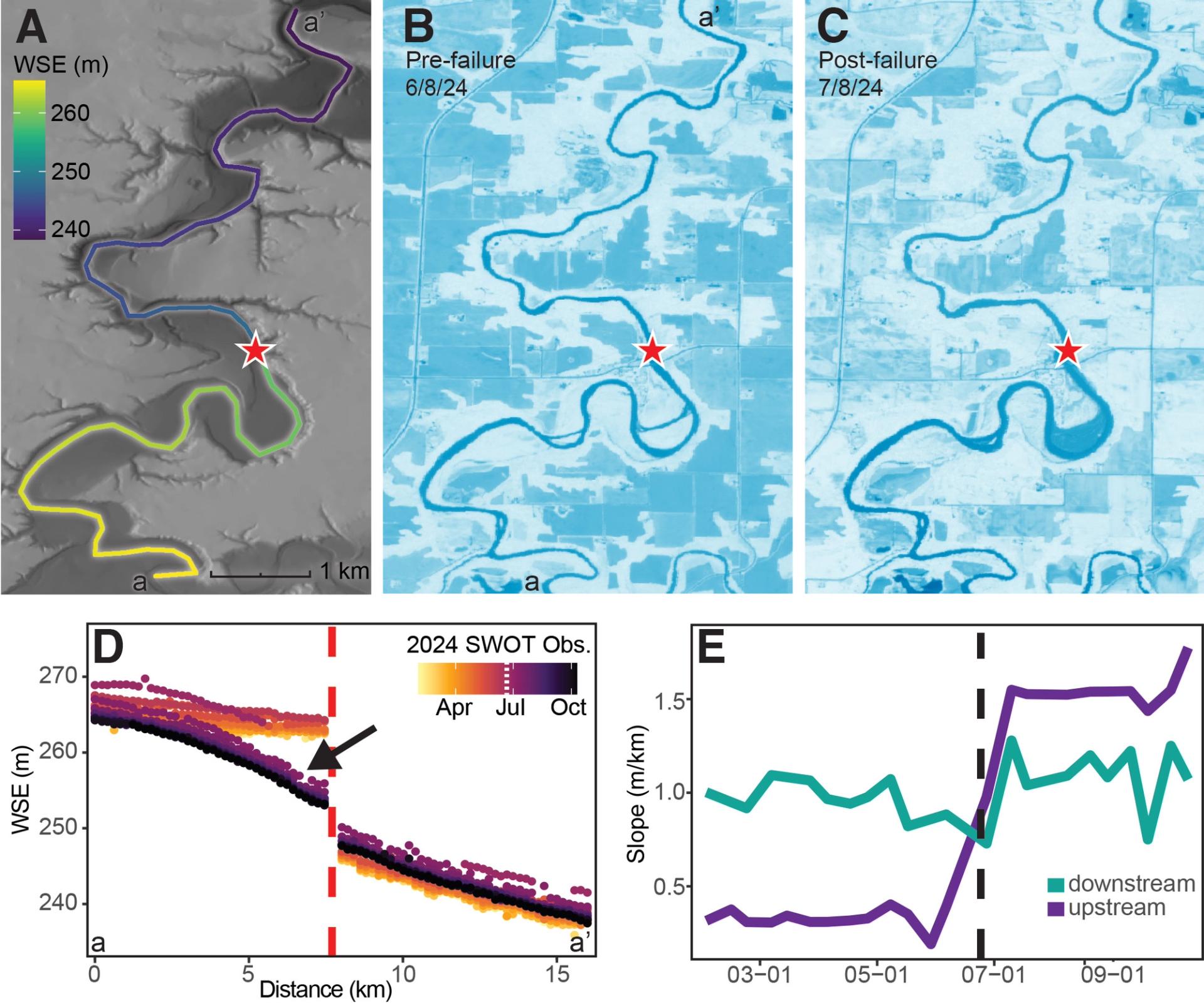
Surface Water and Ocean Topography (SWOT) satellite data over the Rapidan Dam on the Blue Earth River, Minnesota. (A) Average water surface elevation (WSE) of the Blue Earth River from February to September 2024. (B–C) Sentinel-2 images of the Blue Earth River prefailure (B) and postfailure (C), while floods were still occurring. Red star indicates the Rapidan Dam. (D) Long profiles of the Blue Earth River from dates before and after dam failure. Red dashed line indicates the location of dam failure. Arrow indicates newly formed knick zone. White dashed line on color bar indicates the date of dam failure. (E) Change in upstream and downstream mean slope before and after dam failure. Black dashed line indicates the date of dam failure. The Rapidan Dam is located at 44.0926°, –94.1084°.
Emerging Opportunities for SWOT in Fluvial Geomorphology
Beyond the examples discussed above, SWOT will provide many other unexplored opportunities for advancing the field of fluvial geomorphology. SWOT can assist us in understanding the geomorphic impacts of floods: Unlike optical data, SWOT can penetrate cloud cover and thus can provide simultaneous measurements of floodplain extent and water surface elevation during a flood event. In addition to improving flood tracking and observations, SWOT’s observations may be used to track sediment movement and deposition due to flood events, as bed shear stress and/or floodwater inundation extent may be used to estimate bed-load transport and deposition. Improved discharge estimates from SWOT, combined with suspended sediment concentration measurements, could advance our understanding of global sediment transport in large rivers. SWOT’s discharge product enables the estimation of stream power, which is strongly related to sediment discharge and could help to estimate suspended load. Smaller rivers that are higher up in river networks may also be studied with SWOT, although the accuracy of SWOT’s observations on these narrower waters remains to be robustly characterized. As the SWOT mission accumulates a longer data record, more applications will likely become feasible. In this study, we tracked the short-term dynamics of a dam failure, but over a longer time period, SWOT will provide important data for studying the upstream and downstream long-term effects of dam failure as well as dam removal and construction. Other long-term impacts of anthropogenic changes may also be better understood, such as land-use changes and their impacts on stream morphology, with SWOT’s longitudinal and cross-sectional (co-temporal width and WSE) observations. Overall, SWOT’s observations not only provide direct data on these phenomena but may also improve predictive models and simulations via its spatially contiguous and high-precision data. Ultimately, these capabilities position SWOT as a potentially transformative tool for monitoring global river processes and dynamics, and for expanding our understanding of fluvial geomorphology in an era of rapid environmental change.
Acknowledgments
Funding for this project was provided by the Department of Geosciences at Virginia Tech. G.H. Allen was partially supported by the SWOT Science Team grant 80NSSC24K1663. L.C. Smith acknowledges SWOT Science Team grant 80NSSC24K1661. All code used for analysis may be found at github.com/mollystroud/SWOT_Geomorph.
References
- Ashworth, P.J., and Lewin, J., 2012, How do big rivers come to be different?: Earth-Science Reviews, v. 114, p. 84–107, https://doi.org/10.1016/j.earscirev.2012.05.003.
- Bagnold, R.A., 1966, An Approach to the Sediment Transport Problem from General Physics: Washington, D.C., U.S. Government Printing Office, 48 p., https://doi.org/10.3133/pp422I.
- Biancamaria, S., Lettenmaier, D.P., and Pavelsky, T.M., 2016, The SWOT mission and its capabilities for land hydrology, in Cazenave, A., Champollion, N., Benveniste, J., and Chen, J., eds., Remote Sensing and Water Resources: Cham, Switzerland, Springer International Publishing, p. 117–147, https://doi.org/10.1007/978-3-319-32449-4_6.
- Biron, P.M., Richer, A., Kirkbride, A.D., Roy, A.G., and Han, S., 2002, Spatial patterns of water surface topography at a river confluence: Earth Surface Processes and Landforms, v. 27, p. 913–928, https://doi.org/10.1002/esp.359.
- Curtis, J.A., and Benthem, A.J., 2022, Baseline geomorphic map and land-surface parameters, derived from integrated topobathymetric elevation data, for the mainstem Klamath River corridor downstream of Iron Gate Dam, CA, 2018: U.S. Geological Survey Data Release, https://doi.org/10.5066/P90KEKPH.
- Dietrich, W.E., and Whiting, P., 1989, Boundary shear stress and sediment transport in river meanders of sand and gravel, in Ikeda, S., and Parker, G., eds., River Meandering: American Geophysical Union Water Resources Monograph 12, p. 1–50, https://doi.org/10.1029/WM012p0001.
- Durand, M., et al., 2023, A Framework for Estimating Global River Discharge from the Surface Water and Ocean Topography Satellite Mission: Water Resources Research, v. 59, https://doi.org/10.1029/2021WR031614.
- Fernandez Luque, R., and Van Beek, R., 1976, Erosion and transport of bed-load sediment: Journal of Hydraulic Research, v. 14, p. 127–144, https://doi.org/10.1080/00221687609499677.
- Fu, L.L., et al., 2024, The Surface Water and Ocean Topography Mission: A breakthrough in radar remote sensing of the ocean and land surface water: Geophysical Research Letters, v. 51, https://doi.org/10.1029/2023GL107652.
- Gardner, T.W., 1983, Experimental study of knickpoint and longitudinal profile evolution in cohesive, homogeneous material: Geological Society of America Bulletin, v. 94, p. 664–672, https://doi.org/10.1130/0016-7606(1983)94<664:ESOKAL>2.0.CO;2.
- Gearon, J.H., Martin, H.K., DeLisle, C., Barefoot, E.A., Mohrig, D., Paola, C., and Edmonds, D.A., 2024, Rules of river avulsion change downstream: Nature, v. 634, p. 91–95, https://doi.org/10.1038/s41586-024-07964-2.
- Howard, A.D., Dietrich, W.E., and Seidl, M.A., 1994, Modeling fluvial erosion on regional to continental scales: Journal of Geophysical Research: Solid Earth, v. 99, p. 13,971–13,986, https://doi.org/10.1029/94JB00744.
- Kacimi, S., Jaruwatanadilok, S., and Kwok, R., 2025, SWOT observations over sea ice: A first look: Geophysical Research Letters, v. 52, https://doi.org/10.1029/2025GL116079.
- Kirby, E., and Whipple, K.X., 2012, Expression of active tectonics in erosional landscapes: Journal of Structural Geology, v. 44, p. 54–75, https://doi.org/10.1016/j.jsg.2012.07.009.
- Lamouroux, N., Statzner, B., Fuchs, U., Kohmann, F., and Schmedtje, U., 1992, An unconventional approach to modeling spatial and temporal variability of local shear stress in stream segments: Water Resources Research, v. 28, p. 3251–3258, https://doi.org/10.1029/92WR01761.
- Langhorst, T., Pavelsky, T.M., Frasson, R.P. de M., Wei, R., Domeneghetti, A., Altenau, E.H., Durand, M.T., Minear, J.T., Wegmann, K.W., and Fuller, M.R., 2019, Anticipated improvements to river surface elevation profiles from the Surface Water and Ocean Topography Mission: Frontiers of Earth Science, v. 7, https://doi.org/10.3389/feart.2019.00102.
- Major, J.J., O’Connor, J.E., Podolak, C.J., Keith, M.K., and Grant, G.E., 2012, Geomorphic Response of the Sandy River, Oregon, to Removal of Marmot Dam: U.S. Geological Survey Professional Paper 1792, 64 p., https://pubs.usgs.gov/pp/1792/.
- Marcus, W.A., and Fonstad, M.A., 2010, Remote sensing of rivers: The emergence of a subdiscipline in the river sciences: Earth Surface Processes and Landforms, v. 35, p. 1867–1872, https://doi.org/10.1002/esp.2094.
- Martin, H.K., Edmonds, D.A., Yanites, B.J., and Niemi, N.A., 2024, Quantifying landscape change following catastrophic dam failures in Edenville and Sanford, Michigan, USA: Earth Surface Processes and Landforms, v. 49, p. 2767–2778, https://doi.org/10.1002/esp.5855.
- Maubant, L., Dodd, L., and Tregoning, P., 2025, Assessing the accuracy of SWOT measurements of water bodies in Australia: Geophysical Research Letters, v. 52, https://doi.org/10.1029/2024GL114084.
- Piégay, H., Mathias Kondolf, G., Toby Minear, J., and Vaudor, L., 2015, Trends in publications in fluvial geomorphology over two decades: A truly new era in the discipline owing to recent technological revolution?: Geomorphology, v. 248, p. 489–500, https://doi.org/10.1016/j.geomorph.2015.07.039.
- Pizzuto, J., 2002, Effects of dam removal on river form and process: Although many well-established concepts of fluvial geomorphology are relevant for evaluating the effects of dam removal, geomorphologists remain unable to forecast stream channel changes caused by the removal of specific dams: Bioscience, v. 52, p. 683–691, https://doi.org/10.1641/0006-3568(2002)052[0683:EODROR]2.0.CO;2.
- Recking, A., Johannot, A., Horita, K., Nasr, M., Vázquez-Tarrío, D., Zanker, S., Fontaine, F., and Melun, G., 2024, An attempt to take into account natural variability in 1D bedload prediction: Journal of Geophysical Research: Earth Surface, v. 129, https://doi.org/10.1029/2023JF007601.
- Smith, M.J., and Pain, C.F., 2009, Applications of remote sensing in geomorphology: Progress in Physical Geography, v. 33, p. 568–582, https://doi.org/10.1177/0309133309346648.
- van Heijst, M.W.I.M., and Postma, G., 2001, Fluvial response to sea‐level changes: A quantitative analogue, experimental approach: Basin Research, v. 13, p. 269–292, https://doi.org/10.1046/j.1365-2117.2001.00149.x.
- Wang, B., Smith, L.C., Yang, X., Pavelsky, T.M., Altenau, E.H., Gleason, C.J., Pietroniro, A., Rodriguez, E., and Bates, P.D., 2022, Remote sensing of broad-scale controls on large river anabranching: Remote Sensing of Environment, v. 281, https://doi.org/10.1016/j.rse.2022.113243.
- Wang, B., et al., 2023, Athabasca River avulsion underway in the Peace-Athabasca Delta, Canada: Water Resources Research, v. 59, https://doi.org/10.1029/2022WR034114.
- Williams, R.D., Brasington, J., and Hicks, D.M., 2016, Numerical modelling of braided river morphodynamics: Review and future challenges: Geography Compass, v. 10, p. 102–127, https://doi.org/10.1111/gec3.12260.
- Wolman, M.G., and Miller, J.P., 1960, Magnitude and frequency of forces in geomorphic processes: The Journal of Geology, v. 68, p. 54–74, https://doi.org/10.1086/626637.