Incorporating Ethics in College Geoscience Education through Community Engagement
Lixin Wang et al.
In this article
Authors
Lixin Wang
Department of Earth and Environmental Sciences, Indiana University Indianapolis, Indianapolis, Indiana 46202, USA
Grant Fore
STEM Education Innovation and Research Institute (SEIRI), Indiana University Indianapolis, Indianapolis, Indiana 46202, USA
*lxwang@iu.edu
CITATION: Wang, L., and Fore, G.A., 2025, Incorporating ethics in college geoscience education through community engagement: GSA Today, v. 35, p. 14–16, https://doi.org/10.1130/GSATG627GW.1.
© 2025 The Authors. Gold Open Access: This paper is published under the terms of the CC-BY-NC license. Printed in the USA.
Introduction
Ethics has always been important in scientific pursuits, but it has become even more so in today’s world. More than ever, science is under attack, and public trust in science in the United States and across many parts of the world is declining (Lupia et al., 2024). Compounding this issue, unethical behaviors in scientific research are increasingly being reported. A notable example is the report that the number of retractions of biomedical research papers in Europe has increased fourfold between 2000 and 2021, with the majority of these retractions being related to research misconduct (Else, 2024). This highlights the critical need for ethical training (Metzger and Curren, 2017; Mogk and Bruckner, 2020; Wang, 2024). College education is typically where students establish the professional norms and standards of scientific practice. Therefore, research ethics education during this period is crucial for cultivating future scientists who will conduct their work ethically (Nyarko et al., 2023). Geoscience is at the forefront of this battle because it is a subject closely related to many major interconnected issues we are facing, such as climate change, pollution, and soaring energy demand (Metzger, 2024).
Involving ethics in geoscience education is not always straightforward. Here, we share experiences and reflections on a successful case of incorporating ethics into a community-engaged college hydrology course. We provide detailed course design and implementation information and then reflect on the experience of incorporating the ethics training. This is an introductory hydrology course, with most students being juniors and seniors. This class is required for environmental science major students, and it often attracts students from other majors, such as biology, chemistry, and environmental management. The class size typically ranges from 10 to 24 students. During the course design, the course instructor (Wang) had extensive discussions with an education expert (Fore) regarding the proposed activities, the prompt questions for reflections, and the related readings. The course instructor also had several meetings to discuss field activities with the community partner, the White River Alliance, an Indianapolis-based nonprofit organization with the mission to improve and protect water quality in the larger Upper White River region in Indiana.
Implementation of the Ethical Inquiry
In the context of this course, scientific inquiry was reimagined as ethical inquiry: a virtuous activity where the steps of inquiry—such as awareness, judgment, experimentation, and iteration—are intentionally guided by moral excellencies (e.g., attentiveness, responsibility, justice, and competency; Tronto, 2020). As such, our conceptualization of ethical inquiry is grounded in the tradition of virtue ethics. During the implementation of the ethical inquiry activities, students met with the community partner on three separate occasions and conducted a range of group field activities. Coupled with these experiences, a reflection strategy was incorporated, comprising a reading, a guest ethics lecture (led by Fore), and four reflective journal entries.
The reading was a selection from Joan Tronto’s writings on the four elements of care: attentiveness, responsibility, competence, and responsiveness (Tronto, 2020). The guest ethics lecture further discussed an ethic of care and put it into conversation with John Dewey’s notion of moral inquiry (Dewey, 1982). Tronto’s four elements and facets of Dewey’s moral inquiry also provided the themes for each reflective prompt. Students were able to practice the four elements of care and reflectively consider their scientific work as a means of providing care. In addition to the science learning objectives, the specific ethics learning objective was to increase their capacity to care about and analyze the causes and implications of limited water resources. Since these causes and implications are social in nature, the students’ caring analyses were directed toward multiple communities (e.g., scientific, peers, local, ecological).
The field activities centered around urban stream health due to the topic’s relevance to the course, the urban setting of the university, and the needs of the course’s community partner. Stream degradation due to urbanization is a growing issue worldwide, affecting both the ecological systems that depend on streams and the human populations living along them. The impacts of urbanization on local water quality have been studied in different regions (Li et al., 2023). However, there are fewer studies evaluating the impacts of vegetation restoration on stream health in an urban setting. Therefore, studying urban stream health not only addresses an urgent scientific question but also solves practical issues.
Before the first meeting, students were asked to review the community partner’s official website to learn about the community partner organization’s vision and operations. In their first journal entry, they were asked to come up with three questions they would ask the community partner based on their review. The first meeting featured a guest lecture from the community partner, who introduced their organization and provided details about the fieldwork. The students wrote their second journal entries reflecting on the guest lecture experience and how they might take responsibility for the issue raised by the community partner. Next, students participated in a field experience co-led by the course instructor and the community partner, where students quantified soil properties, vegetation characteristics, and water quality at two sites using a variety of methods. One restoration site was located in Indianapolis’ Spade Park, and one control site was located near Harshman Middle School, where no restoration activities had been performed. The soil measurements included infiltration, hydraulic conductivity, bulk density, porosity, gravimetric water content, and heavy metal measurements. The vegetation characteristics were assessed following reach-level assessment from the Center for Watershed Protection’s Unified Stream Assessment manual (Kitchell and Schueler, 2005). The water-quality parameters included water temperature, dissolved oxygen, pH, phosphate, nitrate, nitrite, and turbidity, and measurements were collected following the Hoosier Riverwatch methodology (Indiana Department of Environmental Management, 2022). The students then wrote their third journal entry reflecting on the extent to which they competently engaged in the field experience. At the third meeting, students presented their findings to the community partner. The community partner attended the presentations and provided feedback on them. After incorporating the community partner’s feedback, a subset of students also presented the class findings to the residents living along the waterway, together with the community partner. The students wrote their last journal entries reflecting on the presentation experience and how they might transform their presentations by being responsive to the community partner’s feedback.
Results and Reflections
To assess the effectiveness of the course in achieving the ethics learning objective, we conducted an end-of-course survey over five years and collected the students’ comments. Based on the class survey results, we achieved our objective. The vast majority of students agreed that their capacity to care about water resources increased (Fig. 1). Students also provided enthusiastic comments about their experience. For example, one student wrote, “I think it was a unique and great experience to go into the community to learn about the subject matter. It is tied with the ethics to my education.” Other students also commented on the other dimensions of student experience, namely, the ways the course helped them grow in their capacity to apply hydrology knowledge within the community. For example, “It was an excellent experience conducting hands-on fieldwork with the community partner (even in the blistering cold!). Working alongside them added depth to my learning by connecting classroom concepts to real-world applications.” Similarly, another student stated that, “The community partner involvement definitely helped round out the information we were presented in lecture, and it helped to have a real-world example of how these techniques and information can be implemented.” Regarding this latter point, the student went on to report that by engaging with a community partner, they not only gained valuable experiences about how to apply scientific knowledge in the context of our everyday lives, but also how such community engagement linked them to a network of potentially like-minded practitioners, which could be “helpful once we graduate.” The limitation of this study is that a thematic analysis of the students’ journal reflections was not included. Due to this, our results here do not provide details related to the tracking of student ethical growth.
Figure 1
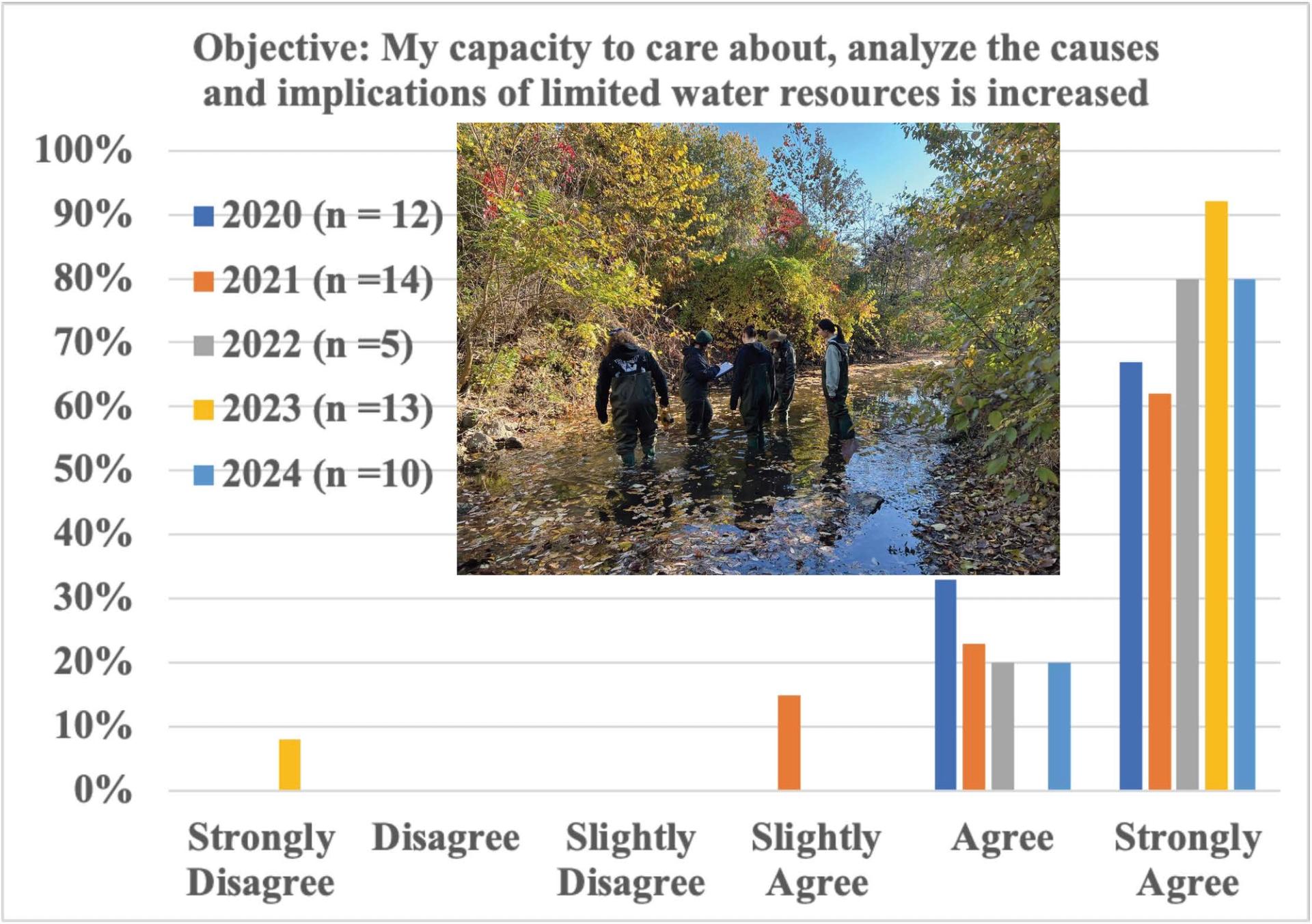
Results of end-of-semester survey of students’ responses to the ethical inquiry objective in this course of “increasing their capacity to care about and analyze the causes and a of limited water resources” between 2020 and 2024, where n is the number of students who responded to the end-of-class survey. Inset: Field photo taken in 2024 by Lixin Wang.
Reflecting on the success of this course, we think the following two key elements are important. First, the mutual benefits between community partners and the course students were crucial to ensuring the project’s success. We purposefully aligned the field activities to meet the community partner’s needs, ensuring the active involvement of the community partner throughout the course period. This successful collaboration continued even when the community partner switched organizations. Second, collaboration with scholars who possess expertise in ethics helped to ensure that the ethical reflection prompts were effectively aligned with the other course activities. These thoughtfully designed activities and prompts significantly enhanced students’ learning.
Acknowledgments
We acknowledge funding support from National Science Foundation grants (EAR-1554894 and DEB-2307257). We thank Science Editor Peter Copeland and David Mogk for their insightful comments and valuable suggestions, which significantly improved the quality of the manuscript.
References
- Dewey, J., 1982, John Dewey: The Middle Works, 1899–1924: Volume 12: Carbondale, Illinois, Southern Illinois University Press, 354 p.
- Else, H., 2024, Biomedical paper retractions have quadrupled in 20 years—Why?: Nature, v. 630, no. 8016, p. 280–281, https://doi.org/10.1038/d41586-024-01609-0.
- Indiana Department of Environmental Management, 2022, Volunteer Stream Monitoring Training Manual: Indianapolis, Indiana, Hoosier Riverwatch, 168 p.
- Kitchell, A., and Schueler,T., 2005, Manual 10: Unified Stream Assessment: A User’s Manual: Urban Subwatershed Restoration Manual Series: Ellicott City, Maryland, Center for Watershed Protection, 142 p.
- Li, R., Filippelli, G., and Wang, L., 2023, Precipitation and discharge changes drive increases in Escherichia coli concentrations in an urban stream: The Science of the Total Environment, v. 886, https://doi.org/10.1016/j.scitotenv.2023.163892.
- Lupia, A., Allison, D.B., Jamieson, K.H., Heimberg, J., Skipper, M., and Wolf, S.M., 2024, Trends in US public confidence in science and opportunities for progress: Proceedings of the National Academy of Sciences of the United States of America, v. 121, no. 11, https://doi.org/10.1073/pnas.2319488121.
- Metzger, E.P., 2024, Reimagining geoscience education for sustainability: Earth Science, Systems and Society, v. 4, no. 1, https://doi.org/10.3389/esss.2024.10116.
- Metzger, E.P., and Curren, R.R., 2017, Sustainability: Why the language and ethics of sustainability matter in the geoscience classroom: Journal of Geoscience Education, v. 65, no. 2, p. 93–100, https://doi.org/10.5408/16-201.1.
- Mogk, D.W., and Bruckner, M.Z., 2020, Geoethics training in the earth and environmental sciences: Nature Reviews Earth & Environment, v. 1, no. 2, p. 81–83, https://doi.org/10.1038/s43017-020-0024-3.
- Nyarko, S.C., Fore, G.A., and Licht, K., 2023, The role of ethical care in the geosciences: Examining the perspectives of geoscience undergraduates: Journal of Geoscience Education, v. 71, no. 4, p. 540–552, https://doi.org/10.1080/10899995.2023.2170621.
- Tronto, J., 2020, Moral Boundaries: A Political Argument for an Ethic of Care: New York, Routledge, 242 p., https://doi.org/10.4324/9781003070672.
- Wang, L., 2024, To regain lost public trust, incorporate research ethics into graduate training: Nature, v. 631, no. 8019, p. 28–28, https://doi.org/10.1038/d41586-024-02131-z.