
Alternative Text (Alt Text) for your Figures
What Is Alt Text?
Alternative text (also called alt text) is short meaningful text describing the contextually relevant aspects/elements of an image/graphic. In short, this text represents the image itself. Alt text should be 2–3 meaningful sentences. On average, alt text should be ~125 characters, but no more than 250 characters.
Why Is Alt Text Important?
Alt text is an important part of digital accessibility. It serves as the text equivalent of an image/graphic. Alt text helps individuals with a visual disability or impairment or processing disorder who use assistive technology to access data. Types of assistive technologies include: screen readers, Braille displays, and audio/text-to-speech technology. It is important that all users have an inclusive equivalent experience with digital content.
The GAAD Foundation states: 1 billion people worldwide have disabilities (https://accessibility.day/). This is a significant portion of the population.
There are laws, standards, and guidelines in place to aid those with disabilities.
- Web Content Accessibility Guidelines (WCAG) standards ensure those who have disabilities and/or use assistive technology can use electronic materials and websites. WCAG success criterion 1.1 on non-text content compliance requires that all non-text content have a text alternative that serves the equivalent purpose of the image. Note: Alt text is a minimum accessibility requirement and you cannot reach any WCAG conformance level (A, AA, AAA) without it.
- Alt text for your figures is necessary for European Accessibility Act and ADA Title II compliance.
Writing Alt Text
When writing alt text for your figures, consider (and keep in mind) the following:
- Be concise. Assistive technology cannot pause alt text.
- The reason you are providing the figure/image/graphic. What is its purpose and intent for the reader?
- Consider word choice and use.
- Consider your audience and the user experience. It is important not to simply repeat the caption. The reader will have access to the caption. Figure captions and alt text serve different purposes.
- Eliminate redundancy. Repetition can be cumbersome for a reader using assistive technology.
- Please do not state “image” or “photo” at the start of an alt text description, assistive technology will state this. However, if it is a map, chart, or graph, state this at the start so the audience can prepare for the description that follows.
- AI (artificial intelligence) can be helpful to use as a starting point when learning to write alt text, but check that its description is accurate.
- Read aloud your final alt text to imagine how a screen reader will sound to a reader when the alt text is read. Or better yet, try using an actual screen reader.
- Alt text should be an integral part of your manuscript workflow and included early in the process with your final manuscript.
Formatting your Alt Text Document
Please upload as a single Word or text file that contains the alt text for all of your figures. The figures themselves and the figure captions should NOT be included in the alt text document. Begin the alt text for each figure with an indicator such as “[[Figure 1 alt text]]” so editors can easily identify it.
Example* of content to include in your alt text file:
[[Figure 1 alt text]] A map of the western United States visualizing mean annual precipitation from high (blue) to low (orange). Most of the covered area is orange, with blue on the west coast. Utah is outlined and Bear Ice Cave is designated with a star. Small arrows show the prevailing west-east pattern of winter winds.
[[Figure 2 alt text]] (Upper left) A photograph of the entrance to the Bear Ice Cave. (Upper right) A sketch map of the cave showing the position of the ice floor at the opposite end from the entrance. (Bottom) A wide-angle photograph of the layered ice body.
[[Figure 3 alt text]] (Left) Calibration ranges for the radiocarbon ages. (Middle) Results for stable isotopes measured in the ice samples. (Right) Estimated fraction of the snowpack lost to sublimation.
*Alt text examples adapted from Munroe, J. and Spötl, C., 2026, Stable isotopes in cave ice reveal Holocene changes in mountain snowpack sublimation: Geology, v. 54. p. 551–555, https://doi.org/10.1130/G54328.1.
Keep in Mind
Alt text will be read aloud by assistive technology to the user. The text needs to be written as it is spoken.
Alt text should be brief, meaningful, and contextually relevant—consider the audience that needs it. Writing alt text will get easier with practice. Accept the challenge and give it a try for your figures. After all, you know your science best!
Note:
- Spell out Greek symbols as opposed to using the unicode symbol. For example, if you have an epsilon symbol, the word "epsilon" should be written.
- Spell out element names instead of using abbreviations. For example, “Titanium-Zirconium-Yttrium” instead of “Ti-Zr-Y.
- Subscript and superscript formatting is not retained in alt text.
Examples using superscripts and subscripts:
a2 + b2 = c2
a squared plus b squared equals c squared
a to the second power plus b to the second power equals c to the second power
Depending on the alt text, H2O could be written as:
H2O (plain text)
water
water molecule
Examples of Alt Text versus Captions
Alt text should not simply repeat your figure captions. Below, you’ll find examples of alt text versus captions for several figures.
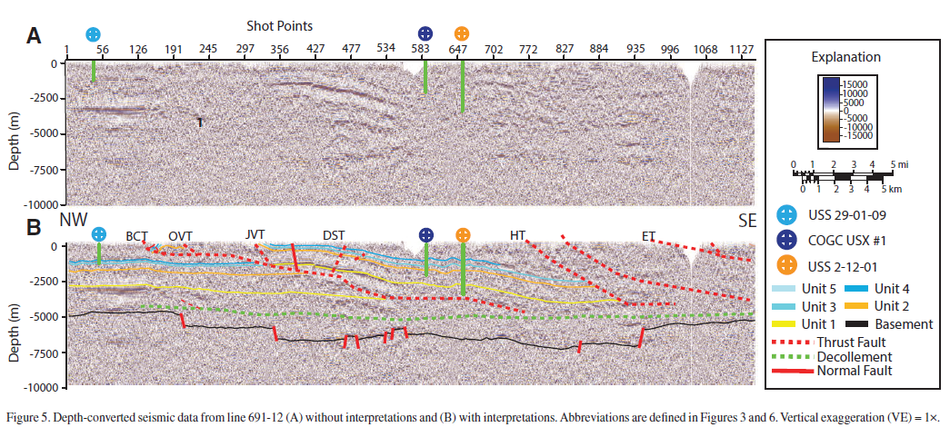
Alt text: A: Color seismic reflection profile of line 691-12 showing stratified reflectors to 10 km depth. B: Interpreted color seismic reflection profile of line 691-12 showing thrust faults, décollement, and basement.
Figure caption: Figure 5. Depth-converted seismic data from line 691-12 (A) without interpretations and (B) with interpretations. Abbreviations are defined in Figures 3 and 6. Vertical exaggeration (VE) = 1×.
Credit: From Robinson and Cato (2026; https://doi.org/10.1130/2025.1225(12)).
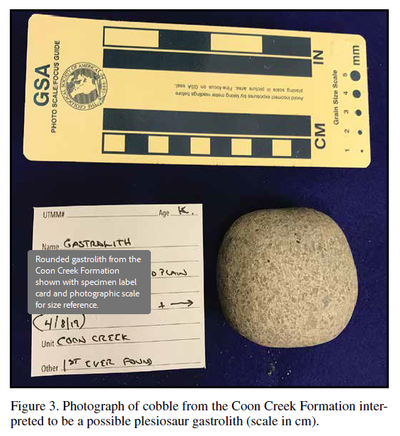
Alt text: Rounded gastrolith from the Coon Creek Formation shown with specimen label card and photographic scale for size reference.
Figure caption: Figure 3. Photograph of cobble from the Coon Creek Formation interpreted to be a possible plesiosaur gastrolith (scale in cm).
Credit: From Gibson et al. (2026; https://doi.org/10.1130/2026.0075(04)).