Geologist Makes the Case for Earth’s Most Overlooked Organ: The Ground Beneath Our Feet
In this article
Geologist Makes the Case for Earth’s Most Overlooked Organ: The Ground Beneath Our Feet
A thin layer of soil, groundwater, bedrock, and vegetation supports nearly all life on the planet—and a career geologist makes the case for giving it a bigger role in how we think about ecosystems.
Contributed by Alyssa V. Pietraszek, GSA Science Communication Fellow
Boulder, Colorado, USA: A thin layer of the Earth, ranging from just a few tens of meters to perhaps a few hundred meters, supports a global population of 8 billion people, and all of the wildlife, many marine organisms, and their encompassing ecosystems on the planet. This layer, known as the “critical zone,” extends from the base of active groundwater to the top of the vegetative canopy—and it is degrading.
“It envelops the Earth as a very thin layer…much like a human’s skin,” says Paul Doss, Professor Emeritus of Geology at the University of Southern Indiana. “Our skin is our body’s largest organ, so a comparison is reasonable. We as humans don’t always walk around thinking about our skin as an organ like our heart or lungs—I think the Earth’s critical zone gets the same neglect.”
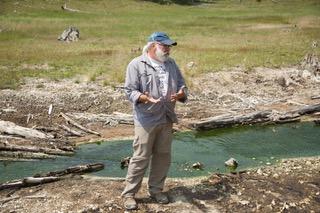
Nearly every important process for the sustenance of life occurs within this critical zone, the importance of which Doss has dedicated much of his career to highlighting. From his early work in the Indiana Dunes to his time working in Yellowstone National Park, the Everglades, and Manistee National Forest in Michigan, the inherent connection between geology and ecosystems has been consistently apparent.
Yet, despite these differences in environments and ecosystems, something Doss has also found to be consistent is the neglect of the geological foundation in ecological conversations. “In Yellowstone National Park, the absolute control of the biotic by the abiotic (geology) is on remarkable display, from microbial communities to the apex predators,” Doss states. “But I don’t always see the same recognition by life scientists. Importantly, when I’ve shared my thoughts about this with whoever will listen, ecologists have uniformly agreed that the abiotic is often neglected in their conceptual framework.”
This neglect is particularly noteworthy given the current state of the critical zone. Doss attributes the degradation of the critical zone to two main factors: human transformation of the Earth’s surface and climate change. Humans now move more sediment, soil, and rock across the planet’s surface than wind, water, ice, and gravity combined, and have altered more than half of Earth’s arable land as a result, fragmenting habitats and reshaping the hydrologic connections that ecosystems depend on. Climate change compounds this problem, altering fundamental processes like precipitation and streamflow. Together, these forces are driving extinctions, degrading habitats, losing biodiversity, and changing resource availability.
While these impacts play out on geological time scales spanning years, decades, and centuries, Doss hopes to help shed light on what these changes mean for us now. “The earth sciences define, describe, and provide an understanding of how our planet works,” Doss states. “We’ve only got one of those, and it seems kind of important that humans have that understanding ...particularly when we are so obviously capable of altering, damaging, and manipulating global-scale processes upon which life depends. We ALL need the critical zone. And so do our children and future generations. We better understand it, advocate for it, and care for it.”
Doss will discuss the critical zone further in his Michel T. Halbouty Distinguished Lecture, “Geologists in the Critical Zone…in a Critical Time,” at GSA Connects 2026 on Wednesday, 14 October from 12:15–1:15 p.m. in the Colorado Convention Center, room Bluebird 1AB, in Denver, Colorado, USA.
About the Geological Society of America
The Geological Society of America (GSA) is a global professional society with more than 18,000 members across over 100 countries. As a leading voice for the geosciences, GSA advances the understanding of Earth's dynamic processes and fosters collaboration among scientists, educators, and policymakers. GSA publishes Geology, the top-ranked geology journal, along with a diverse portfolio of scholarly journals, books, and conference proceedings—several of which rank among Amazon’s top 100 best-selling geology titles.
# # #
Contact Information
Contact:
Kalen Landow
+1-303-357-1016
klandow@geosociety.org