
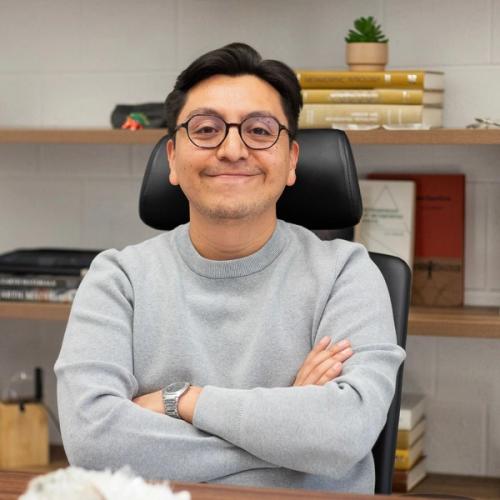
David Hernández Uribe
University of Illinois-Chicago
In this article
2026 Young Scientist Award (Donath Medal)
Presented to David Hernández Uribe
Citation by Tatsuki Tsujimori
David Hernández-Uribe has transformed our understanding of subduction-zone processes through his innovative integration of field geology, petrology, and thermodynamic modeling. Few early-career petrologists work across such a broad range: in a single research program, David has tackled how Earth’s earliest continents formed, how volatiles and mass move through subduction zones, what makes magmas fertile enough to form large, economically important mineral deposits, and how metamorphic rocks record the pressure–temperature history of orogens through deep time. What is most remarkable is not simply that he works across these topics, but that he addresses each with the same rigor and originality that most scientists reserve for a single specialty—a versatility that reflects both his intellectual curiosity and a rare capacity to move fluidly across disciplines without ever working superficially.
David’s path to this point reflects the same range that defines his science. He earned his B.S. in Geological Engineering at the Universidad Nacional Autónoma de México before completing an M.S. at Central Washington University and a Ph.D. in Geology at the Colorado School of Mines. Postdoctoral appointments at the University of Michigan and the University of Illinois Chicago followed, and in 2023 he joined the University of Illinois Chicago as an Assistant Professor, where he now leads an active international research group with students and collaborators spanning both hemispheres.
David’s research on oxidized, hydrous Archean magmas, published in Nature Geoscience, offers a new framework for understanding how continents first formed and grew, directly challenging long-held models of crustal evolution. This is not an isolated result: it builds on years of quantitative modeling of Archean magma generation that collectively reconstruct how mafic crustal overthickening produced the wet, oxidized magmas from which continents were built. Few scientists working on modern subduction zones also possess the depth of knowledge required to tackle the Archean Earth; David does both, and does both well, moving comfortably between problems separated by three billion years of Earth history without losing rigor in either.
That same depth carries into his core expertise: the petrology of subduction zones. Through phase-equilibrium modeling of subducted oceanic crust, David has clarified how oceanic lithosphere dehydrates and melts at depth, how eclogite-facies metamorphism proceeds, and how these processes govern the transfer of water, carbon, and trace elements from slab to mantle. His Geology paper on progressive lawsonite eclogitization, together with a substantial body of work on eclogite thermobarometry and metabasite phase-equilibrium modeling involving rocks from Mexico, China, and Japan, has refined how the community reconstructs pressure–temperature paths in some of the most complex metamorphic terranes on Earth. David has applied his tools internationally rather than settling into a single field area.
David then extended this same quantitative approach into economic geology, an unusual and productive leap for a petrologist. His recent Geology paper shows how strongly hydrous magmas derived from oxidized sources control porphyry copper fertility, offering the mineral exploration community a thermodynamic vector for identifying fertile magmatic systems. This line of research shows that David does not simply apply established tools to new problems; he uses them to forge productive connections between fundamental petrology and mineral exploration.
Beyond science, David has built a record of leadership and service well beyond what is typical for an early-career scientist. He serves as an Editor of Geochemistry, Geophysics, Geosystems, an AGU journal, and in 2025 he co-organized the GSA Penrose Conference on Eclogites, which also served as the International Eclogite Conference—the first time that meeting had been held in the United States. He has also convened sessions at GSA and AGU annual meetings that bring together researchers across career stages around shared scientific questions. He has mentored a rising generation of geoscientists across the United States and Latin America, advising students and serving on thesis committees, and has made a point of communicating science in Spanish as well as English through invited lectures, university courses, and outreach to bilingual classrooms in Chicago.
That said, he is, above all, a delight to work with. He brings the same energy and curiosity to a conference dinner or a field trip that he brings to a difficult thermodynamic model, and he has a gift for making colleagues at every career stage—from undergraduates to senior faculty—feel like part of the conversation. Students seek him out not only for his technical guidance but also for his warmth and generosity with his time. Colleagues describe him as approachable, funny, and endlessly enthusiastic—someone whose company they look forward to as much as his talks. That combination of scientific excellence and genuine collegiality is not incidental to his success.
Response by David Hernández Uribe
I am deeply honored to receive this year's Donath Medal. I thank Tatsuki Tsujimori for nominating me, and Wendy Bohrson, Sarah Penniston-Dorland, Donna Whitney, and Kennet Flores for their supporting letters.
At the Universidad Nacional Autónoma de México, I built my foundation and learned what a petrologist does, thanks especially to Roberto Maldonado and Alfredo Victoria, who mentored me from the very beginning.
I thank Chris Mattinson for the opportunity to show my potential in the United States as his master's student at Central Washington University. Wendy Bohrson supported me continuously at CWU and later at the Colorado School of Mines. My PhD advisor, Richard Palin, taught me to dream big, and to dare to publish in the best journals. I am also indebted to Robert Holder at the University of Michigan, who helped shape me into the scientist and mentor I am today. At UIC, Kathy Nagy provided invaluable support during my first years, and thanks to my students to keep me at the forefront of science. Throughout, I want to thank Kennet Flores for being a mentor and friend.
I also thank the Donath family and GSA, which funded my research and travel to present in this very venue ten years ago and now supports my students.
I thank my parents and sister, who taught me to pursue my dreams, work hard, and hold the values that brought me here. Finally, I thank my wife, Ameyalli, for her support every day and night. She is one of my greatest motivations and has helped me grow as a scientist, but more importantly as a person.