
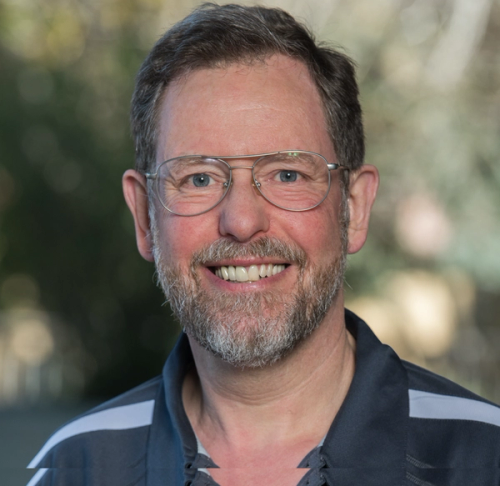
Simon L. Klemperer
Stanford University
In this article
2026 George P. Woollard Award
Presented to Simon L. Klemperer
Citation by Walter D. Mooney
It is a pleasure to introduce Simon Klemperer as our George P. Woollard award winner for 2026. Simon has had an outstanding career in crustal geophysics. His findings have had profound importance for our understanding of crustal architecture and deformation.
Simon was a major contributor to the then new field of deep seismic reflection profiling of the continental crust and mantle lithosphere. Simon's interpretation of the COCORP seismic line across the Basin and Range Province provided a fundamentally new look at the structure of this broad and complex extensional system. The work showed that the subhorizontal seismic fabric is related to ductile deformation and possibly magmatism in the deep crust during major crustal extension. Simon's work in the U.K. included studies of the deep structure of the Iapetus suture, the locus of the closure of the paleo-Atlantic.
Simon and his students have made tremendous contributions to the study of the deep crust beneath the Himalayas and Tibet. One outstanding program that he co-led was the NSF INDEPTH project that carried out seismic and other geophysical profiles across the Tibetan Plateau. Key discoveries included strong evidence for free aqueous fluids (and locally possible melt) in the middle crust. This discovery provided evidence that the weak middle crust beneath Tibet and other orogens could flow laterally, thereby producing the remarkable flat topography of the Tibetan Plateau and the Bolivian Altiplano. Likewise, crustal flow together with isostasy explain the observed smooth, flat Moho beneath Tibet and other orogens.
Simon has made significant discoveries concerning the origin of continents. He and his co-authors tested the oft-cited hypothesis that continental crust grows through the accretion of oceanic island arcs based on work in the Aleutians and in the Mariana arc. The remarkable conclusion is that much of these mafic/ultramafic cumulates are hidden in the low-velocity uppermost mantle beneath the arc.
Simon has provided helium isotopic evidence for the location of the suture between the subducting Indian lithosphere and the sub-Tibetan mantle wedge. This result helps to resolve multiple, mutually conflicting seismological interpretations of how far north the Indian plate extends beneath Tibet. More recent work has identified earthquakes in the sub-crustal mantle, a topic that continues to stir debate.
Simon has chosen his field study areas very wisely, selecting regions with a exceptional potential for scientific discovery. He has provided unique and highly creative insights that have influenced every other worker in his field. Simon richly deserves the year’s Woollard award.
Response by Simon L. Klemperer
Friends and colleagues: thank you for this honor. It is a privilege to be recognized by the Geological Society of America that has been deeply embedded in my scientific life. The first abstract I ever submitted was to a regional meeting in 1982, about the Adirondack lower crust. With the over-weening hubris of the new graduate student I was convinced I had made great discoveries - so much so that my thesis advisor studiously avoided visiting my over-interpreted poster; in retrospect I am grateful Google Scholar does not look back so far! More successfully, my PhD thesis on the Moho of the Basin-and-Range Province became my first paper in the GSA Bulletin and has deeply affected not just me but all my graduate students: the then copy-editor taught me a life-long lesson encapsulated in the name I mentally gave her, the mad hyphenater, and all my students must now scrupulously hyphenate their compound adjectives.
For any geophysicist in the GSA orbit, the Woollard award is an aspirational achievement, its importance highlighted by the previous medallists who include my mentors, several co-authors and cherished colleagues. Early Woollard honorees include Jack Oliver who during my Cornell PhD taught me how to do good science; Drum Matthews, my Cambridge post-doc adviser who taught me how to have fun while doing good science; and George Thompson, elder statesman at Stanford position, who added to those recipes his inspiring mentorship of students. Sadly, I can claim no connection to George Woollard, other than, for my first marine-geophysics cruise, shipping out on Hawaii Institute of Geophysics’ R/V Kana Keoki that was (unofficially) named for him. I am confident that I would not be standing here without the extreme privilege of having such accomplished mentors early in my career.
I have been fortunate in more ways than that: lucky that Cambridge undergraduates are required to take multiple sciences in their first year, without which I would never have taken a geology class and learned that I enjoyed fieldwork more than physics. Lucky that as I started my senior year, Geology published the seminal seismic-reflection imaging of the thin-skinned Appalachians by COCORP that led me to choose Cornell for my PhD with Jack Oliver and Larry Brown. Lucky that during my time at Cornell my citationist Walter Mooney organized a USGS refraction profile in Maine in which I participated, leading to his invitation to visit Menlo Park, and then - since Walter had unaccountably found no funds for my visit – Walter persuaded George Thompson to invite me to lead a seminar at Stanford. Lucky that as I wrote my PhD, the British Institutions’ Reflection Profiling Syndicate (BIRPS) was getting underway and Drum Matthews, returned from his sabbatical at Cornell, needed to hire post-docs to work on his flood of data. Lucky that during the heyday of deep reflection profiling and its many serendipitous discoveries, Stanford chose to hire a crustal geophysicist.
The final piece of luck I will mention is that when Cornell sought to export the COCORP seismic-reflection profiling model to the Himalaya, NSF insisted Cornell broaden the program to include wide-angle seismology. Cornell needed a pliant junior colleague for this subordinate role. Instead, they got me and so began my 30-year infatuation with Tibet and my rewarding association with many Chinese colleagues.
It has been a huge joy to work in all the Himalayan countries and around the globe, from Alaska to Africa; from the Caledonides to California; from the Marianas to the Middle East.
The most memorable occasions have been the moments of accomplishment in the field, when we happy few, we band of brothers (and sisters!) have overcome difficulties – climatic, politic, logistic – to bring home the data. The lure of exotic fieldwork (as well as access to Stanford letterhead) let me attract talented doctoral students with whom it has been a joy to me (and often a frustration to them) to work: Yizhaq Makovsky, Moritz Fliedner, Nikki Godfrey, Darcy Karakelian McPhee, Seth Haines, Kris Walker, Derek Lerch, Ewenet Gashawbeza, Kade Keranen, Marianne Karplus, Warren Caldwell, Shahar Barak, Mairi Litherland, Chris Castillo, Tianze Liu, Alex Blanchette, Shiqi (Axel) Wang, Xiaohan Song, Jason Craig, Junyi Gong. I take undeserved pride in what each one of you has achieved.
The Woollard legacy is the use of geophysics in the service of geology, and as such requires a breadth of expertise only achievable by true collaborative efforts and partnerships with my students, and with so many other more-junior and more-senior scientists. It is not only scientific collaborators who deserve my thanks, but the individuals behind the institutions that have enabled my work. I have been a happy warrior for geoscience only because Stanford and tenure allowed me to pursue sometimes extravagant ideas, because NSF generously funded them, and because IRIS and PASSCAL and UNOLS enabled them. In the 50 years since I first encountered geology, scientific culture has changed for the better. It is too soon to evaluate recent political turmoil, but there has been plenty of long-term change to celebrate progress in eroding gender bias, flattening academic hierarchy, and levelling institutional playing fields. We now recognize that our best undergraduates, though tabulae rasae, are as talented as our PhD students and as capable of full participation in the scientific process. As many of my undergraduate interns as my PhD students are already faculty – their subsequent mentors must have done something right! When I arrived at Stanford we and our neighbor the USGS had privileged opportunities for fieldwork because we owned a set of seismographs: FM-cassette recorders that could store 20 minutes(!) of single-channel data. But 35 years ago, IRIS-PASSCAL revolutionized academic controlled-source seismology by acquiring a national fleet of DAS (back when the abbreviation meant data-acquisition systems) that we warehoused and operated out of basement labs at Stanford. The deeper meaning of IRIS was the democratization of field seismology, providing equal access to every institution in the country. More important, NSF’s requirement that instrument users make all data freely available, and IRIS’ ability to serve these data to any scientist in the world, created a true meritocracy in which the most original ideas and best techniques emerge and flourish. This culture of scientific sharing has spread across all NSF Earth Sciences programs, and I hope it will spread across the globe to yield even higher societal rewards.
Today I recognize what a long, strange trip it’s been, but even as I celebrate how much I have learned about the Earth, I am invigorated by how much more discovery and understanding awaits all of us who play at the interface between geology and geophysics.