
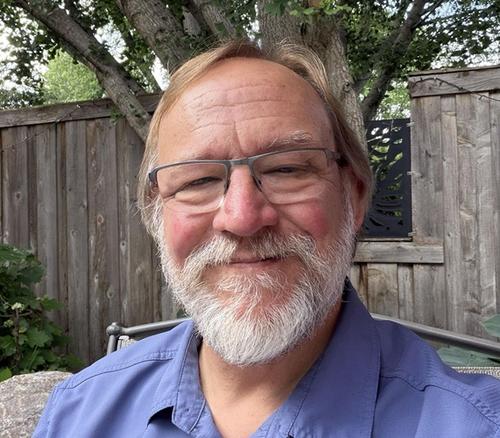
Brad Sageman
Northwestern University
In this article
2026 Laurence L. Sloss Award
Presented to Brad Sageman
Citation by Stephen Meyers
Dr. Bradley Sageman is the recipient of the 2026 Laurence L. Sloss Award for Sedimentary Geology, which is a fitting recognition of Brad’s achievements, an impactful career that continues to inspire.
An expansive and integrative way of thinking pervades Brad’s research contributions and his approach to doing science – a throughline that one can trace from his graduate years at CU-Boulder, mentored by Erle Kauffman, to his postdoc at Penn State mentored by Mike Arthur, and his years as a faculty member at Northwestern University, mentored by Larry Sloss himself.
Grounded in sedimentology and stratigraphy, a centerpiece of Brad’s research is the investigation of the processes that regulate carbon burial and, in turn, the chemistry of the coupled ocean-atmosphere system. His authoritative stratigraphic framework for Cretaceous deposits of the Western Interior Basin (WIB) underpins a body of work that integrates astrochronology, geochronology, geochemistry, paleoclimatology and paleobiology to resolve rates, mechanisms, and feedbacks during greenhouse climates. His career exemplifies creativity and the power of collaborative interdisciplinary Earth System science.
One excellent example of Brad’s integrative and collaborative approach is his work on high-resolution Cretaceous chronostratigraphy and paleoclimate, and the development of the state-of-the-art Cretaceous geological time scale. These topics converge in Brad’s work on cyclostratigraphy. Sageman et al. (1997) provided the first rigorous quantitative assessment of astronomical forcing in WIB deposits using high resolution geochemistry and stratigraphy combined with radioisotope geochronology and power spectral analysis. Much work followed – developing quantitative astrochronologic methodologies and applying them to Cretaceous strata, while also establishing a link between the distal basin records and the proximal shoreface expression of astronomical forcing. This framework then provided the foundation for Brad’s work to dramatically improve the precision and accuracy of the Cretaceous geological timescale, in collaboration with radioisotope geochronologists. The resultant timescales have been leveraged by Brad’s research team to reshape interpretations of oceanic anoxic events and carbon cycle perturbations, and even our understanding of the evolution of the Solar System, through careful evaluation of the preserved astronomical signals. This work has revolved around Brad because of the expansive and integrative way he thinks, including his remarkable ability to connect people and ideas and share knowledge.
Brad’s standout research contributions go well beyond this example – there is not enough space in this citation to do justice to them. Likewise for all his contributions to Northwestern (12 years as department chair!) and the broader community. But the most important contribution he has made is certainly the enduring positive impact on his students and colleagues, as a deeply caring and skilled educator, mentor, and colleague. To our good fortune, Larry and Northwestern found a rare, rare gem.
Response by Brad Sageman
It was 1991 and I was completing a post-doctoral fellowship at Penn State before moving to Northwestern University, where I had been offered a faculty position. The phone rang and a gruff voice announced “Sageman! I’m going to an SEPM meeting in Carbondale IL. You should meet me there! “ I stammered something like “I’ll buy the ticket right away!’ Thus began my too short association with one of the giants of sedimentary geology. I overlapped with Larry Sloss for about 4 years until his death in November of 1996. During that time, despite being in his 80’s and well into emeritus mode, Prof. Sloss would visit the department nearly every weekday that he was in town. And I would stop whatever I was doing when he came to visit my office. What a gift! That gruff exterior concealed a deeply caring, generous, and intelligent soul without whom I have to wonder if I might not have been offered the Northwestern job. For this reason, and many others, I am profoundly honored to receive the 2026 Laurence L. Sloss Award for Sedimentary Geology.
Two themes have been particularly important in my career - collaboration, and the synthesis of curiosity and creativity. The collaborations have always been far greater than the simple sum of their parts, and I am extremely proud of the work accomplished in these team efforts, none of which would have been possible without the excellent mentors, colleagues, and students with whom I have worked. I will endeavor to acknowledge some of the key people without whose support and comradery I would not be standing here.
My mentors exemplify a generation of earth scientists who deeply inspired me and taught me invaluable lessons. Some were direct supervisors, some more remote. Kennard Bork was a paragon of teaching excellence at Denison, and he helped facilitate my transition from biological to geological science. Erle Kauffman and Mike Arthur were my PhD and postdoc advisors, respectively at CU-Boulder and Penn State, and my gratitude to each is impossible to describe. Equally inspiring were Sy Schlanger and Hugh Jenkyns. All of these geologists inspired me to study black shales, ocean anoxic events and sedimentary cycles and opened a window into a wonderous Cretaceous world that totally ignited my curiosity.
In my department, Larry Sloss and Bob Speed were incredibly kind, and I had fruitful collaborations with other senior faculty like Abe Lerman and Ed Birchfield. Beyond the department, and beyond the Cretaceous, Carlton Brett’s generosity and excitement for all things Devonian was instrumental in my forays to the black shales of the Appalachian Basin.
I have been so lucky to work with amazing colleagues. Starting with grad school, the so-called Cretaceous Attack Team at the University of Colorado-Boulder included Jim Kirkland, Will Elder, Gus Gustason, and Mark Leckie. I have learned so much from each of them. Also, originally from CU-Boulder was Mike Gardner, who did his PhD work at School of Mines; Mike’s invitation to work on the Brushy Canyon Formation was part of a very long association (yes, it’s true – my band played at his wedding). In the early years at Northwestern, the late Dave Hollander was an exciting and engaging partner in research and advising, and our collaborations with Tim Lyons were both inspiring and productive. Various projects through the years allowed me to collaborate with so many other superb scientists, and more recent work on the geologic time scale would not have been possible without the excellent team of Steve Meyers, Brad Singer, Mark Schmitz, Dave Selby, Irek Walaszczyk, and Reishi Takashima. I have also enjoyed a wonderful collaboration over the years with two fine Czech geologists – Jiří Laurin and David Ulicny. Lastly, I was deeply fortunate to have two colleagues right in my own department with whom I have co-advised many students and completed many projects – Matt Hurtgen and Andrew Jacobson. Matt and Andy have brought their unique talents and expertise to our joint studies of geochemical dynamics associated with ocean anoxic events and I believe we have made some important contributions.
Finally, a heartfelt thank you to my students and post docs. We all know that while these collaborators may be advisees, they are also independent colleagues and we learn as much from them as we teach them. Every one of my students and postdoctoral advisees has brought different strengths and skills to the table and my gratitude for their hard work and creative contributions is boundless. I should also mention that one of the absolute highlights of my Northwestern career has been superb undergraduates, ranging from one of my very first advisees - who recently won a MacArthur fellowship - to my most recent students, one of whom has just published their undergraduate thesis work in Science. These examples speak to the amazing quality of Northwestern undergraduates and it has been an honor to work with all of them.
To conclude, I will say a final thing about mentorship – I was so incredibly lucky that Erle Kauffman and Mike Arthur not only shared their creativity and curiosity about the Cretaceous with me, but that they welcomed me into their lives as a friend – just as did Larry Sloss in those first years of my professional career. These generous acts of humanity set the standard for how I have approached mentorship and collegial relationships. As a result, I look out upon a world of cherished colleagues and friends and I feel so deeply fortunate to have worked with every single one. At a time when the perception of earth science beyond our community seems to be diminished, and I frequently find myself astonished at how few people appear to understand the importance of our science to the future, it is these relationships and people that give me the drive to keep standing up for geology, for the Geological Society of America, for the Division of Sedimentary Geology, and for all the organizations that support earth science. I hope you will all do the same. Thank you.