
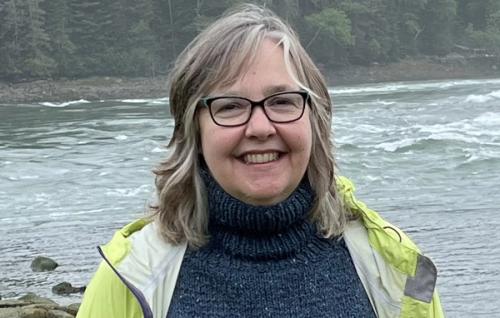
Alison Jean Smith
Kent State University
In this article
2026 Israel C. Russell Award
Presented to Alison Jean Smith
Citation by Sherilyn Fritz
Congratulations to Alison Smith as this year’s recipient of the Israel C. Russell Award in Limnogeology. Alison is being recognized for expanding our knowledge of the ecology of North American non-marine ostracodes and for applying fossil ostracodes to reconstruct the paleohydrology of North American lakes and wetlands during the Quaternary and the Neogene.
Alison, together with the late Rick Forester of USGS, spearheaded the development of an extensive database of North American ostracodes, named NANODe. This database included sampling of hundreds of lakes, wetlands, streams, and springs for ostracodes and their associated water chemistry to document species distribution along gradients of ionic composition and concentration. This tremendous community resource is now curated and maintained as part of the NSF-funded database, NEOTOMA.
Alison has used this foundational knowledge of ostracode ecology to reconstruct past hydrological variation in aquatic systems across North America, particularly in the Great Plains, Midwest, and Great Lakes regions. Of note are several seminal studies that elucidate the important role of groundwater in modulating a lake’s response to climate.
Alison also has had a leadership role in developing an ICDP proposal called PlioWest to drill several large paleolakes in the western US to reconstruct Plio-Pleistocene paleoclimate. The lakes were large pluvial systems that persisted through much of the Pliocene, and the project’s aim is to test several hypotheses about the climate dynamics associated with this warm wet interval of time.
In addition to her scientific contributions, Alison has been a devoted and active community citizen. She served as President of AMQUA, Vice-Chair of the US National Committee for INQUA, on the Council for Earth Cubed, and presently is a member of the Executive Committee for NEOTOMA.
In short, Alison has made a series of strong and varied contributions to the field of limnogeology. Her development of the ostracode database alone is a legacy that will continue long into the future. Moreover, her current work to explore the Plio-Pleistocene paleolakes of western North America is a fitting addition to the foundational work of Russell himself on western lakes and crystalizes why she is a superb recipient of this award in his honor.
Response by Alison Jean Smith
I am honored to receive the 2026 GSA Limnogeology Israel C. Russell Award and would first like to thank Sheri Fritz for her kind words in the award citation. I also thank Dan Ibarra for graciously agreeing to accept this award in my absence.
Israel C. Russell – how proud I am to receive an award bearing his name. Geologist, geomorphologist, paleolimnologist, and intrepid explorer! His description of first seeing Lake Abert in the far northwestern corner of the Great Basin, observed from horseback on a solo trip across southern Oregon in the 1880’s, is captivating. Seeing the lake long before dam construction, he grasped how it fitted into the landscape, and its significance in the Great Basin. He went on to work with G.K. Gilbert, wrote several books on Great Basin paleolake deposits with detailed descriptions of Mono and Pyramid, and became professor at University of Michigan and President of the Geological Society of America.
We each have taken different paths in our own deepening fascination with geology and lakes, but in all cases, collaboration with colleagues is at the heart of it all. I was introduced to the field of paleolimnology by Fred Swain of the University of Minnesota and University of Delaware. He had mapped lake deposits up and down the geologic time scale throughout the western United States and had an astonishing recall of stratigraphic sections. He was the first to show me the significance of paleo lake basins. Later, I was fortunate to work with Rick Forester of the U.S. Geological Survey, who, along with Joe Donovan (West Virginia University), introduced me to groundwater-surface water interactions and the role of groundwater in the hydrology, ecology, and geomorphology of aquatic systems. Rick started the ostracod database which we continued to build in later years, along with colleagues Brandon Curry and Donald Palmer. It was Tom Webb who opened so many avenues for me during my doctoral work, including work with colleagues at the Limnological Research Center, and introducing me to multi-proxy paleoclimate analysis. While at Brown I met Eric Grimm, who encouraged me to expand the developing ostracod database and bring it into what became the Neotoma Database, where it is housed today.
The fun of collaborating with great colleagues and students is undeniable. But of course, there is more to the study of limnogeology than this. Never before have we had so much information available, and so many important societal and scientific questions to answer. The complex links in aquatic systems that sustain metacommunities, from micro-organisms to bird flyways, the short-term and long-term processes that lead to sustainable surface water and the switches and pinch points that control them are fundamentally a story of the history and fate of water. Paleolake records hold answers to many of our questions, and as you know, time is short and the need for answers is great. Reading these records is a lifelong pursuit and something to be passionate about. Thank you again for this award.