
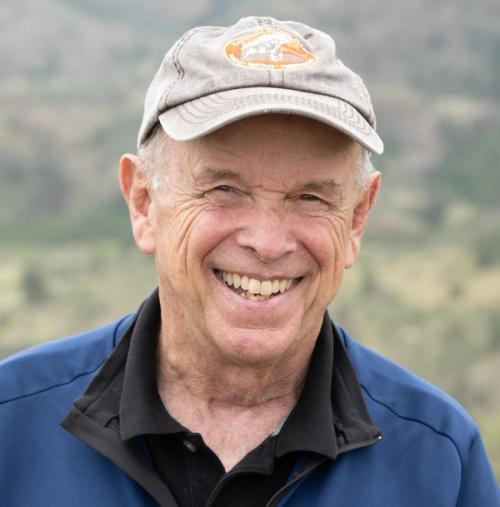
Thomas J. Casadevall
US Geological Survey
In this article
2026 GSA Public Service Award
Presented to Thomas J. Casadevall
Citation by Daniel Tormey
Thomas J. Casadevall is a superb example of geology in public service. Across a remarkable career in volcanic hazards, federal science leadership, emergency response, aviation safety, geoheritage, and international conservation, Tom has repeatedly shown that geology is not only a science of Earth processes, but a practical discipline of public responsibility. His career joins scientific authority with calm leadership, field experience, humility, and a deep commitment to helping communities, governments, and nations make better decisions.
Tom’s public-service arc was shaped early by one of the defining geologic events of modern time: the 1980 eruption of Mount St. Helens. As a young USGS scientist, he experienced firsthand the urgency of volcanic crisis response, the need for clear leadership, and the importance of translating geologic understanding into public action. Mount St. Helens became a career-defining event, not only scientifically, but as a lesson in what people need from geologists during danger and uncertainty. Decades later, Tom continued to return to Mount St. Helens as a teacher, helping younger scientists understand the eruption and ensuring that hard-won knowledge passed across generations.
That commitment deepened during Tom’s 1984–1988 time in Indonesia, which he has described as a career highlight. Working in one of the world’s most volcanically active regions, he saw volcanic hazards as both local and global, and it was there that he was first exposed to the danger volcanic ash poses to aviation. The lesson was urgent: ash clouds could travel far from erupting volcanoes, evade conventional detection, damage aircraft, and put passengers at risk. Tom helped turn those lessons into practical systems of warning, communication, and safety. His later leadership in volcanic ash and aviation safety helped bring together volcanologists, meteorologists, air traffic managers, pilots, aircraft manufacturers, and international agencies around a shared public-safety mission.
Tom brought the same public-service philosophy into senior leadership at the U.S. Geological Survey. As Regional Director, Deputy Director, and acting Director of the USGS, he worked to make earth science visible, credible, and useful to decision-makers and the public. The USGS addresses some of society’s most consequential challenges: natural hazards, climate change, water availability, resource development, and stewardship of the landscapes and systems on which communities depend. Tom understood that technical excellence is only part of the mission. Science must be available when society needs it, and leaders must create conditions in which scientists can serve effectively.
Nowhere was that clearer than in Tom’s leadership during Hurricane Katrina. When flooding stranded people across New Orleans, Tom recognized that this was no ordinary disaster and authorized the use of USGS people and equipment in the rescue effort. USGS teams rescued 600 people directly, aided some 2,000 more, converted thousands of emergency calls into geographic coordinates for responders, produced maps and data products, supported emergency managers, and helped document the dewatering of flooded areas. This was geology and geography in immediate service to life. Colleagues credited the “can do” attitude of the response to Tom’s support, trust, and judgment; the team was later honored with Service to America recognition, and Tom’s broader federal service was recognized with a Presidential Rank Award.
After becoming Scientist Emeritus in the USGS from 2008, Tom did not step away from service. Instead, he turned his experience outward into geoheritage. Through IUCN, the World Commission on Protected Areas, World Heritage evaluations, GSA, and the U.S. Advisory Group for Geoheritage and Geoparks, Tom has helped build bridges among science, conservation, parks, communities, and international heritage practice.
A major expression of this work was his leadership of the IUCN international review World Heritage Volcanoes: Classification, Gap Analysis, and Recommendations for Future Listings. Tom led this work voluntarily, convening an exceptional team of co-authors and ensuring that the wider volcanological community contributed to the study. The report remains a key reference for countries seeking to understand, compare, and protect volcanic geoheritage of potential World Heritage value. In this, Tom extended the same public-service ethic that marked his USGS career: scientific knowledge should be shared, made useful, and placed in service of places and people.
Tom has also chaired the U.S. Geoheritage and Geoparks Advisory Group, helping the group move into GSA and a broader public voice. He has been instrumental in introducing America’s geologic heritage to international audiences and in strengthening the connection between American geoscience, parks, protected areas, and global conservation. His work has helped demonstrate that geoheritage is not a niche interest, but a vital part of how societies understand Earth history, landscape, hazards, culture, and stewardship.
What makes Tom especially deserving of GSA’s Public Service Award is the combination of achievement and character. His work spans Mount St. Helens, Indonesia, volcanic ash and aviation safety, Hurricane Katrina, USGS leadership, World Heritage, IUCN, geoheritage, and GSA service. But colleagues also know him as warm, generous, kind, curious, and deeply attentive to others. He listens across generations and cultures. He brings people into the work. He treats expertise as a responsibility to be shared.
For these reasons, Thomas J. Casadevall embodies the highest ideals of geology in public service. He has helped protect lives, strengthen public institutions, advance hazard preparedness, conserve geological heritage, and inspire colleagues around the world. His career reminds us that geology is not only the study of Earth. In the hands of a public servant like Tom Casadevall, geology becomes a way of serving society.
Response by Thomas J. Casadevall
Thank you, President Thackery, and my colleague Dan Tormey, for these kind remarks. It is a great honor to receive the 2026 GSA Public Service Award.
After nearly 19 years as a retiree and volunteer Scientist Emeritus with the USGS, I am reminded that our efforts are noticed. Geology is unusual: we may retire from our jobs, but rarely from our fascination with the Earth—or our appreciation for those who came before and those who follow.
Over my 50-year career, I have been fortunate to work with generations of scientists who share a commitment to earth science in public service. My colleagues at the USGS, NPS, EPA, NOAA, and other agencies demonstrate that science can be a powerful way to serve the public.
I am deeply grateful to my family, academic mentors at Beloit College and Penn State, colleagues, and friends around the world. This honor belongs to all of them as well.