
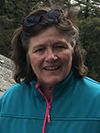
Lucile M. Jones
Dr. Lucy Jones Center for Science and Society
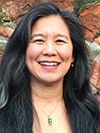
Yumei Wang
Portland State University
2022 GSA Public Service Award
Presented to Lucile M. Jones and Yumei Wang
Citation by David Applegate
Dr. Lucy Jones is recognized for her efforts raising public awareness of disaster risks and for helping communities become more resilient. During a 30-year career with the U.S. Geological Survey (USGS), Dr. Jones was an extraordinary public servant, matching scientific achievements with dedication to advancing preparedness for earthquakes and other natural hazards. Her post-USGS career path has continued to advance the application of science to community resilience and demonstrated her commitment to communicating science to the public.
Early in her career with the USGS, Dr. Jones conducted path-breaking research on earthquake occurrence probability. She was the first to estimate the short-term probability of additional earthquakes in a sequence through the development of the statistics of foreshock and aftershock sequences. Since then, Dr. Jones expanded the scope of her research into the realm of risk and vulnerability studies to improve knowledge transfer across multiple natural hazards. She created and implemented a new approach to risk assessment research by taking scenario development to a new level, integrating state-of-the-art investigations across multiple disciplines to develop a comprehensive depiction of the plausible consequences of catastrophic natural disasters. The resulting scenarios continue to be used at all levels of government and the private sector to reduce risk. The most widespread benefit of the ShakeOut scenario is the public education campaign that she developed in conjunction with the Southern California Earthquake Center and which was subsequently adopted by the American Red Cross, FEMA and many other organizations. It remains the largest public earthquake safety drill in the world with tens of millions of global participants each year.
Before retiring from the USGS, Dr. Jones spent a year as a science advisor to the Mayor of Los Angeles, Dr. Jones spearheaded a consensus approach to improving building safety, a comprehensive program to strengthen the City’s water infrastructure, and convening the State’s utilities to address the vulnerabilities posed by lifelines crossing the San Andreas Fault. In 2016, Dr. Jones moved on to her next career, founding a non-profit organization, the Dr. Lucy Jones Center for Science and Society, to continue her efforts at community-level knowledge building on disaster resilience. She has also published a popular science book The Big Ones: How Natural Disasters Have Shaped Us (and What We Can Do About Them).
Dr. Jones has long been the approachable voice of authority on natural hazards and disaster risk reduction in Southern California, nationally and globally. When disaster strikes, the world's major media outlets turn to her for answers, and time and again she has seized the teachable moment to the benefit of all. Her skill in communicating with reporters and connecting with the public has made her one of the most trusted scientists in America. She has also excelled at the creation of communication products. The handbook for the public she wrote after the 1994 Northridge earthquake, Putting Down Roots in Earthquake Country, has been adapted for other seismically active regions of the United States and translated into Spanish and several Asian languages.
Dr. Jones has served on committees of the National Academy of Sciences on multiple occasions. She has chaired the California Seismic Safety Commission and the California Earthquake Prediction Evaluation Council. She has served on blue-ribbon commissions impaneled by state and local governments to address major infrastructure projects and other high-profile endeavors. Her work has been recognized with the Department of the Interior’s Distinguished Service Award, the Alquist Award from the California Earthquake Safety Foundation, the Award of Merit from the Los Angeles County Emergency Preparedness Commission, and many other honors.
Dr. Lucy Jones is a worthy recipient of the GSA Public Service Award for her great commitment to turning knowledge into practice so that science can make a positive difference for communities at risk.
Response by Lucile M. Jones
Dr. Lucy Jones is recognized for her efforts raising public awareness of disaster risks and for helping communities become more resilient. During a 30-year career with the U.S. Geological Survey (USGS), Dr. Jones was an extraordinary public servant, matching scientific achievements with dedication to advancing preparedness for earthquakes and other natural hazards. She led the development of scenarios that have sparked a science-based approach to earthquake preparedness that now involves tens of millions of people worldwide. As a senior advisor to the Mayor of Los Angeles, Dr. Jones spearheaded a consensus approach to improving building safety and strengthening the City’s water infrastructure. Dr. Jones has long been the approachable voice of authority on natural hazards. When disaster strikes, the world's major media outlets turn to her for answers. Her skill in communicating with reporters and connecting with the public has made her one of the most trusted scientists in America.
Citation by Jeff Rubin
Yumei Wang has dedicated most of her professional career to making communities safer and more resilient through research, public policy, public outreach, and professional service.
Yumei has been a continual presence in the Pacific Northwest, pushing the Cascadia Subduction Zone and other seismic hazards into public consciousness – and policy – for more than 25 years, including as a convener for the 2000 Penrose Conference on the Great Cascadia Earthquake Tricentennial. She has served as a geologist, geotechnical engineer, and was a Resilience Engineer with Oregon’s Department of Geology and Mineral Industries; she’s now Affiliate Faculty and Senior Advisor on Infrastructure Resilience and Risk at Portland State University. Her work on lifelines, hospitals, and other interdependent infrastructure has identified critical vulnerabilities and provided paths forward. She has filled leadership roles in two FEMA regional earthquake consortia, served on a range of professional and technical committees, and has performed several post-earthquake reconnaissance missions. Her participation on the National Academies Committee on State of the Art and Practice in Earthquake Induced Soil Liquefaction Assessment helped address a major hazard in the US and abroad.
Her technical contributions are equaled – and enhanced – by her engagement with policymakers, emergency managers (including me) and responders, and critical infrastructure owners and operators. She continues to engage the public as well, from broadcast media to op-eds, and formal presentations to science pubs. She currently serves on national and state ShakeAlert outreach committees, helping bring a long-awaited resource to the Pacific Northwest. From her days as an AAAS Congressional Science Fellow, through chairing Oregon’s Seismic Safety Policy Advisory Commission, and helping steer the Oregon Resilience Plan to completion, she has become a trusted partner in policy development.
Yumei is a fellow of the American Society of Civil Engineers, past Chair of their Council on Disaster Risk Management and Technical Council on Lifeline Earthquake Engineering, and received their LeVal Lund Award for Practicing Lifeline Risk Reduction. She also has received the Earthquake Engineering Research Institute’s Alfred E. Alquist Special Recognition Medal, for substantial contributions to seismic safety and earthquake risk reduction, and Engineer of the Year from the Professional Engineers of Oregon.
Thanks to Yumei, everyone who steps into Earthquake Country is safer.
Response by Yumei Wang
Thank you to the GSA awards committee for this wonderful honor and to Jeff Rubin for his very gracious nomination.
An ancient Chinese proverb advises us, “when you drink water, remember the source”. Receiving the GSA public service award feels like a deep and nourishing drink of water on the path of my career, and I would like to remember and recognize the abundant source of this award.
Over the years—in my work at the interface of science, public policy, and public safety—I have had the privilege and great fortune to work with so many talented and dedicated people. This has included colleagues in science and engineering, elected officials and policy makers, representatives from industry and concerned members of the general public. Together—with persistence and patience—we have pursued a vision of communities that are more resilient and safer from geologic disasters. This award is equally in recognition of the efforts of so many other people.
I would like to recognize especially several gifted geoscientists who have played important roles along the path of my career:
• Mr. Lloyd Cluff, preeminent earthquake geologist, who hired me as a geotechnical engineer fresh out of graduate school before the 1989 Loma Prieta, California earthquake. That earthquake, and Lloyd’s influence and guidance, helped to start me on a career in disaster resilience.
• Dr. Don Hull, former Oregon State Geologist, for teaching me that politics and media play an important role in improving the public’s safety. Over the course of my 26 years at the Oregon Department of Geology and Mineral Industries (DOGAMI), Dr. Hull and other colleagues at DOGAMI shared their expertise and support.
• Dr. Scott Burns, Portland State University geologist, for his enthusiasm in teaching me about the geology and geomorphology in the Cascadia region.
• Dr. Brian Atwater, U.S. Geological Survey geologist, for warmly welcoming me into the community of scientists studying the Cascadia subduction zone.
• Dr. Chris Goldfinger, Oregon State University geologist, for sharing his research activities and findings along the Cascadia margin.
• Dr. Jeff Rubin, emergency planner and geologist, for his belief and confidence in my demanding and idealist vision for how to best create disaster resilience.
I began working on hazards related to the Cascadia subduction zone at a time when there was a profound lack of awareness and understanding of the enormous societal risks posed by a great Cascadia earthquake. Since then, I have worked with some success to heighten public awareness of the importance of preparing for these disasters. I have also worked on the development of policies and programs to address these risks by improving the safety of schools, emergency response facilities, and essential lifelines related to energy, water, transportation and communication systems.
Despite our progress—with successful programs to identify and fix dangerous school buildings, emergency response facilities, and lifeline systems—we have only begun to address this critically important problem. We continue to build in areas susceptible to great destructive geologic forces, such as on flood plains with liquefiable soils, mountainsides with unstable slopes, and coastal areas at risk of tsunami inundation. As society increases its reliance on modern lifeline services that have been built on older and vulnerable infrastructure systems, we are setting ourselves up for continued disasters—only bigger and more frequent. There is a sobering amount of work ahead to lower the risk from geologic hazards, including earthquakes, tsunamis and landslides—work that should include:
• Improving building codes to require “functional recovery”, in which structures and lifeline systems are designed to better tolerate geologic and extreme weather-related forces, and to control the damages so they can be quickly mitigated.
• Retrofitting existing critical facilities that serve as community safety nets, such as schools, fire stations and hospitals, so they will be available to perform their duties after major disasters.
• Increasing safety standards for facilities containing hazardous materials so that uncontrolled releases do not cause catastrophic harm.
• Assuring that our policies and programs to improve community safety from geologic and weather hazards are inclusive of those members of society who are disadvantaged and less able to take care of themselves.
Again, thank you for this award in recognition of important work to increase the resilience of communities and improve public safety from geologic hazards. I firmly believe that no geologic hazard needs to result in a human disaster. It is within our ability to make that so. My hope is that our collective commitment and efforts to better understand and reduce the societal risks of these hazards will continue to grow and will leave the world a safer place for our children.