
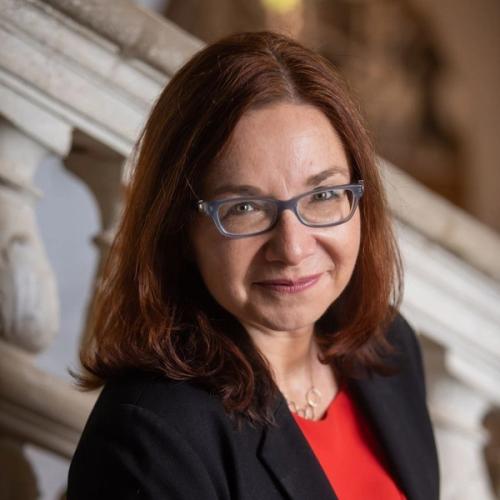
Katharine Hayhoe
Texas Tech University
In this article
2026 GSA President’s Medal
Presented to Katharine Hayhoe
Citation by Nathan A. Niemi
The President’s Medal of the Geological Society of America is conferred on individuals, groups, or entities whose impact has profoundly enhanced the geoscience profession through advancing geosciences, enhancing professional growth, and promoting geosciences in service of humankind. I am proud to present this year’s President’s Medal to Katharine Hayhoe, an atmospheric scientist whose research, writing, and public engagement have transformed how the world — and how previously unreachable audiences within it — understand the Earth system. Her work is especially consequential now, as the institutional foundations of atmospheric and climate science face extraordinary strain.
Dr. Hayhoe’s scientific work, based at Texas Tech University and in her role as Chief Scientist of The Nature Conservancy, has produced peer-reviewed research on regional climate modeling, extreme event analysis, and the translation of global projections into actionable guidance for communities and national assessments. She has served as a lead author on multiple U.S. National Climate Assessments and on reports of the Intergovernmental Panel on Climate Change, and in a 2021 essay in Science she articulated a values-based framework for climate engagement that has shaped how a generation of Earth scientists engages the public.
What further distinguishes Dr. Hayhoe is her gift for carrying Earth science into rooms where it has rarely been welcomed. Through her PBS series Global Weirding, her book Saving Us, her Talking Climate newsletter read by tens of thousands each week, her TED talks viewed by millions, and her patient engagement with faith communities, rural audiences, and long-standing skeptics, she has shown that geoscience can speak across political and cultural divides without surrendering its rigor. Her American Scientist handbook on climate conversation has become a touchstone for colleagues learning this craft. Delivered with rigor and grace, her approach is a model for scientists communicating beyond their disciplines, and persevering when the scientific enterprise itself is buffeted.
Her honors, including the TIME 100, the United Nations Champion of the Earth designation, and the American Geophysical Union’s Climate Communication Prize, reflect the reach of that work. More importantly, her example has expanded the public constituency for the geosciences at precisely the moment the discipline most needs it.
For her scientific contributions, her singular achievements in climate communication, and her sustained service to humankind through the geosciences, Katharine Hayhoe is highly deserving of the President’s Medal of the Geological Society of America.
Response by Nathan A. Niemi
Thank you to the President and Council of the Geological Society of America for this tremendous recognition. I'm honored to receive this medal, and grateful for a citation that recognizes the work of building a public constituency for the geosciences. That work belongs to all of us, as it benefits not only our community, but our global future.
While the citation describes some of the audiences I engage with as "previously unreachable," and I appreciate the sentiment, one of the biggest things I’ve learned is that most people are more reachable than we might think.
Take a water district board in West Texas: their whole job hinges on understanding hydrology and they know something’s changed. Similarly, anyone who’s witnessed a record-breaking flood, a new drought of record, or days of wildfire smoke choking the sky: they understand something’s wrong. They’re just not sure why and, even more importantly, they don’t know what they can do about it that’s consistent with their identity and their beliefs.
That’s why it’s so important to make what I think of as the head-heart-hands connection. As scientists, we’re all about the head: data, monitoring, modeling, and assessments. We observe, analyze, and make sense of the facts. But the heart explains why the facts matter: the people and places we love are at risk. And the hands are arguably the most important piece: what we can do about it, concrete solutions that build a better future.
Today, the scientific institutions we depend on to do our “head” work are under extraordinary strain. How do we get through that? We need to stand together, and we need to be talking with more people outside these walls, because a public that understands what we do is key to ensuring the future of our work for their benefit.
So, when someone asks you to speak at your local community center or church or Rotary lunch – please say yes. And when you do, bring not just your head, but also your heart and our hands. That's how we build that public, one conversation at a time. Thank you.