
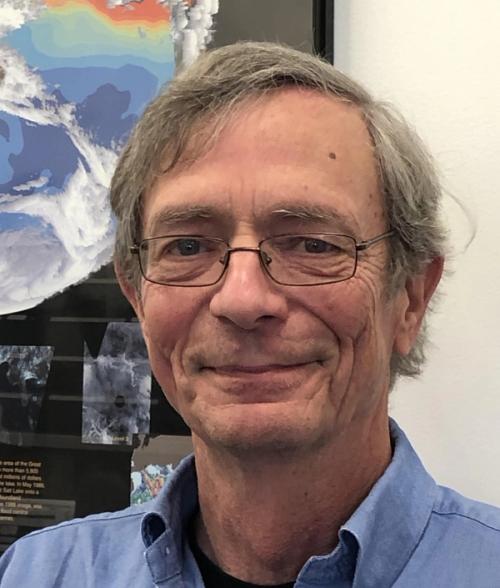
Frank S. Spear
Rensselaer Polytechnic Institute
In this article
2026 Penrose Medal
Presented to Frank S. Spear
Citation by Dr. Matthew J. Kohn:
It is with great pleasure that I introduce Frank Spear as this year’s recipient of the Penrose Medal. The Penrose Medal is GSA’s highest honor and is generally awarded in recognition of the lifetime achievements of an eminent scientist. All too often, we think this refers solely to past performance, and that our friend and colleague has already put up their feet, passed their prime, they’re yesterday’s news, a faded rose, or something similar. Not so for Frank Spear, though, because he remains, as he ever was, a vibrant, productive, and creative scientist. I should comment that when Frank received the Dana Medal, which is a mid-career award, in 2008, he asked somewhat plaintively whether that meant he had to work until the mid 2030’s. I suppose that’s up to him, but we would be happy if he does.
But more seriously, Frank Spear is known widely for his numerous accomplishments, not just the Ferry and Spear garnet-biotite thermometer, which has become an example for how to use mineral compositions to calculate temperatures in rocks. Not just his work with Jane Selverstone that showed how thermodynamic inversion of chemical zoning in minerals can be used to calculate pressure-temperature paths – a pivotal moment in tectonics research that drives our science today. Not just his massive Big Blue textbook on metamorphism and P-T-t paths, which has guided a generation (or more) of researchers in petrology and tectonics. Or his series of papers on trace element zoning in minerals and links to geochronology, which helped found the field of petrochronology. Or his series of papers on reaction overstepping and implications for metamorphic reactions and P-T paths. Or his recent series of papers on kinetics of element movement in rocks and implications for quantitative interpretation of the metamorphic record. Any one of these accomplishments would warrant recogntion. In combination, they have defined the course of metamorphic petrology and tectonics research for nearly 50 years. Philip England, who is most definitely not a petrologist but appreciates its link to geodynamics, commented that if weren’t for Frank, the field of metamorphic petrology and tectonics would be lost.
But I expect you don’t really want to hear me recite Frank’s accomplishments. It’s more likely that you want to know: What’s he really like? Well, I can tell you that Frank Spear can be one of the most annoying scientists on the face of the planet. He’ll take some little detail that you never thought too much about – Why are garnets chemically zoned? How are trace elements distributed in crystals? Why do crystals nucleate and grow? – something that seems like a mosquito in a room full of elephants. And he’ll hide away in his office and write some arcane computer code to model this mathematically. And then he’ll take his results and show you how the solution to what you thought was a teeny-weeny little problem actually explains huge questions that people have been trying to understand for generations. How do Earth’s plates interact when they collide? What are the rates of rock movement through the crust? To what degree can we even trust thermodynamic calculations in rocks? What does a geochronologic measurement actually mean for a crystal? Dave Pattison described a typical Frank Spear contribution as like a beam of light through the fog – it simultaneously illuminates a research question and directs us all in the best path forward. However you want to describe it, Frank’s work has defined the course of our research. What makes him so annoying is that each time it happens you can’t help thinking: What, again? How did he figure that out so easily? And perhaps, if you’re like me, you also wonder: “It seems so obvious, why didn’t I think of that?” And, of course, the answer is simple. Because there’s only one Frank Spear.
In closing, I also want to say that Frank is incredibly fun, kind, and generous. Hey, he doesn’t mean to be annoying. But he made all his code and calculations available for free to anyone who wanted it, long before code-sharing became the norm. He’s supported scores of scientists of all ages, genders, and nationalities without bias. He required the Mineralogical Society of America to charge a rock-bottom price for his Big Blue Book so that everyone could afford it. In all my travels around the world, I have never encountered a researcher in metamorphic petrology or tectonics who did not know Frank and respect his work mightily. And he’s not just a computer guy. All his work is founded on key chemical measurements on rocks he’s collected in the field. When I was a graduate student, Frank dusted me on a relentless ascent up Mount Moosilauke, in New Hampshire. I expect he still could.
To sum up, we are lucky to have Frank Spear. To repeat Philip’s comment, we would be lost without him.
Response by Frank S. Spear
It is truly an honor to have been selected for to be the 2026 recipient of the R.A.F Penrose Medal. I can only think that Matt and my other letter writers must have written some unreasonably flattering things about my work, but I am nevertheless grateful and more than a little humbled to receive this recognition, especially considering the list of past recipients. I certainly didn’t start out my career hoping to someday win a medal, but I am well aware that I have been extremely fortunate as well as lucky to have picked a career that let me pursue whatever topics I choose. It is surely one of the best reasons to become a scientist and an academician. When I first started studying geology, plate tectonics was relatively new and blueschists were all the rage so choosing to attend UCLA and work with Gary Ernst was an easy decision. Gary always made it very clear that the reason we study metamorphic rocks is to understand the tectonics and that is certainly a lesson that I tried to stick with. While at UCLA I had the great fortune of getting to know Doug Rumble who taught me how to apply thermodynamics to metamorphic rocks and how to make sense of the myriad of assemblages and textures. And I confess that what I found most fascinating was how to represent the beauty of a metamorphic rock as a system of equations. This may seem like an odd attraction, but I still find it fascinating that the application of fundamental principles can be used to elucidate complex metamorphic parageneses. At some point along this journey, Rick Ryerson accused me of “…making metamorphic petrology too difficult”. Well, it wasn’t easy for me either but eventually I thought I knew enough to write the “Big Blue Book” mostly so that I wouldn’t forget everything I had struggled so hard to learn.
I have a distinct memory of my first encounter with a metamorphic P–T path, which was through the seminal paper by Phil England and Steve Richardson. What I took from that paper was the notion that the sequence you see on the ground in a metamorphic terrane isn’t the same as the rock path nor is it reflective of the crustal geotherm and any given time. This was certainly a new concept to me, and I wondered whether the chemical zoning in garnet could be used to extract the actual P–T path followed by a rock — and that launched the next 30 years of my career.
I have also been blessed with the opportunity to share this journey with outstanding colleagues, students, friends, and an incredibly supportive family and for this I am infinitely grateful. There are far too many to thank them all but I want to especially acknowledge the major impacts that Jack Cheney, John Brady, Matt Kohn, Mark Harrison, Dave Pattison, Jane Selverstone, Simon Peacock, Gerhard Franz, John Ferry, and Doug Rumble have had on not only my enjoyment of rocks but on my quality of life. Thank you all for sharing this journey with me — you are the best.