
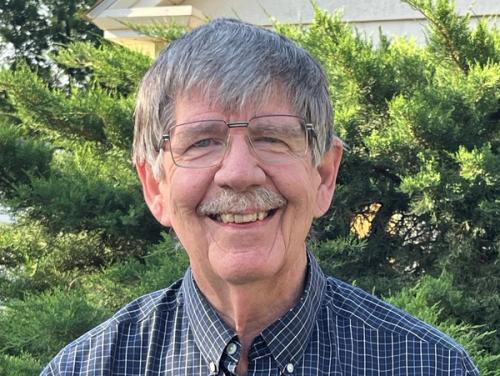
Calvin Barnes
Texas Tech University
In this article
2026 Distinguished Geologic Career Award (MGPV Division)
Presented to Calvin Barnes
Citation by Carol D. Frost
Given my great appreciation for Cal Barnes as a friend and colleague and my equally great admiration for his many scientific contributions, I take tremendous pleasure in introducing Cal as the 2026 Distinguished Career Award by the Mineralogy, Geochemistry, Petrology, and Volcanology (MGPV) Division. This award recognizes individuals who take a field-based, multidisciplinary approach to geologic problem solving, a description that describes Cal’s scientific approach perfectly. Over a career spanning more than four decades, he has established new and more complete understanding of plutonic systems and their tectonic context. He is a generous colleague who has shared his expertise with dozens of collaborators and more than 40 graduate students, to the benefit of all.
Cal’s work clarifying tectonic and petrologic relationships in the classic accretionary complex of the Klamath Mountains established him as a foremost expert on arc plutonism in orogenic belts. His early recognition of tilted plutons in arc sections enabled him to describe magmatic processes at various crustal levels. Studies of tectonic and magmatic processes in the Klamath accretionary arc in GSA Special Paper 410, co-edited by Cal, built on his early work and were foundational for ongoing research by Cal and others.
In the 2000s Cal undertook multidisciplinary investigations of the Helgeland Nappe Complex, combining careful field study with geochronology, geochemistry, and petrology to elucidate the complex interplay of plutonism, metamorphism, and sedimentation during contractional orogenesis. The results of this research were the focus of the 2011 Eurogranites field trip. He was elected to the Royal Norwegian Society of Science and Letters in recognition of his contributions to the geology of north-central Norway.
More recently Cal developed applications of trace element systematics of rock-forming igneous minerals to describe the evolution of plutonic systems. This information, combined with careful textural evidence, led to evidence for magma defrosting in plutonic rocks.
In addition to his research accomplishments, Cal has served as department head, editor and reviewer, and in multiple roles at GSA including almost every position in the MGPV Division and the Cordilleran Section, responsibilities he describes as “mostly fun.” Please join me in celebrating a lifetime of accomplishment. Congratulations, Cal!
Response by Calvin Barnes
Many thanks to Carol Frost for the nice citation and to the other nominators: Gary Ernst, Art Snoke, and Ken Johnson. Being the recipient of the MGPV Distinguished Geologic Career Award was a big surprise and is a great honor, for which I am most grateful! Writing a response to Carol’s citation led me to reflect on a career, on the interplay of curiosity, education and mentoring, and on formative collaborations during that career.
It is not clear why a kid from eastern Nebraska, a place devoid of crystalline rocks, should find igneous and metamorphic rocks interesting. Luckily, my parents put up with my interest in rocks, in collecting forays to local gravel pits, and in a basement strewn with samples and “rockhounding” equipment. This hobbyist beginning led to the geology program at the University of Nebraska. In those days, UNL offered a classic geology program, which resulted in a deep appreciation for the excitement, joys, and sorrows of field geology. I was lucky to share these experiences with an academic competitor and first colleague, Greg Harper. (Little did we know that our Ph.D. field areas in the Klamath Mountains would be just 60 km apart!). My mentor at UNL was Old Antarctic Explorer Sam Treves, who put me to work over two field seasons in the Dry Valleys of Antarctica—an experience that opened many geologic and professional horizons.
Graduate school at the U. of Oregon was a grand time, where classmates started a “granite mafia” and faculty members, particularly Jack Rice, Allan Kays, and A.R. McBirney challenged us to think deeply about high-temperature rocks. With Al Kays’ help, I landed a summer job at the USGS doing resource evaluation of Klamath Mountain wilderness areas. Our major project involved my USGS bosses Mary Donato and Bob Coleman, plus Al Kays, Gary Ernst, and Bob Jachens. Conversations on outcrops and over dinner with this crowd were fun and full of advice and encouragement.
It was perhaps predictable that I landed a job at Texas Tech, because on the High Plains there are as many crystalline rocks as in eastern Nebraska. This meant more work in the Klamath Mountains! With encouragement from Art Snoke, Mary Donato, Gary Ernst, Porter Irwin, and Ron Kistler, a bevy of students and I began studies on Jurassic magmatism and tectonism and their relationships to terrane accretion. While this work was fun and informative, too many field seasons in the Klamaths became tiring. Enter the Helgeland Nappe Complex.
We met Tore Prestvik during grad school, while he was on sabbatical in Eugene. He encouraged more work on “old” plutons in the Norwegian Caledonides, and he helped me land Fulbright funding in 1991. The Fulbright year was a fantastic introduction to Caledonian geology, with alkaline igneous rocks and a surplus of metapelites and marbles. Tore and Øystein Nordgulen of the Norwegian Geological Survey, patiently schooled me in Caledonian geology, encouraged detailed work on the plutons and their host rocks, and provided geologic, logistical, and analytical help. This great introduction led to acquisition of NSF support with Aaron Yoshinobu and Carol Frost, which meant we were able to involve students from Texas Tech and U. of Wyoming over the course of two decades.
In addition to convergent margin geology, there were forays into the Ruby Mountain core complex with Art Snoke and Keith Howard, and the Precambrian basement of the Southwest with Kate Miller. By this time, we were ready for a return to the Klamath Mountains. It was actually several returns: first with Art Snoke in his dissertation area, then with Aaron and Kevin Chamberlain in my dissertation area, and then with Aaron, Callum Hetherington, and a cast of thousands on the age and tectonic history of high-grade metamorphic rocks. Finally, there was a project on the provenance of the Late Jurassic Galice Formation (sandstone! gasp) with Aaron and Kathy Surpless.
A throughgoing topic of our pluton studies has been open system behavior, particularly assimilation and magma mixing. In the Klamaths, much of the evidence is cryptic but decipherable, as Charlotte Allen and I initially demonstrated using Sr, oxygen, and trace element data, and as shown in greater detail through Nolwenn Coint’s work on trace elements in augite. In Norway, we studied assimilation in several mid-crustal settings, where hybridization with partially-melted host rocks were evident in the field. One outstanding location involved assimilation of siliceous carbonates and formation of critically saturated and even undersaturated syenite. This example was an ideal target for trace element analysis of magmatic skarn minerals formed during assimilation. Therefore, we turned to Charlotte Allen’s expertise in laser ablation (LA) analysis. Visits to her lab in Canberra were seminal in providing lots of data, an understanding of LA methods, and the impetus to set up a lab at Texas Tech. This analytical capability has fostered new and on-going projects with Vali Memeti, Tapani Ramo, Katie Ardill, and Ken Johnson, among others.
In much of this response, I’ve used the pronoun “we”. This is not the royal “we”, rather it refers to my long-term partner in field work, analytical work, travel (for fun), and in life: Dr. Melanie Barnes. She has been an invaluable part of this research, a mentor to untold graduate and undergraduate students, and the geochemist-in-chief at Texas Tech. It is also important to acknowledge financial support over the years from NSF, the Norwegian Geological Survey, the State of Texas, and the Petroleum Research Fund.
Within the limits of this response, it is only possible to cite a subset of the students, colleagues, and collaborators who have influenced my views on geology, petrology, and tectonics. With their constant help, I can say that my initial curiosity about rocks and minerals evolved into a life-long journey of discovery, confusion, understanding, and sharing with so many talented earth scientists. To all of them and to the members of MGPV, my heartfelt thanks.