
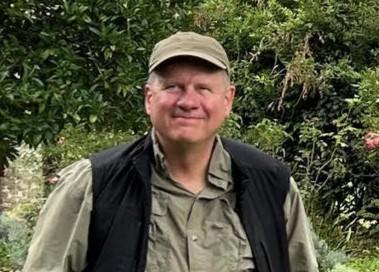
Randall J. Hunt
US Geological Survey (Emeritus)
In this article
2026 O.E. Meinzer Award
Presented to Randall J. Hunt
Citation by Yu-Feng Lin
It is a great honor and privilege to present the 2026 O.E. Meinzer Award to Dr. Randy J. Hunt, whose distinguished career has profoundly advanced the science and practice of hydrogeology. For more than three decades, Dr. Hunt has been an international leader in groundwater modeling, groundwater–surface water interactions, wetland hydrology, and parameter estimation, producing research that has transformed both our scientific understanding and the way hydrogeologists investigate and manage water resources.
Throughout his career with Barr Engineering and the U.S. Geological Survey, Dr. Hunt has consistently united rigorous field investigations with innovative numerical modeling to solve some of the most challenging problems in hydrogeology. His pioneering studies of groundwater interactions with lakes, streams, and wetlands established new conceptual and quantitative frameworks that continue to guide ecosystem restoration, groundwater management, and environmental stewardship. Equally transformative has been his leadership in advancing parameter estimation and model calibration. Through his seminal research, influential technical guidance, and the landmark textbook Applied Groundwater Modeling, Dr. Hunt has helped establish modern groundwater modeling as a more robust, reliable, and scientifically defensible discipline.
Dr. Hunt’s impact extends far beyond his exceptional scholarship. As a mentor, educator, collaborator, and scientific leader, he has generously invested in the success of students, colleagues, and professionals throughout the world. His willingness to share ideas, challenge conventional thinking, and quietly elevate those around him has shaped generations of hydrogeologists across academia, government, industry, and the international scientific community.
I have had the privilege of knowing Randy since I was a graduate student at the University of Wisconsin–Madison and worked at the USGS in… the last century. Like so many who have had the good fortune to work with him, I have witnessed firsthand that his greatest legacy is not simply the breadth or impact of his scientific contributions, but the integrity, humility, generosity, and quiet leadership with which he has advanced our profession. Randy has never sought recognition for himself; instead, he has devoted his career to advancing science, mentoring others, and strengthening our community. His influence has been extended by the countless scientists whose careers he has inspired.
For his transformative scientific achievements, his unwavering commitment to excellence, and his enduring service to the hydrogeologic profession, it is my distinct honor to recognize Dr. Randy J. Hunt as the recipient of the 2026 O.E. Meinzer Award.
Response by Randall J. Hunt
Thank you, Yu-Feng, for the generous introduction, and thank you to the Hydrogeology Division and Award Committee for selecting me. The Meinzer Award was the first professional award I really paid attention to and has always been a favorite. It highlights the much-overlooked groundwater system, emphasizes multidisciplinary approaches, and looks to identify work that moved our field toward better problem solving – all of which are important to me. The list of previous award winners presents a great cross-section of the field, one that gives us much of our present understanding. I have also always followed the Meinzer Award papers – many of which occurred during bursts of productivity that seemed to me akin to Shakespearean output. Growing up in Minnesota (where Meinzer first worked) and having a good number Scandinavian ancestors, one can imagine giving a talk about myself, in the context of receiving such an award, is not the norm. But here we are.
My interest in hydrogeology began as a kid walking intersecting trees floating in a spring-fen complex in northern Wisconsin. This wetland had layers of plants and colors very different than the uplands. Why was that? In 1927, Oscar Meinzer asked (and answered) a similar question with a treatise focusing on phreatophytes in the western United States. For me, this question led to an incredible and wide-ranging exploration of many of the facets of groundwater.
The best part of receiving an award such as this is the chance to acknowledge and celebrate those that contributed. Although I cannot cover everyone associated with my journey, there are some that stand out in relation to this award. My graduate advisor Mary Anderson was willing to take a chance on me – a hard-rock master’s student wanting to switch programs because of a newfound passion for hydrogeology. When I was admitted, I found myself surrounded with an outstanding group: Mary Stoertz, Dave Krabbenhoft, Moe Muldoon, Chunmiao Zheng, Laura Toran, Daniel Feinstein, Ken Bradbury, Bill Simpkins, Eloise Kendy, Dan Craig, and Bob Nauta. Having seminars with this group was daunting, especially in that Mary required everyone to speak at least once at each seminar. For a middle-child from Minnesota, this was gut-wrenching. Yet it was in that crucible I learned to formulate better questions and speak up (I know for some it is hard to imagine I needed to learn to speak up). For those on the receiving end of a hard question I may have asked, note that it was a learned, and not innate, trait. And, I should also mention, Meinzer himself was known as being a bit “brusque”. However, I truly intended a good question to enhance someone’s presentation – as a presenter I always felt I had done a better job when a good question was asked.
Mary let me into her program with the caveat I had to develop my own funding – a valuable skill for my career it turns out! The first request for proposal she gave me focused on delineating the hydrogeochemistry of the Leopold Memorial Reserve. My father had “A Sand County Almanac” so I had heard a little about the conservationist Aldo Leopold; I knew even less about water chemistry. Needing a project, I wrote a proposal anyway and, surprisingly, it was funded. The first day I showed up onsite I met the Reserve co-directors Charles Bradley and Nina Leopold Bradley, daughter of Aldo Leopold. Their first question was “what kind of tree do you think that is?”. Caught off guard, I said that I was not sure, but it looked like a kind of oak. Then they asked what type of flower was near me – to which I answered maybe a daisy? Then what type of fungus was by my foot. Red faced, I apologized and said there must be some mistake, but I was the hydrogeologist that was here to study groundwater. They laughed and said that was the point – to fully understand the groundwater one needed to know something about the plants and even fungi. So, much of my first months of groundwater work centered around learning to identify plants and animals. As I learned later, I probably should have expected such questions as they are a hallmark of Aldo Leopold’s method of teaching. But, for me, this exchange was when I fully understood, and benefited from, what it means to do multidisciplinary work. Leopold was contemporaneous with Meinzer, but one could argue Aldo’s was the broader view on “multidiscipline”.
After my master’s, I became a hydrogeologist for Barr Engineering during what may have been a golden era for hydrogeology in consulting. One day, after a day of consulting, my old officemate Dave Krabbenhoft, now with USGS, called. He had remembered my interest in wetlands, and he had a USGS project that needed PhD level wetland hydrogeology. Would I be willing to work with him for half of what I was making now? Well, all of you who know Dave knows he’s been known to exaggerate once or twice – turns out a research assistantship paid about a quarter of what I was making! Looking back, of course, Dave’s call made all the difference. I did join the USGS, I came back to do a PhD with Mary, and I was able to apply newly learned tools – heat, isotope chemistry, modeling, and characterization of plant communities – to wetlands.
But one does not apply new tools without help. Dave Krabbenhoft not only brought me to USGS, from the first days of grad school he has been a huge mentor, collaborator, colleague, sounding board, and friend. It is fitting that he shows up as a coauthor on one of my award citations. In truth, many things I have done have been improved upon, in some way or another, talking with Dave. Being in the USGS also opened up a new world of experts to pull from – too many to name. But one USGS colleague, Tom Bullen, I’d like to single out as an important mentor and friend. He not only showed me how to run strontium isotopes on his mass spec in Menlo Park, he invested time helping me become a better scientist. He gave me latitude to pursue maverick hypotheses using his mass specs (if I could convince him they were plausible). He also modeled what I’d like to be – generous and willing to give the benefit of the doubt, and enjoying life with both hands. For example, I gave up writing anonymous reviews after an offhand conversation I had with Tom 30 years ago. He was correct – we are truer to ourselves, and are a bit kinder, when our name accompanies the comments.
The citations included in my award are founded on collaboration with gifted and unique people. Meeting a kindred spirit in John Doherty in the 1990s led to many hours of hard work, and just as many of merriment. As Meinzer noted, hydrogeology is, at its core, the intersection of engineering and geology. John’s mathematical and coding focus, as well as later my collaborations with Jeremy White and Mike Fienen, added a needed engineering Yin to my geology Yang. It is hard to imagine my work on pathogens in drinking water being what it is without the assistance of accomplished microbiologists such as Mark Borchardt and Sue Spencer. Likewise, the Applied Modeling textbook would not exist without Bill Woessner. Yet, beyond the coauthors listed in my award, there are also other coauthors where I also learned so much from, such as Ken Bradbury, Tony Jakeman, Suzanne Pierce, Henk Haitjema, Daniel Feinstein, Mac Strand, Alex Kendrick, James Walsh, Eric Morway, and Dave Prudic. Moreover, I cannot imagine getting to this podium without the interaction with students I’ve had over the years. One truly sees a topic in new ways when trying to explain it to others. Yet students also pushed me to re-evaluate my ideas as they develop their own maverick hypotheses. Because of my interaction with these students over the years (like Yu-Feng!), I see the addition of my name on the list of Meinzer awardees as a gratifying but ultimately passing moment. There is good work on its way to moving our field forward.
Finally, I cannot imagine being here without the leg up given to me by my parents and grandparents – and not just for owning land in Wisconsin next to a spring-fed wetland. Their focus on education, the value of work, and the benefits of laughter gave the foundation for anything I’ve been able to accomplish. My wife, Lori, supported me in all the productive and not-so-productive endeavors. A better partner I cannot imagine.
What might be some take home points from my journey?
Be open to changing your mind. There is nothing better than publishing on both endmembers of an issue – you always have something that can be cited regardless of where things end up. Don’t get defensive – get expansive! Models are too complex (Hunt and Zheng 1998); models are too simple (Hunt Doherty and Tonkin 2007). Does this make me look indecisive? I don’t know. What do you think?
Don’t just do, think. Those with field experience often make the best modelers, but also those that know modeling often make the best field people. Don’t collect samples and then plot them to see what the story is or add elaboration to a model just to see if it shows something. Have a hypothesis, or prediction, that frames fieldwork or modeling. Then actively punch holes in it in real time. Decomposing the problem to its important components is 90% of finding the answer.
Recognize the challenge. When I started, I benefited from a more digestible pace of scientific advances. Today there are many years of accumulated advances to absorb, so much so often it feels like one is drinking from a firehose. Even with all that is in the firehose, there will always be a place for new ground, perhaps now found by chasing down sources of the sources in an AI synthesis. There is much to mine in previous work – the conceptual depth and breadth in some of the old papers is amazing.
Think broadly. The popular book “Range” (Epstein, 2019) argued for the value of experience across multiple disciplines rather than deep knowledge in one. Meinzer recognized something similar a century ago. Approaching a problem from multiple lines of inquiry can only strengthen the science. The world is an open system and nonunique, and this is even more true for groundwater, unseen and sparsely measured. The Venn diagram overlap constructed from what is reasonable given each discipline reduces the overall uncertainty of any finding.
Finally, be useful. The most effective science is rarely the most sophisticated or theoretically dense. Meinzer’s work documents groundwater science solving societal needs. Yet interacting with non-hydrogeologists is time consuming and frustrating, especially when science is often only one of many elements considered in decision making (and often not the most important). It is hard to calculate what will move the needle in our field in the future, but starting with better answers for societal issues seems a good start.
One day, as a new grad student overwhelmed by the quality and high level of a seminar discussion, I happened to spy a copy of NGWA’s Water Well Journal. I wondered if, someday, I might publish something there. Many publications later, I get more satisfaction as a supporting author rather than lead. Yet it is not the publications that resonate when I look back. Rather, it is the connection with my coauthors and how, with them, the co-generation of science always resulted with sums bigger than the parts. These sums seem even larger when they are appreciated by peers with an award such as this. Thank you once again, it is a tremendous honor to accept the OE Meinzer Award.