
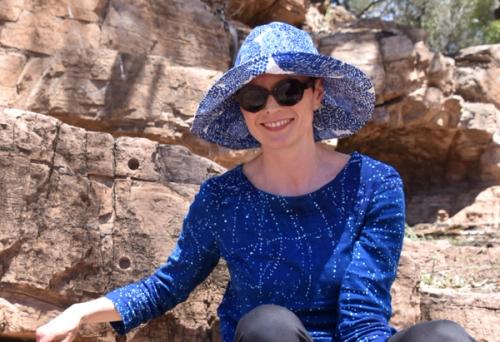
Adriana Dutkiewicz
University of Sydney
In this article
2026 M. Lee Allison Award for Geoinformatics
Presented to Adriana Dutkiewicz
Citation by Millard F. Coffin
I am delighted to laud Dr Adriana Dutkiewicz, Associate Professor of Sedimentology at the University of Sydney (Australia), as recipient of the GSA’s M. Lee Allison Award for Geoinformatics. Adriana is an internationally recognized leader in marine sedimentology and geoinformatics whose work has invigorated and transformed how legacy geological and scientific ocean drilling data are used to generate new discoveries about the seafloor, ocean circulation, deep-sea resources, and the long-term carbon cycle.
Adriana’s career exemplifies scientific achievement through discovery enabled by application. Her work consistently demonstrates how methodological innovation—particularly large-scale data synthesis and machine learning—can be translated into new geoscientific understanding. She has repeatedly shown that legacy datasets, when analyzed systematically and quantitatively, can yield discoveries comparable in significance to those derived from new data acquisition. Her contributions have reshaped community datasets, altered long-standing conceptual models, and provided new quantitative foundations for research across sedimentology, paleoceanography, and Earth system science.
A defining feature of Adriana’s career is her ability to envision scientific opportunity in datasets that others have regarded as archival, incomplete, or too heterogeneous to analyze quantitatively. One of Adriana’s most influential achievements was the creation of the first machine-learning-based global digital map of seafloor sediment lithologies (Geology, 2015). By systematically mining more than 15,000 sediment descriptions from underutilized legacy archives and applying data-driven classification techniques, she replaced a long-established, hand-drawn conceptual map with a reproducible, quantitative global framework. This and subsequent work revealed unexpected regional complexities in sediment distribution, including vigorous deep-sea currents causing anomalous sediment accumulation in the Southern Ocean (Geology, 2016), and predicted marine sediment thickness on vanished oceanic crust (Geochemistry Geophysics Geosystems, 2017). Her research has demonstrated the scientific power of reanalyzing existing data on a global scale. The global dataset has since been incorporated into widely used community tools and has become a critical reference for research and teaching in marine geology and oceanography.
Adriana has repeatedly extended this geoinformatics approach into new areas of Earth science. Her machine-learning analyses have linked deep-sea sediment lithologies to oceanographic parameters, showing that subtle changes in salinity and temperature can strongly influence biological productivity and seafloor lithology (Geochemistry Geophysics Geosystems, 2016). She later applied similar methods to produce the first machine-learning-based global map of deep-sea polymetallic nodules (Geology, 2020), providing an improved, scientifically robust framework for deep-sea resource assessment and policy, and helping resolve the long-standing question of how nodules persist on the seafloor over geological time.
Adriana’s contributions also include major advances in open community cyberinfrastructure. She co-designed the GPlates Portal, a cloud-based platform that provides interactive public access to global geological datasets, and she co-developed the open community software pyBacktrack, enabling large-scale paleobathymetric reconstructions of scientific ocean drilling sites worldwide. These tools have enabled two other major pillars of Adriana’s research, carbon cycling since Early Cretaceous time and reconstructions of marine sedimentation since Late Cretaceous time. She has led and co-led landmark research on global marine carbonate budgets (Geology, 2018, 2021), deep-sea carbonate sequestration and subduction (Geology, 2018), and new reconstructions of the carbonate compensation depth (CCD) in the Atlantic Ocean (Geology, 2021; Geochemistry Geophysics Geosystems, 2022), the Indian Ocean (Geo-Marine Letters, 2025), and the Pacific Ocean (Frontiers in Earth Science, 2025). This research has elucidated the behavior of Earth’s largest long-term carbon sink and its response to tectonic and climatic forcing.
Particularly noteworthy is her synthesis of global scientific ocean drilling data to compile a comprehensive dataset of deep-sea sediment hiatuses, which she combined with paleobathymetric reconstructions to demonstrate that late Cenozoic global cooling correlated with decreased abyssal hiatus frequency (Geology, 2022). This counterintuitive result challenged prevailing assumptions about the relationship between climate change and deep-ocean circulation, and it has inspired renewed discussion of sediment preservation and ocean circulation vigor in the geological record. Subsequent research has correlated maxima in Cenozoic deep-sea hiatus cycles with orbitally-forced intensification of deep-water circulation and erosive bottom current activity, linked to eccentricity maxima and peaks in insolation and seasonality (Nature Communications, 2024).
Beyond her scientific discoveries, Adriana has built and led distinctive cross-disciplinary research teams. At the University of Sydney, she has mentored emerging researchers, including postdoctoral fellows, PhD students, and Honors students.
Defining features of Adriana’s career are the originality and consistency of her scientific contributions, coupled with their exceptional visibility in the GSA’s flagship journal, Geology, and other leading international journals. She has authored or co-authored 14 full research articles in Geology, and two formal Replies, published between 2003 and 2024. This level of sustained contribution to Geology over more than two decades is extraordinary, placing her among an exclusive cohort of geoscientists worldwide. It reflects not only productivity, but also the enduring relevance and broad appeal of her work to the diverse GSA community.
Concurrently with her research achievements, Adriana has dedicated significant service to the GSA. She has served on the Editorial Board of Geology since 2022, contributing directly to the stewardship and scientific quality of the GSA’s premier journal. This role reflects both her standing in the international geoscience community and her commitment to advancing the mission of the GSA through service.
Adriana’s work exemplifies best practice in geoinformatics: rigorous data synthesis, innovative computational methods, open community tools, and new geoscientific insights from existing information. Her originality, leadership, and sustained contributions to machine learning, community data infrastructure, and global-scale geological discovery have made her a trailblazer and foremost leader in this discipline worldwide. She is a most deserving recipient of the M. Lee Allison Award for Geoinformatics, and the GSA should be proud to honor her as well as bask in the reflected glory of a scientist who has contributed so much to global geoinformatics and sedimentological research.
Response by Adriana Dutkiewicz
I thank Professor Mike Coffin for his very kind and generous citation and I’m grateful to the nominator. I am truly honored to receive the M. Lee Allison Award for Geoinformatics, and I am very grateful to the Geological Society of America, the award committee, and to the late Professor Pål Wessel, whose support and encouragement meant a great deal to me. I would also like to acknowledge my husband and long-time collaborator, Dietmar Müller. His expertise in plate tectonics and global reconstructions has been fundamental to much of this work, helping us place ocean-drilling observations into their changing geological context through time. It is particularly meaningful to receive an award which bears the name of M. Lee Allison. His vision of a geoscience community in which data are made accessible, connected across institutional and disciplinary boundaries, and used to enable new discovery is one that resonates deeply with me. He understood that the value of geological observations grows when we make them available to others and create the tools that allow them to be explored in new ways. I feel very privileged to receive an award associated with that vision. Much of the work recognized by this award has grown from something I have always found deeply exciting: the idea that there are still discoveries waiting to be made in data that already exist. Although I had once imagined taking part in many ocean-drilling expeditions myself, severe seasickness meant that one expedition was more than enough, and I have instead had the privilege of exploring the extraordinary legacy of ocean drilling from dry land. I would especially like to acknowledge the international ocean drilling community. For more than half a century, generations of scientists, technicians, shipboard crews, curators, data managers and many others involved in DSDP, ODP, IODP and now IODP³ have built an extraordinary record of our oceans and our planet. I have been incredibly fortunate to work with this data. There is something quite special about returning to observations made decades ago and finding that they can answer questions that could not have been imagined when they were collected. Many of the datasets I have worked with were created through painstaking work at sea and on shore, long before machine learning, global digital databases or modern plate reconstructions existed. I have always felt a strong sense of responsibility to honor that effort by finding new ways to make those observations useful. I particularly enjoy bringing together geology, oceanography, tectonics and computational approaches and seeing what emerges when they are viewed together at a global scale. Sometimes the most interesting results come from data that initially seemed too scattered, too old, or too heterogeneous to do very much with. To me, that is one of the most rewarding aspects of geoinformatics: it can give existing observations a new life and allow us to see the Earth in ways that were not previously possible. I have also been extraordinarily fortunate in the people I have worked with. My collaborators, colleagues, and students have contributed ideas, expertise, enthusiasm and persistence to every part of this work. Many of the projects recognized by this award began with conversations, curiosity, and the willingness to try something that we were not entirely sure would work. For me, geoinformatics has never simply been about large datasets or computational methods. It is about connecting observations, people and ideas, and making data and tools available so that others can ask questions we have not yet thought of. I accept this award with enormous gratitude, and with particular appreciation for the ocean drilling community and for all the people whose work, friendship and generosity have made my own research possible.