
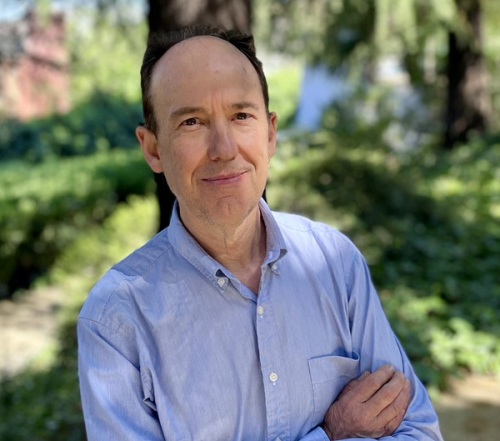
Gerardo Benito
Spanish Research Council
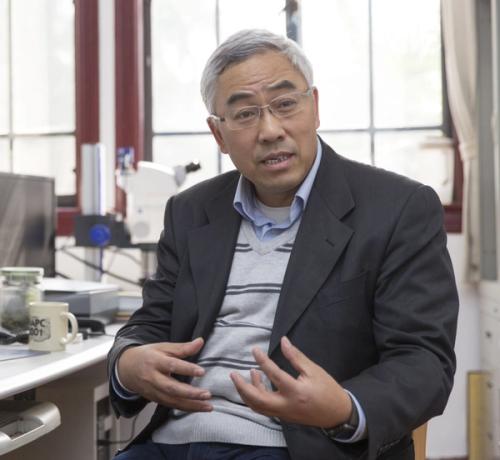
Shuzhong Shen
Nanjing University, China
In this article
2026 GSA International Honorary Fellow
Presented to Gerardo Benito and Shuzhong Shen
Citation by Jim E. O’Connor
Across 35 years of research, mentoring, collaboration, and scientific leadership, Dr Gerardo Benito Ferrández, a Research Professor at the Spanish National Research Council based in Madrid, Spain, has been an international force in Quaternary geology and geomorphology, particularly in the expanding field of paleohydrology, the study of large floods and their causes. This work has been conducted globally, resulting in more than 150 scientific articles in indexed journals. But perhaps more important than Dr. Benito’s many research accomplishments is his visionary activism in the international scientific community, leveraging his research stature into broadscale capacity building and science application. This includes leading collaborative scientific programs and committed assistance in applying science to the issues of the day, including climate change, environmental hazards, and water supply. These contributions, together producing an outstanding and international body of work, justify recognizing Gerardo Benito as a Geological Society of America International Honorary Fellow.
Response by Gerardo Benito
Thank you, Jim, for your generous citation, and thank you to the Geological Society of America for this tremendous honor.
My path in science was shaped by extraordinary mentors and friends. Vic Baker welcomed me to Arizona more than three decades ago and opened my eyes to the power of floods written in the geological record. Jim O'Connor and Yehouda Enzel have been companions on that journey ever since, from the Columbia River Gorge to the deserts of the Negev and Namibia.
Science, like rivers, gains strength from its tributaries. This award truly honors the colleagues and students in Spain, across Europe, and around the world who believed that reading past floods could help societies face those to come. Recent tragedies, like the 2024 Valencia flood, remind us why this matters.
Finally, to my wife and my daughters: thank you for sharing every step.
Citation by Shuhai Xiao
Dr. Shuzhong Shen is Professor of Geology at Nanjing University and a Member of the Chinese Academy of Sciences. He has made sustained and transformative contributions to quantifying the magnitude and tempo of the end-Guadalupian and end-Permian mass extinctions, calibrating the Carboniferous–Permian time scale with unprecedented precision, and elucidating first-order evolutionary and environmental patterns throughout Earth history. His research established fundamental links among global environmental perturbations, carbon-cycle disruption, mass extinction, and biotic recovery at millennial timescales, providing critical insights into the processes underlying modern biodiversity crises. He has played a leading role in the International Commission on Stratigraphy and was a driving force in establishing international standards for key geological boundaries. He also spearheaded the Deep-time Digital Earth initiative, an international effort that advances Earth-system history research by integrating extensive paleontological and stratigraphic databases with artificial intelligence and other advanced computational approaches.
Response by Shuzhong Shen
I am deeply honored and humbled to receive the 2026 GSA International Honorary Fellow Award. I wish to express my sincere gratitude to the Geological Society of America for this prestigious recognition, and to Prof. Shuhai Xiao for his generous and thoughtful citation.
This award holds special meaning for me because it comes from a community that has shaped my scientific career in profound ways. Over the past three decades, I have had the privilege of collaborating with outstanding colleagues from around the world, including Douglas Erwin, Samuel Bowring, and Charles Henderson, among many others. These collaborations have been the cornerstone of my research and have enriched my understanding of Earth's deep-time history far beyond what I could have achieved alone.
I have particularly cherished the opportunity to bring many of my American colleagues to China to work side by side in the field, examining some of the world's finest Permian-Triassic sections in South China as well as visiting many world class sites in the USA. These joint fieldwork experiences, from the classic Meishan and Penglaitan GSSP sections to the GSSP sections in the Guadalupe Mountains in West Texas, have not only produced transformative scientific results but have also fostered lasting friendships and genuine intellectual exchange. There is a special joy in debating stratigraphic interpretations under the sun on a remote outcrop, knowing that we are collectively piecing together Earth's most profound crises.
My team’s research journey has been driven by a deep curiosity about the co-evolution of life and environment on Earth. The Permian-Triassic transition, in particular, represents one of the most critical intervals in Earth's history, a time when our planet experienced the most severe biodiversity crisis of the Phanerozoic. Together with my colleagues, we have strived to quantify the magnitude and tempo of the end-Guadalupian and end-Permian mass extinctions, calibrate the Permian-Triassic timescale with unprecedented precision, and establish fundamental links among global environmental perturbations, carbon-cycle disruption, mass extinction, and biotic recovery at millennial timescales. Our high-resolution geochronological and chemostratigraphic work, including the calibration of the end-Permian mass extinction published in Science (2011, 2020) and GSA Bulletin (2019) and our high-precision timeline in PNAS (2014), has revealed the abruptness of these crises and provided critical insights into the processes underlying modern biodiversity loss.
I am particularly proud of our contributions to international stratigraphy. Serving first as Secretary (2004-2012) and then as Chair (2012-2020) of the ICS Subcommission on Permian Stratigraphy and ICS Vice-Chair has been the greatest honors of my career. In this capacity, I have worked diligently with the global Permian community to establish and refine GSSPs, including the base-Lopingian and base-Changhsingian GSSPs in South China, and more recently, the three GSSPs in the Guadalupe Mountains in USA. These "golden spikes" represent not just geological milestones, but the collective effort of an international community committed to a unified global timescale.
Beyond stratigraphy, my team continues to be deeply committed to advancing the field through data-driven discovery. Our OneStratigraphy (OneS) represents a vision of integrating extensive paleontological and stratigraphic data with advanced computational approaches to build a high-resolution digital geological timeline that can revolutionize our understanding of Earth's evolutionary history.
I am grateful to my home institutions, first the Nanjing Institute of Geology and Palaeontology, Chinese Academy of Sciences, and now Nanjing University, for their unwavering support over the years. I am especially indebted to my mentors, particularly the late Prof. Yugan Jin and Prof. Samuel Bowring, whose inspiration and guidance set me on this path. I also wish to thank my colleagues, students and postdoctoral researchers in my team, whose energy, creativity, and dedication have been the driving force behind much of our recent progress.
Finally, I would like to thank the GSA for this honor. I accept it not as a personal achievement, but as a recognition of the collective efforts of the entire international Permian research community. I look forward to continuing our collaborative work to unravel the mysteries of Earth's past and to contribute to a more sustainable future.