
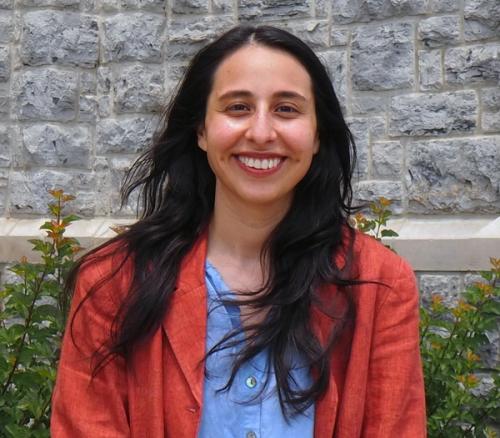
Julia Cisneros
Virginia Tech
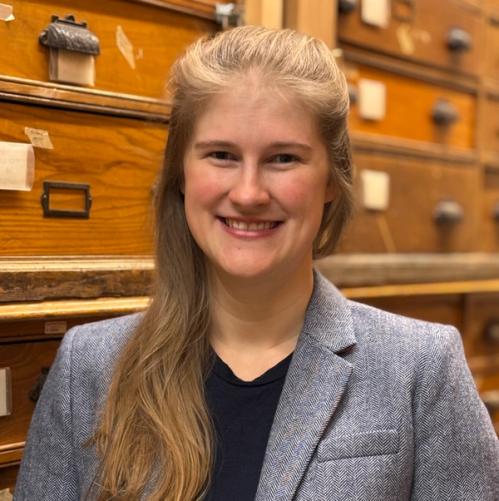
Katie M. Maloney
Michigan State University
In this article
2026 Doris M. Curtis Outstanding Woman in Science Award
Presented to Julia Cisneros and Katie M. Maloney
Citation by David Mohrig
I am delighted and honored to introduce Julia Cisneros as a 2026 Doris M. Curtis Outstanding Woman in Science awardee. Dr. Cisneros is an amazing scientist, sedimentologist and geomorphologist whose research focusses on the flow of solids across landscapes, often using new technologies to capture resultant changes in surface topography. She discovered that sand dunes in Earth’s largest rivers have a markedly different form than those observed smaller channels and identified how this shape difference affected both sediment transport and flooding. Her work has improved our understanding of rivers and the adjacent riparian systems they construct, a populated setting that is particularly sensitive to both natural and human-induced environmental change. Beyond her scientific accomplishments, Dr. Cisneros is a dedicated mentor, educator, and spokesperson for geoscience research, as well as a champion for underrepresented groups in all sciences. Please join me in congratulating Julia Cisneros on this well-earned recognition.
Response by Julia Cisneros
I am incredibly honored to receive this award from GSA and to be recognized among such esteemed scientists in the field. I share this achievement with my mentors, peers, and colleagues who have supported me and encouraged me to dive into the research that excites me and feeds my curiosity. I also know that excellence is everywhere, and my receipt of this award is largely a result of the dedication of my nominators —thank you to Maddy Schreiber, David Mohrig, Alice Lefebvre, and Ryan Ewing for your hard work, advocacy, and support. Finally, I share my appreciation and gratitude to the several individuals and institutions throughout my academic journey, especially during my PhD, who believed in me and gave me the resources to develop into the researcher I am today. I hope to continue to make you proud!
In 6th grade, way back in 1963, I had to write two term papers on topics of my choice. I chose first “President Franklin Roosevelt during World War II”, probably from repeatedly watching with my father the ground-breaking 1950’s TV documentary, “Victory at Sea” about US WWII naval battles, and, secondly, and unsurprisingly, “Volcanoes and Earthquakes”. (I did not build a papier mache volcano at that time but did two years later for the 8th grade science fair.)
Later, in the Fall of 1969, as a freshman in college, right after the first Moon landing, I was considering majoring in Astronomy, Russian Studies or Asian Studies: Astronomy because I thought it might prepare me to boldly go where no woman had gone before. But I discovered that Astronomy was really Physics in disguise; much later I realized what I really wanted was Planetary Geology, but that topic was not a mainstream academic discipline at that time.
I ended up majoring in History, with a minor in Geology, and my first career was as a Foreign Service Officer, US Department of State. I eventually changed my career path to Geology, and, after my Master’s degree, I applied in 1985 to be on GSA’s Geology and Public Policy Committee, also known as GPPC. It seemed like an ideal melding of my geoscience plus social science background.
At that time, GPPC’s primary product was symposia at the annual meeting, published symposia summaries, and occasional white papers. I chaired the GPPC symposium, “The Urbanized Desert”, at the 1987 GSA annual meeting in Phoenix. GPPC was formed 55 years ago, in 1971, as the Committee on Environment and Public Policy, in the heady days of the first Earth Day and the founding of the EPA.
In 2001, 25 years ago, GPPC started issuing Position Statements, written by GPPC, and approved by GSA Council after a GSA membership comment period. The first Position Statement was “Teaching Evolution”. The 28th Position Statement was approved last year, “The Benefits of Professional Geologist Licensure”.
After a reproductive hiatus and getting a PhD, I resumed volunteering in geoscience policy activities by attending Geoscience Congressional Visits Day, held every fall since about 2008, and sponsored by several geoscience societies including GSA. I have attended most Geo-CVDs since 2009, plus other Congressional Visits events, become familiar with and less intimidated by Capitol Hill, and met a rich variety of fellow geoscientists.
Currently I am the GPPC Past Chair after two terms as Northeastern Section Representative on GPPC starting in 2018. I have also been privileged to serve on the NE Section Management Board including as 2012 Section Chair. GSA’s Geographic Sections are a unique strength and offering among the large US-based geoscience societies. Section meetings are a reliably predictable annual event offering a relatively local opportunity for Section students to present their research, sometimes their first science conference experience; to hear preliminary results of regional geological research; and attend local field trips. The success of these meetings depends on the volunteerism of both the Management Board and the tireless section meeting committees. Importantly, the support of GSA headquarters in member communications, elections, abstract submission, standardized abstract and program publication, plus field guides, contributes to Section success.
Emily mentioned the decision last year for the accelerated completion of the Position Statement on The Benefits of Professional Geologist Licensure. The expected finish date for this statement was Spring or Fall 2026. However, in June 2025, GSA leadership requested it be finished in 6-8 weeks, while it still required more draft text review, a GSA membership comment period, and final votes by GPPC and GSA Council. While doing this during summer vacation and field work season seemed ambitious, the Committee, external writing group, and DC policy office staff accepted the challenge, zooming in at times from the highest points in their field area in search of the best Wi-Fi and from the passenger seat of the family car while their spouse drove. We met the deadline, and the approved Position Statement was published in mid-August 2025.
This outcome is an example of a work product, as described recently by author Jody Kantor, “made by groups of former strangers who labored together in shared discovery, discipline, and purpose”. (The New Yorker, June 22, 2026, p. 59). Expanding geoscience friendships is one reward of GSA volunteer service, but especially, service strengthens our Society.
Citation by Marc Laflamme
Dr. Katie Maloney is an exceptional Earth scientist whose research has significantly advanced our understanding of early eukaryotic life and Neoproterozoic oceans. Her discovery of large (cm-scale) fossilized green algae from rocks dating back over 900 million years has expanded the known distribution, both geographically and temporally, of algal species. Her commitment to respectful and inclusive science is exemplified by her collaboration with Na-Cho Nyäk Dun First Nation elders in naming Archaeochaeta guncho, meaning “big worm” in the Northern Tutchone language. Dr. Maloney is a dedicated mentor who has guided student research and publication, a leader in national and international scientific communities, and a champion for equity, diversity, and inclusion. Her innovative outreach initiatives and educational resources include the publication of Rocky the Raccoon Explores the Niagara Escarpment, a children’s book designed to inspire future generations of scientists and foster greater public engagement with Earth science.
Response by Katie M. Maloney
I am very honored to receive this award and be included among outstanding women in science who I admire. Doris Curtis is often described as remarkable and I hope to follow the trail she blazed for women in geoscience by continuing her legacy of scientific achievements and leadership.
I would not be here without the many mentors, peers, students, colleagues, and collaborators that have guided me along the way. Thanks to my graduate thesis supervisor, Marc Laflamme for teaching me how to be a well-rounded scientist. Learning about Ediacaran Biota in Namibia with you and Simon Darroch was a fantastic introduction to paleontology. Galen Halverson invited me to explore northwestern Canada and taught me how to be a field-based paleontologist, which has shaped my career. I am grateful for support from Sara Pruss, Shuhai Xiao, Jim Schiffbauer and Jean-Bernad Caron as generous mentors who have become ongoing collaborators.
I would like to thank my family for their unwavering support and specifically my parents for encouraging me to be curious and giving me perspective when I need it the most. Finally, deep appreciation to Carolyn Eyles who convinced me geology was more fun than pre-med and always reminded me of our important role in educating the next generation of geoscientists inside and outside the classroom.