
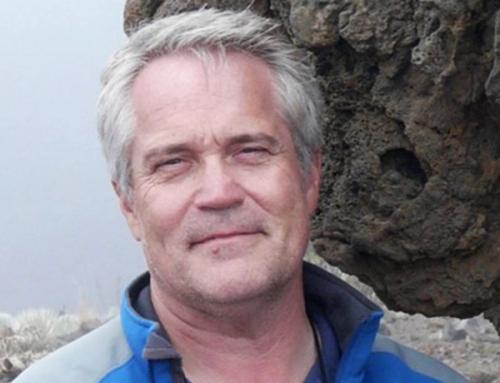
Kip Hodges
Arizona State University
In this article
2026 Structural Geology & Tectonics Career Contribution Award
Presented to Kip Hodges
Citation by Kelin Whipple
We are honored to present Kip Hodges with the Career Contribution Award of the SGT division of GSA. Kip is an internationally renowned scholar who has had an immense impact on the field of tectonics, spanning fundamental advances in quantifying pressure-temperature-time histories, extensional tectonics, the co-evolution of compressive and extensional structures in collisional orogens, methods and application of noble-gas thermochronology, coupling of climate, erosion, and tectonics in orogen evolution, and even refining lunar impact history and preparing for human-robotic planetary geologic exploration. Common threads throughout include: (1) an amazing capacity to constantly evolve and innovate, to develop and/or refine the analytical tools required to answer the next question, (2) a knack for synthesis and integration across scales from minerals to geologic structures to landscapes and to complete orogenic systems, (3) a commitment to mentoring and diversity, and (4) a tireless pursuit of scientific communication and community building.
The breadth and depth of Kip’s impact cannot be adequately captured in a few words and was only made possible by an impressive evolutionary arc. Kip started as a field-based structural geologist working in metamorphic terrains in the Appalachians and Caledonides. Not satisfied with these approaches alone, he worked to refine and quantify thermobarometric tools to better constrain the structural evolution of mountain ranges. This early work and his experience exploring the extensional tectonics of the Basin and Range and Baja California set the stage for his work in the Himalaya-Tibetan orogenic system for which he is best known. His focus on integration of metamorphic petrology and structural geology coupled with his experience in extensional systems was critical to the breakthrough recognition of the significance of the South Tibetan Detachment System. The magnitude of deformation and regional extent of this structure together with the determination that slip was coeval with thrusting on the Main Central Thust revolutionized our understanding of evolution of the Himalaya. To take this work further, Kip recognized the need to complement mapping, fabric analysis, and metamorphic petrology with precision thermochronology. Kip took the bold step of redefining himself by building a state-of-the-art noble gas laboratory. His initial focus on 40Ar/39Ar was only the beginning, later expanding into U-Th/He dating of Apatite, Zircon and other accessory minerals, driving innovations in microanalytical methods, and pioneering applications to detrital mineral samples. Despite this focus on method development, to the benefit of his students, postdocs and collaborators, Kip always placed a premium on sampling strategy and the critical context of field observations.
Kip has paired his scientific and methodological advances with a dedication to mentoring students, postdocs, junior colleagues and collaborators, and a life-long commitment to enhancing diversity in the sciences. In addition, he has been a tireless community advocate and leader, serving effectively in numerous administrative roles, as an editor of several core journals in structural geology and tectonics, as the founding Editor for Science Advances, and as the Chair of the Advisory Committee to the NSF Directorate of Geosciences. Congratulations Kip on this richly deserved recognition of all you have done for the Structural Geology and Tectonics division of the GSA.
Response from Kip Hodges
Thank you, Kelin, for the kind citation. I’m deeply appreciative of this award and I thank my nominators, the awards committee, the Structural Geology and Tectonics Division, and the Geological Society of America for making it happen. The list of previous winners of this award includes many of my heroes and heroines, and I am humbled to be in their company.
Kelin said in his citation that my career had followed an evolutionary arc. Like biological evolution, my evolution was anything but deliberate. I went to college at the University of North Carolina in 1974 set on becoming a journalist, but an introductory geology class made me reconsider my chosen path. The instructor, a recent PhD in structural geology named Gerry Stirewalt, had essentially rewritten the syllabus to feature the “novel” ideas of plate tectonics and his infectious enthusiasm for tectonics – particularly the role of plate tectonics in shaping Earth’s continents – changed my life. I developed a passion for studying the evolution of mountain ranges and went on to do my PhD work at the Massachusetts Institute of Technology under the supervision of one of the leading figures in continental tectonics, Clark Burchfiel. First a mentor, then a friend, and ultimately a colleague, Clark was and is the most profound influence on my evolutionary arc as a scientist.
Early on, while doing dissertation research in northern Norway, I realized that the tools of structural geology alone were insufficient to really understand the complexities of orogenesis. I learned to let tectonic problems dictate the most productive research strategies, so I worked hard to become conversant in multiple subdisciplines of geology and to incorporate those tools into my arsenal for tectonics studies. When the tools I needed didn’t exist, or weren’t yet adequate, I tried to improve them and, in some cases, develop new ones. Before I knew it, I was publishing papers that featured not just structural geology and field mapping but also geochemistry, petrology, and isotope geology. That holistic approach to continental tectonics was extremely unusual when I became a professor in the early 1980s, but I’m happy to see it as the mainstream four decades later.
I have been blessed to have worked with an incredible cadre of scientists over the years, and my successes are in no small part a reflection of their talent and creativity. Through those collaborations, I’ve done extensive fieldwork in the Himalaya, Tibet, the Andes, the North American Cordillera, and the Scandinavian and Greenland Caledonides. However, I have never viewed myself as a Himalayan geologist, a Caledonian geologist, or an Andean geologist; for me, it’s all about helping to elucidate tectonic processes.
My wonderful wife Larky keeps reminding me that my legacy is not so much the knowledge my colleagues and I have created, but the successes of my advisees. Now that I’m professor emeritus, it’s perhaps time to tally them up. My PhD and MS students total 53, and I’m proud to say that over half (30) have been women. They have gone on to do incredible things in and out of academia and I salute their many successes. I have also had the pleasure of teaching and working with many more students in the classroom and in the field. All of these young scientists have been accomplices in my intellectual evolution, and I am grateful that we were able to mentor one another.
I happened to have been chatting with Clark Burchfiel when he received word that he would be receiving the SGT Career Contribution Award a few years back. His first reaction was “I thought you had to be dead to get this award.” He went on to make many great contributions after that, so fortunately he was wrong. That’s encouraging to me because there are so many unsolved tectonic problems out there and my curiosity continues unabated. I like to tell undergraduates that you learn almost everything you need to know as a geologist in an introductory geology class and then spend the rest of your career discovering that almost everything you learned was at least partly incomplete. One of the gratifying things about a long career is that the questions only multiply, while our opportunities to address them through increasingly integrated studies continue to improve.
Much of my early love for journalism eventually reemerged as a passion for scientific communication, for building strong research infrastructures, and for advocating on behalf of science. We are practicing our craft at a time when the value of scientific inquiry is increasingly challenged, and I believe we have a responsibility not only to do good science but also to explain its importance and defend the conditions that make it possible. Scientific societies such as GSA matter: individually our voices may be limited, but collectively they can be powerful. I want to end by thanking SGT not just for this award, but for being a scientific community in which I have been proud to participate.