
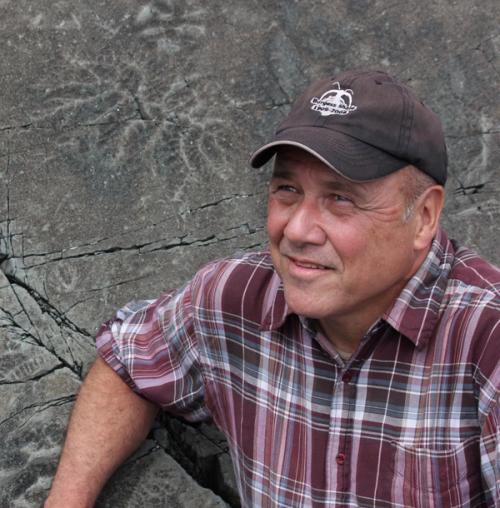
Guy Narbonne
Queens University
In this article
2026 Geobiology and Geomicrobiology Division Distinguished Career Award
Presented to Guy Narbonne
Citation by Shuhai Xiao
Professor Guy M. Narbonne is a world-renowned and globally influential geobiologist whose research has transformed our understanding of the early evolution of animals and their geobiological impacts. Over a distinguished career spanning more than four decades, he has conducted pioneering field research across the globe, from the rocky coasts of Newfoundland to the mountain ranges of the Yukon and Northwest Territories, and the deserts of Namibia and Australia. His groundbreaking contributions encompass a wide range of topics, including Paleozoic reef ecosystems, the rise of animals, and ecosystem evolution across major transitions in Earth history. He was instrumental in establishing the Ediacaran–Cambrian Global Stratotype Section and Point (GSSP), has made seminal contributions to Ediacaran stratigraphy, and played a pivotal role in the successful inscription of Mistaken Point as a UNESCO World Heritage Site.
Response by Guy Narbonne
First, I would like to thank Marc Laflamme who nominated me for this award and my citationist Shuhai Xiao for his kind words.
My interests in geobiology began during my University of Ottawa doctorate on the paleoecology of Silurian reefs and trace fossils in the Canadian Arctic Islands coupled with summer employment assisting helicopter-based geological studies of the Mesoproterozoic of Baffin Island (Operation Borden) and the Cambrian-Silurian of Devon Island (Operation Devon) for the Geological Survey of Canada. These studies led me to ask questions about “when life got big”, the then largely unknown interface between the microbial-dominated Proterozoic and the abundant shelly fossils of the Phanerozoic.
I am grateful to the people and institutions who helped me at various stages in what has become my life-long research program at the dawn of animal life and welcome this opportunity to thank them publicly for their help.
I owe much to my post-doctoral supervisor, Hans Hofmann, who happily shared his incredible knowledge about this critical stage in Earth evolution with me and was a wonderful mentor as I began studies in the Wernecke and Mackenzie mountains of northwestern Canada. The geology of this remote region was only partly explored when I began my research, and I am grateful to Bill Fritz and Jim Aitken of the Geological Survey of Canada who guided me in different aspects of the logistics and geology of this subarctic mountainous terrain, and with whom I published papers describing some of the first Ediacaran macrofossils ever found in the Canadian Cordillera.
I was hired by Queen’s University in 1982, and they have provided me with stability, understanding, and truly wonderful undergraduate students and colleagues over my entire academic career. To date, research collaborations with my departmental colleagues have produced 40 refereed scientific papers and numerous joint supervisions of some incredible students and postdocs who have done well in their subsequent careers. Noel James and I co-taught a field school on modern reefs and published a series of papers documenting the geobiology of Proterozoic microbial reefs ranging from 1200 to 635 Ma, and Bob Dalrymple’s process-based sedimentology enhanced our understanding of the ecology and taphonomy of the Ediacaran macrofossil impressions we discovered. Four decades of continuous funding from the Natural Sciences and Engineering Research Council of Canada (NSERC) provided financial stability for my research program.
Establishing a precise timescale is essential to my geobiological studies, and this led me to serve on various Subcommissions and Working Groups of the International Commission on Stratigraphy (ICS). Soon after my appointment to Queen’s University, I worked with Paul Myrow and others on trace fossil zonation in the Burin Peninsula of Newfoundland, which ultimately led to Fortune Head being ratified as the global stratotype section and point (GSSP) for the Cambrian in 1994. In 1989 I was asked to join a newly established ICS Working Group/Subcommission, superbly headed by Andy Knoll and Malcolm Walter, with a mandate to define a new terminal Proterozoic period. I served as its Secretary and Nick Christie-Blick was our exceptionally dynamic co-leader of IGCP 320, which investigated key sections on nearly every continent. In 2004 IUGS ratified the newly named Ediacaran Period and its GSSP located in the Flinders Ranges of Australia, the first new period added to the Geologic Time Scale in more than a century.
Many of my collaborations resulted directly or indirectly from sections I visited or researchers I met during our ICS discussions. John Grotzinger invited me to work with his team in Namibia in 1995, which resulted in the discovery of Swartpuntia and other fossils that extended the known range of Ediacaran macrofossils in Africa by more than 600 meters to near the base of the Cambrian. My return to Namibia 20 years later to collect and restudy the iconic Ediacaran fossils Rangea and Ernietta was facilitated by Pat Vickers-Rich, and I must especially thank Peter Trusler who brings my descriptions and interpretations of Ediacaran fossils to life through his spectacular illustrations. Continuing work on the Cambrian GSSP in Newfoundland has benefited from ongoing collaborations with Luis Buatois and Gabriela Managano, who I first met when we puzzled over a trace fossil during a field trip to Ediacara in 2002. Jay Kaufman provided isotope chemostratigraphy from the same sections as produced my biostratigraphy in several papers linking oceanographic and biological events in the Neoproterozoic and early Cambrian.
Jim Gehling showed me around the Flinders Ranges during my first sabbatical in 1988, and in return Michael Anderson and I showed Gehling around Newfoundland two years later. Our joint discoveries in Avalonian Newfoundland extended its known Ediacaran fossil record more than a kilometer lower in the succession and confirmed that these were the oldest abundant, large and morphologically complex, Ediacara-type fossils known anywhere. Subsequent paleontological studies, tied in with ground-breaking research on the redox of Proterozoic oceans by Don Canfield and Simon Poulton, produced numerous high-impact publications that established Mistaken Point as one of the world’s major Ediacaran fossil sites. As Chief Scientist I worked with the local community (especially Catherine Ward) and government officials from NL Parks and Natural Areas (especially Sian French, Jere Graham, and Richard Thomas) to nominate Mistaken Point for UNESCO World Heritage status. Mistaken Point was inscribed on the World Heritage List in July 2016 – the first pre-Cambrian fossil site and one of only 12 fossil sites of any age anywhere to obtain World Heritage status.
My recent studies with Shuhai Xiao and other Queen’s University and VT researchers have focused on strata that directly underlie the oldest fossils at Mistaken Point, strata that are especially well exposed elsewhere in Newfoundland and on nearby uninhabited islands, and that may hold additional keys to our global understanding of “when life got big”.
Finally, and most importantly, I am deeply grateful to my wife and partner, Carolyn Greentree, who fills my life with meaning and joy, helps me in all my endeavors, and provides me with incredible insights into both present and ancient life.