
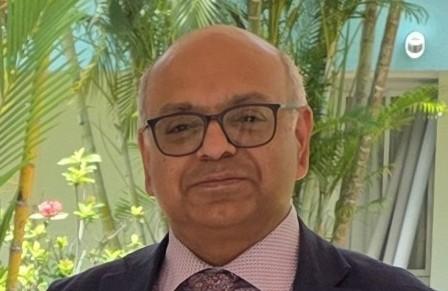
Prosun Bhattacharya
KTH Royal Institute of Technology
In this article
2026 Distinguished Career Award (Geology & Health)
Presented to Prosun Bhattacharya
Citation by Abhijit Mukherjee
Professor Prosun Bhattacharya is a distinguished global leader in groundwater geochemistry whose research and leadership have profoundly influenced science, policy, and public health across continents. With a geoscience career spanning over 35 years, including nearly two decades of service to the Geological Society of America, Prof. Bhattacharya has led transformative, interdisciplinary research addressing the occurrence, fate, and mitigation of geogenic contaminants—especially arsenic and fluoride—in groundwater systems used for drinking.
He earned his PhD in Sedimentary Geochemistry from the University of Delhi, India (1990), and currently serves as Professor of Groundwater Chemistry at the KTH Royal Institute of Technology in Stockholm, Sweden, where he coordinates the KTH-International Groundwater Arsenic Research Group. He has held additional academic affiliations, including Adjunct Professor at the University of Southern Queensland, Australia (2016–2019), and since 2020, Affiliate Scientist at the KWR Water Research Institute, The Netherlands.
Prof. Bhattacharya’s global scientific reach extends across South and Southeast Asia, Sub-Saharan Africa, Latin America, and the MENA region, where his field-driven, community-centered work has provided sustainable solutions for safe water access. He led the landmark Sida-funded Sustainable Arsenic Mitigation (SASMIT) project in Bangladesh (2007–2017), which introduced practical tools such as the Sediment Colour Tool and advanced treatment systems like AOCF to identify and access safe aquifers. In partnership with UNICEF and Bangladesh’s Department of Public Health Engineering, his projects have strengthened arsenic-safe water delivery through private sector training, digital water safety platforms, and institutional capacity development.
Beyond South Asia, he has initiated Sida-supported bilateral capacity-building research programs between Sweden and Tanzania, and Sweden and Bolivia, advancing local scientific capacity in resource-constrained settings. His current projects in Tanzania, Turkey, Jordan, and Argentina further extend his integrated approach to hydrogeochemistry, health, and sustainability and currently he is envisioning a global south-south collaborative action on ensuring water security and public health.
An internationally recognized scholar, Prof. Bhattacharya has authored or co-authored over 500 peer-reviewed articles and conference papers, cited more than 26,800 times (Google Scholar h-index: 85), and edited 17 books on groundwater quality and water sustainability. He is the founding Editor-in-Chief of Groundwater for Sustainable Development and has served as Associate Editor of Journal of Hydrology and Frontiers in Environmental Sciences. He has played a pivotal role in shaping global groundwater research agenda—especially through the International Society of Groundwater for Sustainable Development and two decades of leadership in organizing the International Arsenic Congress. Prof. Bhattacharya has also actively contributed to pandemic-related research on wastewater-based epidemiology, working with governments and public health networks.
Prof. Bhattacharya’s commitment to mentorship is equally notable—having supervised over 24 PhD and 50 master’s students, most from Africa, South Asia, and South America, who now contribute significantly to geoscience education and groundwater management in their home countries.
An elected Fellow of the Geological Society of America (2012) and the International Water Association (2018), he is the recipient of the George Burke Maxey Distinguished Service Award (2021), the STE International Achiever Award (2019), and GSA International Distinguished Career Award (2025). He also served as Member-at-Large of the GSA International Committee (2021–2025).
Prof. Bhattacharya is widely respected not only for his scientific rigor and global vision but also for his humility, inclusivity, and unwavering commitment to social equity. His work exemplifies the integration of cutting-edge science and real-world impact—uplifting communities, building local capacities, and safeguarding drinking water for millions. For his outstanding international geoscience research, sustained service to the GSA, and his transformative leadership in groundwater chemistry, Prof. Bhattacharya is most deserving of the GSA Geology and Health Division Distinguished Career Award.
Response by Prosun Bhattacharya
I am deeply honored and sincerely grateful to receive the GSA Geology and Health Division’s 2026 Distinguished Career Award. This recognition is especially meaningful because it comes from a Division whose mission lies at the heart of my scientific journey: connecting geology, groundwater, geochemistry, environmental quality, and human health.
My academic path began in sedimentary geochemistry, with a focus on elemental signatures, mineral-fluid interactions, and the geological processes that record crustal evolution and control the distribution and mobility of elements. At that time, I did not fully appreciate that these same geochemical principles would later become central to understanding some of the most serious drinking-water and public-health challenges in the world. Fieldwork in arsenic- and fluoride-affected regions changed that perspective. It became clear to me that geology is not only about understanding the processes that drive the Earth’s crustal evolution and reconstructing Earth’s past; it is also about interpreting present-day Earth-surface and subsurface processes that shape environmental quality and affect human health and wellbeing.
The challenge of naturally occurring contaminants in groundwater has remained central to my work. Arsenic, fluoride, salinity, manganese, uranium, and other geogenic constituents remind us that water quality cannot be understood without considering the interactions among the lithosphere, hydrosphere, atmosphere, soils, sediments, and living systems. Their mobilization may be natural, or enhanced by human activities, but their impacts extend through water resources, agriculture, livestock, fisheries, food systems, and human communities. These are therefore not only scientific problems. They are human and societal problems. This awareness has shaped my commitment to science that is rigorous, field-based, collaborative, and useful beyond research articles, informing practice, policy, and public health.
I am especially grateful to the Geological Society of America and its Geology and Health Division for providing a home for interdisciplinary work at the interface of Earth system processes and human health. Over many years, GSA sessions on arsenic, geogenic contaminants, hydrogeochemistry, groundwater quality, medical geology, and environmental health have helped build a community that crosses disciplinary boundaries. I have been privileged both to contribute to this community and to learn from colleagues in hydrogeology, geochemistry, medical geology, engineering, public health, and policy.
A major part of my scientific and professional journey has been connected with South Asia, especially Bangladesh and the Bengal Basin. The Sida-supported Sustainable Arsenic Mitigation (SASMIT) project was particularly formative because it translated aquifer-scale geochemical understanding into practical approaches for identifying and accessing safer groundwater. The Sediment Colour Tool, together with treatment and mitigation approaches developed with local partners, helped connect geoscientific knowledge with safer drinking-water access. Collaborations with UNICEF, Bangladesh’s Department of Public Health Engineering, universities, local drillers, and communities taught me that durable solutions require trust, local capacity, and institutional engagement. Building on this foundation, the work evolved toward ASMITAS and digital data-management systems, integrating well records, field observations, water-quality data, aquifer-safety indicators, and spatial decision-support tools to strengthen arsenic-safe water planning, monitoring, and decision-making.
Beyond South Asia, my work has extended to diverse geological and social settings where groundwater quality is closely linked to health and sustainability. In Tanzania and East Africa, collaborative research and capacity-building programs have focused on fluoride and other groundwater-quality challenges, geospatial analysis, monitoring, and decision support for water-resource management. In Bolivia, Argentina, Chile, Turkey, Jordan, and other regions, studies of arsenic, fluoride, salinity, trace elements, and volcanic, geothermal, sedimentary, and arid-zone aquifer systems have reinforced a common lesson: geological settings may differ, but the need for safe water, scientific capacity, and context-sensitive solutions is universal.
I am deeply thankful to KTH Royal Institute of Technology, where I have had the opportunity to build long-term research, doctoral training, and international collaborations through the KTH-International Groundwater Arsenic Research Group. KTH has provided an academic home from which it has been possible to work with partners across countries, disciplines, and institutions. I am also deeply grateful to the Swedish International Development Cooperation Agency (Sida) for its long-term support of research and capacity-building programs in Bangladesh, Tanzania, Bolivia, and other international settings. This support made it possible to connect groundwater geochemistry with safe-water implementation, doctoral training, institutional development, and South–South collaboration. Through these partnerships, research has moved from process understanding to field tools, monitoring approaches, digital platforms, treatment systems, training, and policy-relevant outputs.
Mentorship beyond boundaries has been one of the most rewarding parts of my career. I am proud of my students and former students from Asia, Africa, Latin America, Europe, and beyond, many of whom now serve as researchers, teachers, supervisors, government professionals, consultants, and water-sector leaders. I am equally grateful for the opportunity to mentor early-career and established researchers who were not formally my students, but whose research capacity, confidence, and international engagement I have been able to support through collaborations, networks, and long-term scientific exchange. Their achievements are among the most meaningful outcomes of my professional life. Science becomes enduring when it helps create independent thinkers and responsible practitioners who carry knowledge into their own institutions, communities, and regions.
I am deeply grateful to Professor Abhijit Mukherjee, my citationist, and to Dr. Malcolm Siegel for their generous support in the nomination process. I also sincerely thank Professor Saugata Datta, Professor María Aurora Armienta, and Professor Kazi Matin Ahmed for their thoughtful support letters, and the many colleagues whose collaboration, encouragement, and critique have shaped this journey.
I accept this award with humility and gratitude, mindful that it reflects not only my own work but also the contributions of many students, collaborators, communities, institutions, and funding partners. I am sincerely grateful to the GSA Geology and Health Division for bestowing this honor through the 2026 Distinguished Career Award. I remain committed to advancing groundwater geochemistry and medical geology in ways that serve science, strengthen capacity, protect human health, and responsibly harness AI-enabled digital approaches, from field evidence to predictive tools and digital twins, for safer and more sustainable groundwater futures.