
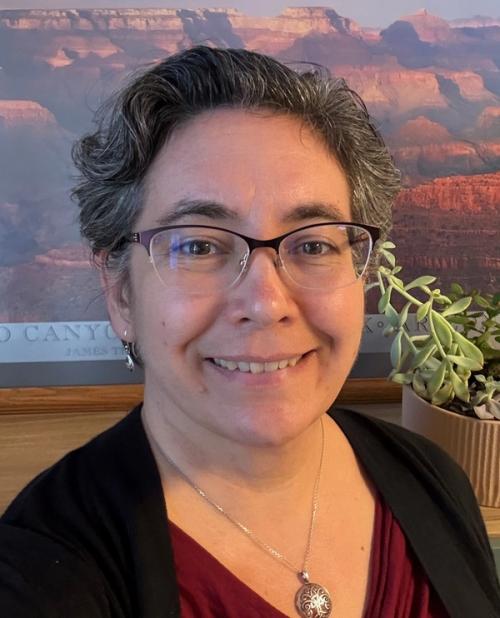
Jennifer M.K. O'Keefe
Morehead State University
In this article
2026 Gilbert H. Cady Coal Geology Award
Presented to Jennifer M.K. O'Keefe
Citation by James C. Hower
Jennifer O’Keefe followed an unconventional path throughout her career. Following her Bachelor of Arts and Master of Science degrees at Cornell College (Iowa) and Texas A&M, respectively, she joined Morehead State University (Kentucky) as full-time faculty while she was a PhD student at the University of Kentucky (UK). While at Kentucky, Jen conducted research on the petrology, palynology, and mycology of the Eocene lignites in Kentucky’s Jackson Purchase region. Mentored by Jim Hower (UK), Jen enlisted Cortland Eble, Kentucky Geological Survey, a fellow palynologist, and nurtured an international network of informal advisors, including Anne Raymond at Texas A&M. Her research experience at Kentucky also included the sampling of coal and fly ash at Kentucky power plants and Morehead’s coal-fired steam plant, and the sampling and long-term monitoring of coal fires in Kentucky and Wyoming.
Establishing a research career as a professor at a “non-research” university is not easy. Research goes against the grain and some colleagues at research universities do not always appreciate the handicaps of a large teaching and advising load. Jen turned the perceived handicaps to her advantage and established herself as a leader in Cenozoic palynology and as a world-class paleomycologist. She leveraged a large student workforce, building a tiered-mentoring training ground for young scientists, often in collaboration with post-doctoral researchers, and co-advised masters’ and doctoral students from around the world. Many undergraduates hail from the Appalachian counties in eastern Kentucky and southern Ohio; they found a nurturing environment that prepared them for success. This revolving team of students and a global cadre of professional colleagues form her team of trusted collaborators. Jen is currently the chair of Morehead’s Department of Engineering Sciences, a testament to her ability to work with a wide range of disciplines and stakeholders.
She is a GSA Fellow, past-chair of the GSA Energy Division and past-president of AASP-The Palynological Society. Jen received the Distinguished Service Award from AASP in 2023, the American Association of Petroleum Geologist’s Eastern Section Gordon H. Wood, Jr. Memorial Award in 2024, and The Society for Organic Petrology’s John Castaño Honorary Member Award in 2025. The recognition of Jen O’Keefe as the 2026 recipient of the Geological Society of America’s Energy Geology Division’s Gilbert H. Cady Award is a highly deserved acknowledgement of her contributions to coal geology, petrology, palynology, and paleomycology; her mentoring of students and research trainees; and her contributions to her profession.
Response by Jennifer M.K. O'Keefe
An unconventional path is an apt description of the early part of my training and career.
I went to Cornell College fresh from an exchange program in Walsrode, Germany, with grand plans to become a translator and travel the world. I had no intention of becoming a scientist – indeed, only took geology because a poll of my friends indicated that “rocks for jocks” was the best way to meet the general education science requirement.
That first course with Peter Thompson, quickly became six more, squeezed in between my beloved languages and music. It was Raymond Rogers who convinced me to change my major partway through my junior year. With his and Benjamin Greenstein’s encouragement and support, I went home to Texas for my MS degree at Texas A&M, where I found the two great loves of my scientific life: coal and fungi. Anne Raymond was instrumental in convincing me to study palynology with Vaughn Bryant, who in turn introduced me to Bill Elsik, Doug Nichols, Norm Frederiksen, and Lucy Edwards, who all contributed in various ways to my palynology training – with Bill and Doug remaining strong mentors until their deaths. A summer internship then employment with USGS introduced me to Peter Warwick, John SanFilipo, Mark Palewicz, and Charlie Barker and the fascinating coal depositional systems of the U.S. Gulf Coast, a continuous theme of my research for nearly 30 years. In 2021, I was transplanted to eastern Kentucky less than a year after beginning my doctoral studies under Anne Raymond. Sadly, I barely lasted a year under my next supervisor before a truly spectacular failure saw me walk away from geology, possibly forever.
Healing took time, and many long wanders in the Daniel Boone National Forest. Had I not noticed a rotting stump adjacent to a hillslope forested wetland, and stopped to look at it, and the fungi growing from it on so many occasions, I might never have started wondering about maceral genesis relative to fungal decay. I might never have been courageous enough to approach Jim Hower and Cortland Eble and ask to try again.
Part-time doctoral work and full-time employment at a small university were not easy, but Jim and Cortland made it fun. Jim especially encouraged me to broaden my scope, and I added petrographic studies of a wide array of materials to my repertoire, from bituminous coals, fly ash, concrete, hydrocarbon wastes, carbon fibers, to dispersed organic matter. I became a skilled microscopist, not only in reflected light, but also in transmitted light.
Jim also encouraged me to meet and collaborate with fellow scientists, some, like Aureal Cross, Fredrick Rich, Bob Clarke, and Reinhardt Sachsenhofer, had profound impacts on my science through long conversations at meetings and via email. Others, like Shifeng Dai and Maria Mastalerz became outstanding and understanding collaborators. Collaborations tend to expand like ripples on a pond, and these early connections led to so many more, including those with Magdalena Misz-Kennan, Agneszka Drobniak, Mark Engle, Thomas Demchuk, and James Riding. Hosting meetings, too, has led to new collaborations, especially those with Noelia Nuñes Otaño, Matthew Pound, Stephen Stukins, Vera Korasidis, Ingrid Romero, Fabienne Marret-Davies, and Lyudmila Shumilovskikh.
In 25 years at Morehead State University, I’ve had the pleasure of mentoring many talented individuals across a wide array of scientific and engineering disciplines. These range from high school, undergraduate, and graduate students, post-doctoral researchers, to young faculty. Providing the opportunity for young scientists and engineers to grow into their best selves, and to showcase their accomplishments on the global stage is one of my greatest joys and accomplishments. That I was also able to support them through significant grants and contracts with both government and industry is a testament to my training and perseverance.
Looking at the membership of the Energy Division reminds me of one of my greatest accomplishments: you. I was elected 2nd Vice Chair of the Coal Geology Division in 2012, with the division facing an uncertain future. The 2nd oldest division of the society, our membership was shrinking, and most heads were greying, or bald: we could not continue as we were. Most division-sponsored sessions in the early 2010’s were not about coal, but about black shales, carbon sequestration, oil and gas, and produced waters – and were always full in ways our division meetings never were. It was clear that change was necessary, indeed, change had been tried before. You might not realize it, but I’m a naturally shy person, and loathe being in the spotlight. It took many deep breaths, and not a few evenings of tossing tennis balls at a reverberating door in the attic, to instigate first the interest in a change, even among the division leadership, and then acceptance of change. We’d settled on the name “Energy Geology Division,” which was approved by 80% of the voting membership in later March of 2015, six months into my tenure as Division Chair, and six months after our 60th anniversary as a division. Eleven years on, we are among the larger divisions and have become an incredibly vibrant interdisciplinary organization focused on global energy needs and resources.
I am continually surprised at where life has taken me. The journey has not always been smooth, but the collaborations and friendships formed along the way have made it very rich. I am truly humbled by this honor and look forward to continuing to mentor the next generation of energy scientists and engineers.
Twenty years ago, a coal geologist from Kentucky received the Cady award and his PhD student received a Medlin. This year that Medlin awardee receives the Cady, and her PhD student receives a Medlin. From small, challenging beginnings, great things happen, often when and where you least expect them. I dedicate this award to all of us, our students, and their students.