
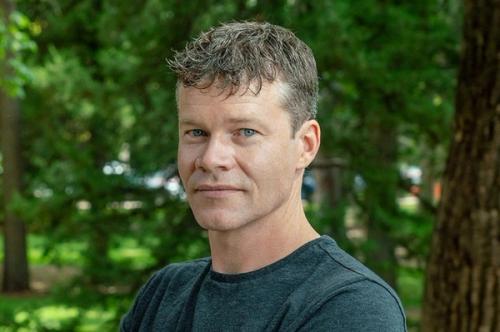
Sean F. Gallen
Colorado State University
In this article
2026 Kirk Bryan Award
Presented to Sean F. Gallen
Citation by Joel Pederson
In conjunction with five colleagues who provided support letters, I am excited to deliver this citation for the 2026 Kirk Bryan Award given to Sean Gallen and co-authors for their 2023 paper in Nature Geosciences, “Calabrian forearc uplift paced by slab-mantle interactions during subduction retreat”.
Some of the studies we consider foundational introduce new techniques that spur a transformation in understanding. Other important research presents large datasets that address mysteries in our science. And others – such as this study – combine and build upon those datasets and those techniques, analyzing them in novel ways and with new tools to relate a geological story more completely and definitively than we might have thought possible.
We feel this study is not only exceptional scholarship, but that it exemplifies the full realization of the field of tectonic geomorphology. In brief, this paper is important in its synthesis of broad data and in its transformative numerical analysis, linking surface processes to plate-margin geodynamics over long geologic timescales, and answering grand questions about landscape evolution in a fascinating study area.
In more words, Sean and his colleagues have embraced the Calabria forearc in southern Italy as a natural laboratory endowed with existing geomorphic and geophysical datasets. Adding new geochronology and an innovative Bayesian inversion framework, they integrate cosmogenic nuclide-derived erosion rates, low-temperature thermochronology, marine terrace records, and river-profile topography, to produce a cohesive and temporally complete record of uplift over 30 million years, with quantified uncertainty. In doing so, they provide a transferable methodology for reconstructing landscape evolution in diverse tectonic settings.
By establishing a mechanistic link between mantle dynamics and surface processes, the authors demonstrate that upper-plate topography is coupled with subduction velocity, mantle convection-cell dynamics, and slab tearing during rollback. This changes how we conceptualize the interaction between these things, influencing research in both geomorphology and geodynamics.
Finally -- all coauthors made significant contributions to this paper. But we nominators also recognize that Sean Gallen drove the study, and we are motivated to recognize the innovation, collaboration, and mastery that Sean exhibits in all his research.
Response by Sean F. Gallen
On behalf of my coauthors, Nikki Seymour, Christoph Glotzbach, Danny Stockli, and Paul O’Sullivan, we are deeply honored to receive the 2026 Kirk Bryan Award for our 2023 Nature Geoscience paper, “Calabrian forearc uplift paced by slab-mantle interactions during subduction retreat.” I want to thank Joel Pederson, those who wrote in support of my nomination, and the QG&G awards panel for recognizing our work, especially given that it spans from the Oligocene to the Quaternary. I am personally humbled to receive this award and was quite shocked to learn our paper had been selected.
In 2019, Nikki Seymour, then a PhD student working in structural geology, and I got into a discussion about low-temperature thermochronology in southern Italy. I explained that I was interested in the uplift history and geodynamics of the forearc above the Calabrian Subduction Zone—the toe of the Italian boot. I knew the landscape beautifully recorded a change in rock uplift rate during the Quaternary in the form of high-elevation plateaus flanked by deeply incised bedrock rivers, as well as remarkable fossil beaches along the peninsula’s coasts. However, I wanted to go deeper in time than the landscape and landforms alone allowed because I thought a longer-term history might help explain why Calabria popped out of the Mediterranean so rapidly a million or two years ago. Nikki thought this was an interesting idea, so in the summer of 2019 we went to Italy, along with my former students Johanna Eidmann and Eyal Marder, to collect bedrock samples for low-temperature thermochronology.
After we returned, I knew we needed to assemble a team. Danny and Paul joined the project with their thermochronology experience, and Christoph brought computational expertise that was essential to the study. From there, we generated, synthesized, and harmonized typically disparate datasets into a unified modeling framework that enabled us to reconstruct the forearc’s long-term rock uplift history, illuminating how the mountains evolved in response to interactions between the subducting slab and the mantle. The modeling approach shows how tectonic geomorphology can be used to conduct broadband geodetic experiments and how this can improve understanding of orogen-scale geodynamics. This study could not have been realized without a truly collaborative and interdisciplinary effort, and I am grateful that others recognize the value of that kind of science.
This study is a passion project born of wonder about how landscapes evolve over geologic time. It grew out of my long-term curiosity about how mountains develop, particularly those above subduction zones. Since I was a graduate student, I have been fascinated by the idea that landscapes record the surface, climatic, and tectonic processes that shaped them. I love that Earth surface processes and landforms are critical to understanding mountain building and that geomorphology can expand our knowledge of geodynamic processes. Early in my career, I was heavily influenced not only by my PhD advisor, Karl Wegmann, but also by researchers including Frank Pazzaglia, Kelin Whipple, and Doug Burbank. Reading their work inspired me and showed me that geomorphology is a critical tool for addressing large-scale questions in Earth science.
Understanding the fundamentals of how the Earth works and what drives the uplift and decay of mountains excites me and engages my imagination. Beyond generating fundamental knowledge with cascading impacts on applied science, tackling such curiosity-driven basic research questions requires abstract, creative thinking to interpret complex data across broad spatial and temporal scales. Such studies offer unique opportunities to train and strengthen our intellectual muscle by engaging our imagination and ingenuity, ultimately reshaping how we approach science. I am deeply grateful that this work has been recognized with the Kirk Bryan Award, and I hope this study encourages others to pursue the questions that capture their imagination, even when it is not immediately clear where the answers might lead.