
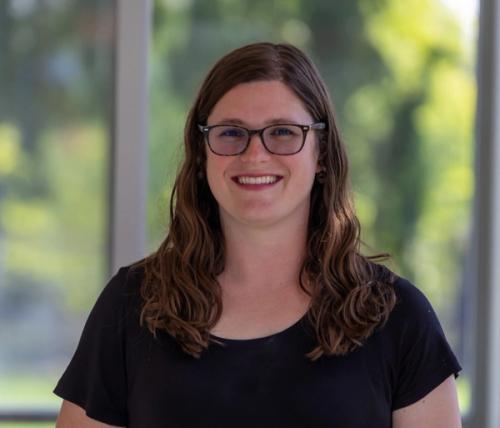
Kathryn Maneiro
Wheaton College
In this article
2026 Biggs Award for Excellence in Earth Science Teaching
Presented to Kathryn Maneiro
Citation by Andrew Luhmann
Dr. Kathryn (Katie) Maneiro truly shines in her role as a teacher in class, lab, and field settings. Students love her and thoroughly enjoy being in her classes, and she enjoys helping students engage well through clarity and organization. Peer evaluators also note that she is effective, engaging, creative, and rigorous while preparing students well for future opportunities and careers. She is a life-long learner and devotes time to think about and act upon different pedagogical techniques and practices, all focused on improving student learning. Additionally, the range of course offerings that Katie provides to our students is quite remarkable, including courses that benefit from her research expertise as a geochronologist to those she created while developing our Aequitas Fellows Program in Sustainability.
I share the following as one example of what it is like to be in her class: Our introductory Dynamic Earth and Environment course serves as the first course for students who decide to pursue a major in Geology or Environmental Science. Many students from other majors across campus also take the class to fulfill a science general education requirement. Several years ago, Katie introduced a semester-long Survivor game (based on the television series) into the course, where the students complete an activity in teams that is relevant to the class topic for the day. Each team tries to amass the most points through Reward Challenges or avoid elimination during Immunity Challenges to win a prize at the end of the semester. Students engage well with the course material through the Survivor game, and they have a lot of fun while they are learning; the semester-long game is simultaneously educational and entertaining. Students speak fondly of their time in her intro course, a result of her inclusive, hands-on, and engaging teaching practices. Others can benefit from this as well, as Katie wrote about it in her In the Trenches publication.
Katie is incredibly deserving of the Biggs Award for Excellence in Earth Science Teaching, and she is a wonderful colleague and friend.
Response by Kathryn Maneiro
I am grateful to accept the Biggs Award for Excellence in Earth Science Teaching, and equally grateful for those who nurtured my love of teaching, both within and outside this community.
When I was a child, I loved to play “school” and kept a meticulous gradebook for my younger brothers — who, in fairness, were only ever interested in "gym class" (playing outside). In second grade, my teacher Brenda Allspaw recognized that I needed a challenge and invited me and a friend to design a lesson for our peers. Together we wrote a worksheet and taught a lesson on Cloudy with a Chance of Meatballs, complete with a giant meatball on poster board and red pens for grading.
Through middle school my vocational aspirations cycled, but they always circled back to teacher or scientist — especially after I won the science fair for growing petri dishes of bacteria in my parents' bathtub. By senior year, in Amy Keller's AP Biology class, I discovered an error in the textbook answer key. Mrs. Keller contacted the publisher, who corrected the key and sent free resources to our classroom. I entered college dreaming of teaching high school biology myself.
That dream shifted in a single semester. Needing to get through many science classes at Olivet Nazarene University, I enrolled in introductory biology, chemistry, and geology — with all three labs — in my first term. At the end of the semester, geology department chair Dr. Max Reams reached out, recognized the quality of my work, and offered me a position as an undergraduate teaching assistant for introductory geology lab starting in my second term. I never looked back. By graduation, I had earned a double major in secondary science education and geology and had taught seven of my eight college semesters, sometimes multiple sections. Along the way, Prof. Priscilla Skalac — who never met a rock she didn't love — took me to teaching conferences and modeled what it looks like to care deeply for students in the classroom. Dr. Charles Carrigan patiently channeled my sky-high expectations and left me with a genuine joy of learning how the Earth works.
In graduate school, my PhD adviser Dr. Ethan Baxter already had a reputation as an enthusiastic teacher — a passion he now shares with the world through his Every Rock has a Story YouTube channel. His enthusiasm sharpened my own, and through graduate school, a postdoc, and a one-year lecturer position, I kept finding my way back to the classroom, including requesting a summer teaching assignment when I was already covered by a research assistantship just for the love of the classroom.
At Wheaton College, I have been blessed with a community that has helped my pedagogy flourish. Dr. Noah Toly recognized my love for sustainability and invited me to design what is now the Aequitas Fellows Program in Sustainability, which welcomes 9–15 new students each year. Dr. Becky Eggimann gave me opportunities to lead Division meetings on pedagogy and, as my Dean, entrusted me with helping shape our distanced learning response after the pandemic. Dr. Nadine Rorem has fed our family, become "Grammadine" to my kids, and served as my faculty mentor. Drs. Andrew Luhmann, Chris Keil, Stephen Moshier, and Bolton Howes, along with Prof. Katy Foltz, have become more than colleagues. They are a second family who graciously put up with the noise, and the endless creative ideas, spilling out of my classroom.
The joy of discovery is the heartbeat of all of this. Students need the space to discover their own vocational calling, as classroom experiences shape their aspirations and open interests they never imagined — just as mine did through a second-grade lesson and a freshman geology lab. They also need to discover the wonder of how the world works. As we navigate the challenges of artificial intelligence, shifting national sentiments toward higher education, and the mounting ecological and climate pressures our students will inherit, we must not lose sight of the power of the joy of discovery. It will take creativity, ingenuity, and hard work to carry on — but our students need that inspiration now more than they ever have.
Earth science, geology, and sustainability are too often overlooked in the broader educational landscape, and yet they hold exactly what this moment demands: keys to curiosity, pathways to fruitful vocations, and the scientific grounding for real solutions to global climate change. It is my great joy to watch students discover these opportunities in my classroom — but no single classroom is enough. As a community, it is on us to champion this discipline, to reach students who have never thought of themselves as earth scientists, and to send them into the world equipped with both hope and agency. That is the work I am honored to share with you.