
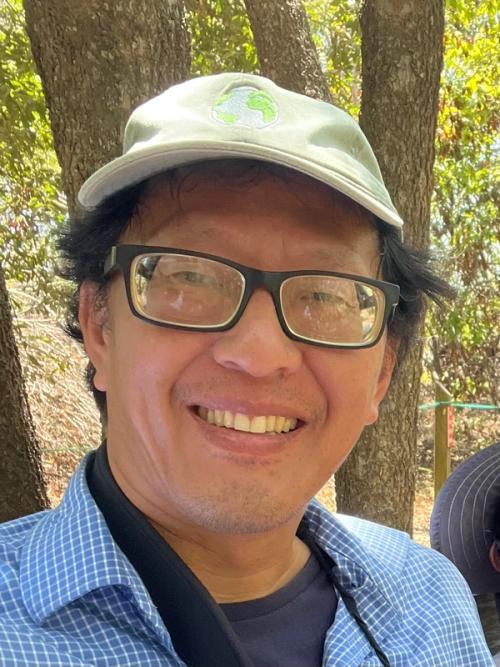
Cin-Ty Lee
Rice University
In this article
2026 Arthur L. Day Medal
Presented to Cin-Ty Lee
Citation by Fang-Zhen Teng
Prof. Lee is a pioneer in applying mineralogical, petrological and geochemical sciences to address first-order questions in Earth sciences, including the structure, composition, origin and evolution of the continental lithosphere; global geochemical cycles of ore minerals and related elements; magmatic processes in island and continental arcs; chemical weathering; and the evolution of Earth’s atmosphere. Field geology, petrology and geochemistry lie at the core of most of his work, giving it both coherence and enduring impact. The exceptional influence of his scholarship is reflected in more than 200 publications cited over 20,000 times. Beyond his scientific achievements, Prof. Lee has profoundly advanced geological sciences through outstanding mentorship, transformative leadership at Rice, and extensive service to the geoscience community in numerous committees and editorial roles. Professor Lee exemplifies the exceptional scientific achievement and leadership that the Arthur L. Day Medal was established to recognize and is highly deserving of this honor.
Response by Cin-Ty Lee
I am truly grateful for this award and the opportunity to reflect. We often think of science as purely objective, but it’s not. The path one takes, the hypotheses one tests or formulates, are influenced by what we see, who we interact with. I grew up on California geology and perhaps never left it. Through George Brimhall and then my PhD adviser Roberta Rudnick I fell in love with the lithospheric mantle and the lower crust in the Sierra Nevada, so my view of arc magmatism came from deep. I got a lot of mileage out of being in the right place and right time. It is this lower crustal bias that influenced my thinkings on deep crustal differentiation controls on magma redox and the origin of copper porphyries. Years of running around the Southern California batholith with Doug Morton and some of the early work I did with Emily Chin, Monica Erdman and later Ming Tang and Duncan Keller made me begin to connect these magmatic concepts with the tectonic evolution of arcs. With Mark Little, Hehe Jiang, and Sydney Allen, I began to appreciate the coupling of surface and deep processes. And before you know it, you think you have the most internally consistent model of arc evolution and ore deposit formation ever. Until you don’t. Recently, Jackson Borchardt’s dive into amphibole chemistry has made me realize that shallow level processes that control chlorine and water may be just as important if not more for copper deposits. Or maybe it’s all linked. Ultimately, I don’t really know. I still have much more to see and to learn. I must make sure that I don’t trick myself into thinking I understand. Thank you to Roberta Rudnick, Rajdeep Dasgupta, Fang-zhen Teng, Francis Albarede, Janne Blichert-Toft, Don DePaolo, Catherine McCammon, Bill McDonough, all the students and post-docs for your support and inspiration.